


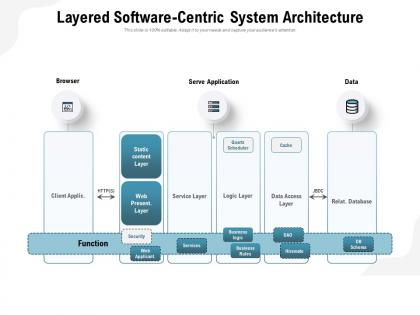
Layered software centric system architecture




Try Before you Buy Download Free Sample Product
 Impress Your
 Audience
 100%
100% Editable
 Save Hours
 of Time


Our Layered Software Centric System Architecture are topically designed to provide an attractive backdrop to any subject. Use them to look like a presentation pro.
People who downloaded this PowerPoint presentation also viewed the following :
Layered software centric system architecture with all 2 slides:
Use our Layered Software Centric System Architecture to effectively help you save your valuable time. They are readymade to fit into any presentation structure.
FAQs for Layered software
Key components of a layered architecture model include presentation layer, business logic layer, data access layer, and database layer, with each handling distinct responsibilities like user interface, processing rules, and data management. This strategic separation enables organizations to enhance maintainability, scalability, and development efficiency, with many software teams finding that modular design accelerates deployment cycles while reducing operational complexity.
Layered architecture enhances separation of concerns by organizing code into distinct layers with specific responsibilities, such as presentation, business logic, data access, and infrastructure layers. This structural approach enables developers to modify, test, and scale individual components independently, while reducing dependencies between layers, ultimately delivering improved maintainability, faster debugging, and enhanced system flexibility across enterprise applications.
Layered architecture improves maintainability by separating concerns across distinct layers, enabling isolated modifications, standardized interfaces, and cleaner code organization. This separation allows development teams to update business logic, data access, or presentation layers independently without affecting other components, ultimately reducing debugging time and development costs while facilitating faster feature deployments.
The common layers in three-layer architecture include presentation layer, business logic layer, and data access layer. These layers streamline application development by separating user interface concerns, processing business rules, and managing database interactions, with many organizations finding that this strategic separation enhances maintainability, scalability, and development efficiency across enterprise applications.
Layered architecture facilitates testing and debugging by enabling isolated unit testing of individual layers, mock implementations for dependency simulation, and systematic error tracking through defined interfaces. This structured approach allows developers to identify issues within specific layers more efficiently, implement automated testing strategies for each tier, and maintain cleaner code separation, ultimately reducing debugging time and improving software reliability.
The data access layer serves as the critical intermediary between business logic and data storage, handling database connections, query execution, data retrieval, and transaction management. This layer abstracts complex database operations from upper layers, enabling organizations in finance, healthcare, and retail to maintain data consistency, implement security protocols, and scale database operations seamlessly, ultimately delivering improved performance and simplified maintenance across enterprise applications.
Layered architecture can be effectively implemented in microservices by applying architectural layers within each individual service, including presentation, business logic, data access, and integration layers. Each microservice maintains its own layered structure while communicating through well-defined APIs, enabling teams to achieve both internal organization and external modularity, ultimately delivering scalable systems with clear separation of concerns.
Potential drawbacks of layered architecture include performance overhead from multiple layer traversals, increased complexity in simple applications, rigid structure limiting flexibility, potential for over-engineering, and maintenance challenges when changes span multiple layers. While these concerns exist, many organizations find that proper design patterns, selective layer bypassing for performance-critical operations, and strategic architectural decisions ultimately deliver maintainable systems with clear separation of concerns.
Layered architecture supports scalability and flexibility by separating concerns across distinct layers, enabling independent scaling of components, streamlined maintenance, and modular updates without affecting the entire system. This architectural approach allows organizations to scale specific layers based on demand, modify business logic without touching data layers, and integrate new technologies seamlessly, ultimately delivering enhanced performance and reduced development costs.
Layered architecture proves most beneficial in complex enterprise applications requiring clear separation of concerns, such as banking systems, e-commerce platforms, healthcare management systems, and large-scale web applications. This approach streamlines development by enabling teams to work independently on different layers, enhances maintainability through modular design, and facilitates scalability, with many organizations finding that structured separation ultimately delivers faster deployment cycles and reduced long-term maintenance costs.
Layered architecture assists third-party integration by creating dedicated integration layers that isolate external dependencies, standardize communication protocols, and manage data transformation between systems. Through service abstraction and API gateways, organizations streamline vendor management, reduce system coupling, and enable seamless data exchange, with many enterprises finding that this approach significantly accelerates integration timelines while maintaining system reliability.
Popular tools for implementing layered architecture include Spring Framework, .NET Framework, Django, Ruby on Rails, and Angular for different application tiers. These frameworks streamline development by providing built-in separation of concerns, dependency injection, and modular components, with many organizations finding that this structured approach accelerates development cycles while maintaining code quality and scalability.
Layered architecture organizes components in hierarchical tiers with defined dependencies, while SOA structures applications as loosely coupled, reusable services communicating through standardized interfaces. Layered approaches excel in maintainability and clear separation of concerns, whereas SOA delivers greater flexibility and scalability, with many enterprises finding that hybrid implementations combining both patterns optimize system performance and business agility.
Layered architecture impacts system performance by introducing communication overhead between layers, potential bottlenecks, and latency from multi-tier processing, while enabling optimized resource allocation and targeted performance tuning. Through strategic caching, load distribution, and modular scaling, organizations in banking and e-commerce streamline operations, ultimately delivering improved maintainability and system reliability despite initial performance considerations.
Developers can ensure proper layering by establishing clear separation of concerns, defining strict inter-layer communication protocols, implementing dependency injection, and conducting regular architecture reviews. Through consistent interface contracts and avoiding direct database access from presentation layers, teams streamline maintainability and scalability, with many organizations finding that automated testing and code analysis tools ultimately deliver cleaner architectures and faster development cycles.
No Reviews