


Lean management process presentation powerpoint




Try Before you Buy Download Free Sample Product
 Impress Your
 Audience
 100%
100% Editable
 Save Hours
 of Time


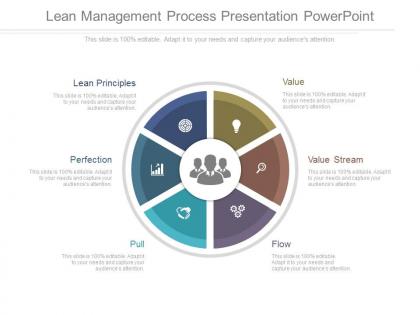
Get the group going with our Lean Management Process Presentation Powerpoint. Give them grounds to believe in you.
People who downloaded this PowerPoint presentation also viewed the following :
Lean management process presentation powerpoint with all 7 slides:
Save time and energy by making use of our Lean Management Process Presentation Powerpoint designed by the most experienced of presentation professions. They really come in cheap too.
FAQs for Lean management
Lean management principles include eliminating waste, continuous improvement, value stream mapping, just-in-time production, and employee empowerment. These approaches streamline operations by reducing inventory costs, minimizing defects, and accelerating delivery times, with many manufacturing and service organizations finding that strategic implementation ultimately delivers enhanced customer satisfaction and significant competitive advantage.
Organizations identify and eliminate waste through value stream mapping, root cause analysis, and continuous improvement cycles like PDCA. These lean techniques streamline operations by reducing overproduction, minimizing wait times, and eliminating unnecessary motion, with many manufacturing and healthcare organizations finding that systematic waste identification ultimately delivers 20-30% efficiency gains and enhanced customer satisfaction.
Continuous improvement serves as the cornerstone of lean management, driving systematic elimination of waste, enhanced operational efficiency, and sustained competitive advantage through regular process evaluation and refinement. Manufacturing companies, healthcare systems, and service organizations effectively implement this through employee-driven kaizen events, data-driven performance metrics, and cross-functional improvement teams, ultimately delivering reduced costs, faster cycle times, and improved customer satisfaction while fostering a culture of innovation.
Lean management practices adapt to industry-specific challenges while maintaining core principles of waste elimination and continuous improvement. In manufacturing, lean focuses on streamlining production lines and reducing inventory, while healthcare emphasizes patient flow optimization and medical error reduction, and service sectors prioritize customer experience enhancement and process standardization, with many organizations finding that industry-tailored lean approaches deliver significant operational efficiency and competitive advantage.
Common lean management tools include 5S (workplace organization), Kaizen (continuous improvement), Value Stream Mapping, Kanban systems, and Poka-Yoke (error prevention). These methodologies streamline operations by eliminating waste, enhancing workflow efficiency, and fostering employee engagement, with many manufacturing and healthcare organizations finding that systematic implementation delivers reduced costs, faster processes, and improved quality outcomes.
Leadership supports lean thinking culture by modeling continuous improvement behaviors, investing in employee training programs, establishing clear communication channels, and recognizing lean achievements consistently. While this approach enhances operational efficiency and employee engagement, challenges include resistance to change from established teams, initial resource investments for training, and maintaining momentum during implementation phases, with many organizations finding that sustained leadership commitment ultimately delivers competitive advantage.
Organizations should track cycle time, lead time, defect rates, customer satisfaction scores, and employee engagement levels to measure lean effectiveness. These metrics enable companies to identify bottlenecks, reduce waste, and enhance operational efficiency, with many manufacturing and service organizations finding that balanced scorecards combining quality, speed, and cost metrics deliver the most comprehensive insights.
Employee engagement and feedback enhance lean management by identifying process inefficiencies, generating improvement ideas, and ensuring sustainable implementation of changes. When employees actively participate in lean initiatives, companies experience higher adoption rates, reduced resistance to change, and continuous optimization, with many organizations finding that engaged teams deliver faster problem-solving and measurable operational improvements.
Common pitfalls include viewing lean as a quick fix rather than cultural transformation, focusing solely on cost-cutting without considering employee engagement, and implementing tools without understanding underlying principles. Many organizations struggle with leadership commitment and resistance to change, while others mistakenly believe lean eliminates all inventory or applies universally across departments, ultimately requiring sustained commitment and strategic adaptation.
Technology enhances lean management by automating repetitive tasks, providing real-time performance analytics, and identifying bottlenecks through predictive insights. Through IoT sensors and AI-driven dashboards, manufacturers streamline production workflows, reduce waste significantly, and optimize resource allocation, with many organizations finding that these digital tools accelerate continuous improvement while delivering measurable operational efficiency.
Companies should establish continuous improvement cultures through regular kaizen events, employee training programs, leadership commitment, and performance measurement systems that track lean metrics consistently. Organizations in manufacturing, healthcare, and retail find that embedding lean principles into daily operations, rewarding innovation, and maintaining cross-functional teams ultimately delivers sustained operational efficiency and competitive advantage.
Lean management integrates with Six Sigma through structured problem-solving and data-driven waste elimination, while combining with Agile methodologies to enhance iterative delivery and customer responsiveness. Organizations in manufacturing, healthcare, and software development successfully blend these approaches by using Lean's efficiency focus, Six Sigma's quality metrics, and Agile's flexibility, ultimately delivering faster innovation cycles and improved operational performance.
Toyota's Production System revolutionized automotive manufacturing through waste elimination and continuous improvement, while General Electric reduced inventory costs by 30% using lean principles across operations. Boeing streamlined aircraft assembly processes, Amazon optimized warehouse operations for faster deliveries, and healthcare institutions like Virginia Mason Medical Center enhanced patient care while reducing operational costs, with many organizations finding that systematic lean implementation delivers significant competitive advantages and sustainable growth.
Businesses can tailor lean management by conducting cultural assessments, aligning lean principles with existing values, customizing implementation timelines, and adapting communication styles to organizational preferences. Through gradual rollouts and employee feedback integration, companies across manufacturing, healthcare, and service sectors streamline operations while respecting cultural nuances, ultimately delivering sustainable improvements and enhanced employee engagement.
Lean management significantly enhances customer satisfaction through faster delivery times, reduced defects, and improved responsiveness to customer needs, while strengthening quality assurance via continuous improvement processes and waste elimination. Organizations implementing lean principles experience higher customer retention rates and reduced product recalls, with manufacturing and service companies finding that streamlined operations ultimately deliver superior customer experiences and competitive advantage.
-
Top Quality presentations that are easily editable.
-
Excellent products for quick understanding.