


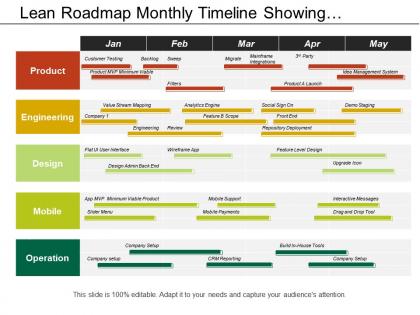
Lean roadmap monthly timeline showing customer testing engineering and design




Try Before you Buy Download Free Sample Product
 Impress Your
 Audience
 100%
100% Editable
 Save Hours
 of Time


Download our lean roadmap monthly timeline showing customer testing engineering and design PowerPoint presentation to help your development team in delivering value to your customers and your company. Our presentation slide of lean user testing allows you to put the core idea in place followed by development team which begins to provide their insights on the direction of the design and feasibility. This PowerPoint slide of roadmap for lean transformation has been created by our professional team members to keep you updated of new market trends and help to document lean journeys which are about serving customers, designing and improving our work. This template of lean system can be applied to various sectors such as manufacturing or service environment and useful to focus on immediate benefits, standardize your work, and eliminate waste or non-value adding steps. This layout can be used to document user testing to simplify the communication with stakeholders. Gain entry to elite groups with our Lean Roadmap Monthly Timeline Showing Customer Testing Engineering And Design. The favored few will gladly accept you.
People who downloaded this PowerPoint presentation also viewed the following :
Lean roadmap monthly timeline showing customer testing engineering and design with all 5 slides:
Keep ennui at bay with our Lean Roadmap Monthly Timeline Showing Customer Testing Engineering And Design. Ensure the daily grind doesn't get boring.


FAQs for Lean roadmap monthly timeline showing customer testing
Honestly, just focus on five things: figure out what your customers actually value, map out your processes to spot waste, get rid of bottlenecks so work flows smoothly, set up pull systems where demand drives the work, and keep improving constantly. Kaizen becomes weirdly addictive once you see results, trust me. Don't overthink the eight wastes thing initially - overproduction, waiting, transport issues, you know the drill. Pick one area in your company and walk through it step by step. You'll be shocked at how much junk you find that's slowing everything down. Start small though.
Value stream mapping is where you want to start - seriously, it's a game changer. Go through every single step and ask yourself "would a customer actually pay for this?" The amount of pointless stuff will blow your mind. Hunt for the usual suspects: waiting around, making too much, hoarding inventory, people running all over the place, defects, over-processing stuff. Oh and transportation waste too. Get your frontline people involved because honestly, they know where the real pain points are way better than management does. Time everything, track the handoffs, write it all down. Once you've got that map laid out, the waste becomes super obvious.
Dude, you absolutely need your stakeholders on board from the start. I learned this the hard way watching roadmaps crash and burn because someone tried to go solo. Your stakeholders know the real priorities and constraints - stuff you'd never think of sitting alone at your desk. Get their input early, then keep checking back with them regularly. Don't just do it once and disappear. Honestly, the feedback sessions are kind of a pain to schedule but they're what separate successful roadmaps from complete disasters. Trust me on this one.
Look, the same Lean principles work everywhere, but you've gotta tweak them for your situation. Manufacturing focuses on equipment efficiency and cutting inventory waste. Healthcare? Patient flow and wait times become huge. Software teams obsess over delivery speed and removing handoffs - honestly, anything that slows getting stuff to users. Your metrics and tools will be totally different depending on your industry. The trick is figuring out what actually creates value for your customers and where things get bottlenecked. I'd start by mapping your workflow to see where value gets stuck. That'll show you exactly what to fix first.
Don't get caught up tracking vanity metrics that look good but don't mean anything. Cycle time and lead time are your friends - how long stuff takes from start to customer hands. Deployment frequency matters too. I'd honestly say customer satisfaction is the biggest one though. Like, you can optimize till you're blue in the face but if users still hate your product... yeah. Defect rates and team velocity are solid picks. Oh, and measure waste - meetings that go nowhere, rework, that kind of stuff. Start small with maybe 3-4 metrics max. You can always pile on more later.
Look at customer value vs business impact first - that's your main framework. Quick wins are honestly way more important than people think, they build real momentum. High-impact stuff obviously goes first, but also grab those easy victories. Target anything that cuts waste or fixes actual customer problems. Check your team's bandwidth too (learned that the hard way). Value stream mapping shows you the real bottlenecks - start there. Simple scoring works best. Review weekly since things change fast. Dependencies will mess up your timeline if you don't map them early.
Start with Kanban boards and value stream maps - they're honestly game-changers for tracking lean stuff. A3 problem-solving templates are solid too. Don't just sit in meetings though. Get out there and do Gemba walks to see what's actually happening on the floor (I learned this the hard way). Simple metrics dashboards work great for measuring progress. Do regular retrospectives so your team stays honest about results. Oh, and stick to maybe 2-3 tools at first - I've seen teams get overwhelmed trying everything at once. You can always add fancier techniques later once people get comfortable with the basics.
Draw it out first - simple diagrams showing where you are now, where you're going, and the steps in between. Town halls and team huddles work way better than just emailing a deck around (seriously, nobody reads those). Give different groups what they actually need to know - your floor team wants the nitty-gritty details while execs just want the big milestones. Oh, and put up one-pagers around the office too. People absorb info differently. Build in ways for folks to ask questions and push back on stuff that doesn't make sense. You'll catch problems early that way.
Honestly, the biggest mistake is trying to do everything at once - your team will hate you for it. Pick one department first instead of going nuclear on the whole company. Don't skip explaining WHY you're doing this either, because pushback will kill your project faster than bad coffee kills Monday mornings. Most people treat lean like it's some weekend project instead of a real culture change. Tools are shiny and fun, but if you're obsessing over kanban boards without getting the actual principles, you're missing the point. Get some quick wins first to show it works, then slowly expand from there.
Block out time monthly to actually review what's working - don't just hope improvement happens randomly. Schedule kaizen events right into your roadmap timeline. Get feedback from your team consistently and track your key metrics. Honestly, most people say they'll do this "when things calm down" but that day never comes. Review sessions every quarter work too, just pick something realistic. The whole point is making it systematic instead of scrambling to fix things after they break. Oh, and be ready to change direction based on what you discover. Book your first review in the next couple weeks.
So here's the thing - a Lean roadmap stops you from trying to fix everything at once, which honestly is where most companies screw up their digital stuff. You break big projects into tiny experiments instead. Test one small thing, see what happens, then adjust. Way less risky than those massive tech overhauls that usually crash and burn. Plus your boss will actually see progress happening regularly instead of waiting months for some grand reveal. I'd start with whatever's bugging your customers most and build the tiniest possible solution for that first. Makes way more sense than going all-in on some huge system nobody's sure will work.
Skip the boring presentations and just have your teams jump into value stream mapping and gemba walks. That's honestly where the real learning happens - not death by PowerPoint. Find some natural coaches in each department who can help people daily. Mix up your improvement projects so everyone sees how this stuff works everywhere, not just manufacturing. Your managers better be doing this too, because nothing tanks morale faster than leaders who preach Lean but act totally different. Oh, and definitely schedule regular check-ins where teams can actually talk about what's bombing versus what's clicking.
Honestly, most teams mess this up by skipping the regular check-ins - that's where everything falls apart. Pick 2-3 solid feedback sources: customers, your team, maybe key stakeholders. Then set up weekly or bi-weekly reviews to actually look at the data and user feedback. Don't wait for those big quarterly meetings to make changes. Small tweaks work way better than massive pivots. Oh, and track the stuff that predicts what's coming, not just what already happened. You'll catch problems before they blow up. Schedule your first review this week - seriously, just pick a day.
Man, Toyota basically wrote the book on this stuff - their system became the blueprint for manufacturing everywhere. Virginia Mason Medical Center used it to slash patient wait times in half and cut way down on medical errors. Amazon's warehouses run on similar principles (though they probably won't admit it). Even Spotify adapted these ideas for how their teams build products. My advice? Don't try to copy anyone exactly. Start with small pilot projects, track your results obsessively, and tweak things to fit your company's vibe. What works for Toyota won't necessarily work for you.
Honestly, Lean roadmaps are like giving your team permission to mess up quickly - and that's where the magic happens. You're testing ideas constantly instead of being stuck with some massive plan from six months ago. Short feedback loops keep everyone curious and asking "wait, what if we did this differently?" When people see their little experiments actually changing the roadmap, they get way more invested. It's kind of like training wheels for bigger risks - you can try weird stuff without putting everything on the line. My advice? Pick one small experiment this quarter and see what happens. Way better than overthinking it.
-
Awesome use of colors and designs in product templates.
-
Use of different colors is good. It's simple and attractive.