


Lean waste colored boxes with icons




Try Before you Buy Download Free Sample Product
 Impress Your
 Audience
 100%
100% Editable
 Save Hours
 of Time


Folks agree for joint action due to our Lean Waste Colored Boxes With Icons. They will express a desire to combine efforts.
People who downloaded this PowerPoint presentation also viewed the following :
Lean waste colored boxes with icons with all 5 slides:
Close the deficit with our Lean Waste Colored Boxes With Icons. They will even it up for you.



FAQs for Lean waste colored
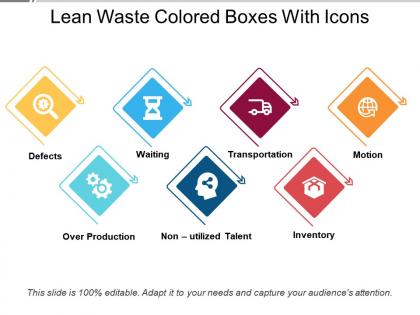
The primary categories of waste in Lean methodology include overproduction, waiting, transportation, over-processing, inventory, motion, defects, and unused employee skills. These eight wastes systematically drain organizational efficiency by consuming resources without adding customer value, with manufacturing companies, healthcare institutions, and service organizations finding that identifying and eliminating these wastes streamlines operations, reduces costs, and delivers significant competitive advantages.
Organizations identify waste by conducting systematic process mapping, value stream analysis, and gemba walks to observe actual workflows, while implementing employee feedback systems and cross-functional audits. These approaches reveal overproduction, waiting times, unnecessary transportation, excess inventory, defects, and underutilized talent, with many manufacturing and service companies finding significant cost reduction opportunities through structured waste identification programs.
Eliminating excess inventory reduces storage costs, minimizes waste from obsolete products, and improves cash flow by freeing up working capital tied in unsold goods. This approach enables organizations to respond more quickly to customer demand changes, reduces handling and management overhead, and ultimately delivers better resource allocation and operational efficiency across manufacturing and retail sectors.
Employee engagement drives waste reduction by encouraging frontline workers to identify inefficiencies, suggest process improvements, and take ownership of quality outcomes. Engaged employees actively participate in continuous improvement initiatives like kaizen events, spot bottlenecks in real-time, and develop innovative solutions, with many manufacturing and healthcare organizations finding that empowered teams reduce defects and streamline operations significantly.
Effective tools for mapping and analyzing workflow waste include value stream mapping, process flow charts, spaghetti diagrams, time and motion studies, and waste walk assessments. These methodologies streamline operations by identifying bottlenecks, eliminating redundancies, and optimizing resource allocation, with many manufacturing and service organizations finding that systematic waste analysis delivers faster cycle times and improved operational efficiency.
Organizations can prioritize waste categories by conducting value stream mapping to identify bottlenecks, measuring impact through cost analysis and customer feedback, and assessing implementation feasibility. Manufacturing companies often start with overproduction or waiting times, while service organizations frequently address transportation or motion inefficiencies, ultimately delivering quick wins that build momentum for broader lean transformation initiatives.
Just-In-Time production minimizes Lean waste by reducing inventory excess, eliminating overproduction, and streamlining material flow to match actual demand. This approach enables manufacturers to decrease storage costs, minimize defects through smaller batch sizes, and enhance responsiveness to customer needs, with many automotive and electronics companies finding that JIT delivery ultimately delivers significant cost reductions and operational efficiency.
Overproduction waste significantly impacts organizational efficiency by creating excess inventory, increasing storage costs, and tying up valuable capital in unsold goods. This leads to longer lead times, reduced cash flow, and higher operational expenses, while masking underlying production problems, with many manufacturing organizations finding that eliminating overproduction streamlines workflows and enhances resource allocation.
Strategies to reduce waiting time include implementing just-in-time production, optimizing workflow layouts, using predictive maintenance scheduling, establishing pull-based systems, and deploying real-time monitoring technologies. These approaches streamline operations by minimizing bottlenecks, synchronizing production stages, and enhancing equipment reliability, with manufacturing organizations finding that reduced waiting ultimately delivers faster throughput and improved operational efficiency.
Lean principles eliminate service industry waste by standardizing processes, reducing waiting times, minimizing unnecessary steps, and streamlining communication flows. Service organizations like banks, hospitals, and call centers apply these methods to reduce customer wait times, eliminate redundant approvals, and optimize resource allocation, ultimately delivering faster service experiences and improved operational efficiency.
Muda directly translates to "waste" in Lean methodology and forms the foundation of all Lean waste categories, representing any activity that consumes resources without adding customer value. The eight traditional waste categories—overproduction, waiting, transportation, over-processing, inventory, motion, defects, and unused talent—are all specific manifestations of Muda, with organizations finding that systematically identifying and eliminating these inefficiencies streamlines operations and enhances competitive advantage.
Underutilized talent creates significant operational inefficiency by wasting human potential, reducing innovation capacity, limiting problem-solving capabilities, and decreasing employee engagement across organizations. This waste ultimately undermines competitive advantage, as companies miss opportunities for process improvements, strategic insights, and skill development, with many manufacturers and service providers finding that better talent utilization directly correlates with enhanced productivity and market positioning.
Technology streamlines waste identification through IoT sensors, data analytics, automated monitoring systems, and AI-powered process analysis that detect inefficiencies in real-time. These digital solutions enhance operational visibility by tracking inventory flows, analyzing production bottlenecks, and optimizing resource allocation, with manufacturing and healthcare organizations finding significantly reduced costs and improved productivity.
Common misconceptions about Lean waste reduction include believing it's solely about cost-cutting, that it eliminates all inventory, requires massive upfront investment, or only applies to manufacturing. While Lean does reduce costs, it primarily focuses on value creation, strategic inventory management, and continuous improvement across all sectors, with organizations in healthcare, finance, and services finding that systematic waste identification ultimately delivers enhanced customer experiences and operational efficiency.
Continuous improvement practices sustain waste reductions by establishing regular monitoring systems, employee feedback loops, and systematic process reviews that identify emerging inefficiencies before they compound. Through methodologies like Kaizen events and performance dashboards, organizations in manufacturing, healthcare, and service industries maintain operational excellence, adapt to changing conditions, and continuously optimize resource allocation, ultimately delivering sustained competitive advantage.
-
Great product with highly impressive and engaging designs.
-
Appreciate the research and its presentable format.