


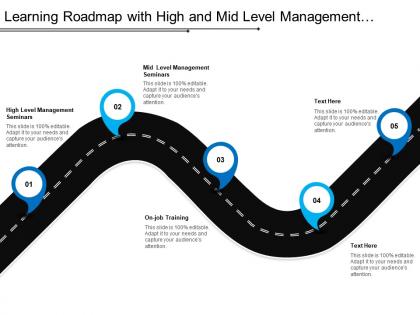
Roteiro de Aprendizagem com Seminários de Gerenciamento de Nível Médio e Superior




Try Before you Buy Download Free Sample Product
 Impress Your
 Audience
 100%
100% Editable
 Save Hours
 of Time


Trate de forma eficaz as restrições com nosso Roteiro de Aprendizagem com Seminários de Gerenciamento de Nível Médio e Alto. Não permita que as compulsões o derrubem.
People who downloaded this PowerPoint presentation also viewed the following :
Roteiro de aprendizado com seminários de gerenciamento de nível médio e alto com todos os 5 slides:
Nosso roteiro de aprendizado com seminários de gerenciamento de nível médio e alto não deixa você se sentir perturbado. Você será igual a qualquer desafio.

FAQs for Learning roadmap with high and mid
Effective leaders in today's dynamic business environment demonstrate adaptability, emotional intelligence, strategic vision, collaborative communication, and decisive problem-solving skills. These qualities enable leaders to navigate uncertainty, build resilient teams, and drive innovation across diverse sectors, with many organizations finding that leaders combining these competencies deliver enhanced performance, stronger employee engagement, and sustainable competitive advantage.
Organizations assess leadership capabilities through comprehensive 360-degree feedback, leadership competency assessments, succession planning audits, performance metrics analysis, and employee engagement surveys. These evaluation methods enable companies to identify skill gaps, measure leadership effectiveness across departments, and benchmark against industry standards, ultimately delivering targeted development programs and stronger organizational performance with improved retention rates.
Emotional intelligence enables leaders to understand and manage their own emotions while effectively reading and responding to others' emotional states, fostering stronger team relationships and communication. Leaders with high emotional intelligence excel at conflict resolution, employee motivation, and organizational change management, with studies showing these leaders deliver significantly better team performance and retention rates.
Mentorship programs enhance leadership development by providing personalized guidance, accelerating skill acquisition, and fostering knowledge transfer between experienced and emerging leaders. These strategic relationships enable organizations to build robust leadership pipelines, improve employee retention, and create succession planning frameworks, with many companies finding that structured mentorship ultimately delivers stronger decision-making capabilities and enhanced organizational culture.
Organizations can cultivate continuous leadership learning through mentorship programs, cross-functional project assignments, regular feedback sessions, leadership competency assessments, and structured peer learning circles. These strategies enhance leadership capabilities by fostering knowledge sharing, developing diverse skill sets, and creating accountability systems, with many companies finding that integrated approaches ultimately deliver stronger succession pipelines and improved organizational adaptability.
Emerging leaders can balance personal development with organizational goals by aligning individual growth objectives with company priorities, seeking mentorship that bridges both perspectives, and pursuing skill-building opportunities that serve dual purposes. Through strategic project assignments, cross-functional experiences, and leadership training programs, they simultaneously enhance their capabilities while delivering organizational value, ultimately creating synergies that accelerate both personal advancement and business outcomes.
Diversity and inclusion significantly enhance leadership effectiveness by bringing varied perspectives, improving decision-making quality, fostering innovation, and strengthening team engagement across organizations. Through inclusive leadership practices, companies in sectors like technology, healthcare, and financial services deliver better problem-solving capabilities, reduced groupthink, and enhanced customer understanding, ultimately driving superior business performance and competitive advantage.
Technology enhances leadership training through virtual reality simulations, AI-powered coaching platforms, gamified learning modules, real-time feedback systems, and personalized development analytics. These digital tools enable organizations to deliver scalable, immersive experiences while tracking progress and measuring outcomes, with many companies finding that blended approaches significantly accelerate leadership skill development across all organizational levels.
Best practices for providing constructive feedback to developing leaders include being specific and timely, focusing on behaviors rather than personality, balancing recognition with improvement areas, and creating two-way dialogue opportunities. These approaches enhance leadership growth by building self-awareness, strengthening decision-making capabilities, and fostering accountability, with many organizations finding that regular, structured feedback accelerates leadership development and improves overall team performance.
Leadership development programs can be tailored through visual presentations for visual learners, interactive workshops for kinesthetic learners, podcasts for auditory learners, and case studies for analytical thinkers. This multi-modal approach enhances engagement and retention, with many organizations finding that personalized learning pathways accelerate skill development and ultimately deliver stronger leadership capabilities across diverse teams.
Organizations should evaluate leadership development success using employee engagement scores, retention rates of high-potential talent, promotion rates from internal candidates, 360-degree feedback improvements, and business performance metrics tied to leadership competencies. These measurements enable companies to track both individual growth and organizational impact, with many finding that combining quantitative data with qualitative assessments delivers the most comprehensive view of program effectiveness and ROI.
Leaders effectively navigate change by communicating transparently, involving team members in decision-making processes, and providing clear vision while acknowledging uncertainties. Through consistent engagement, strategic training programs, and regular feedback loops, organizations like healthcare systems and financial services find that empowering employees during transitions ultimately delivers higher adoption rates, reduced resistance, and stronger organizational resilience.
Common pitfalls include lack of practical application, one-size-fits-all approaches, insufficient ongoing support, poor alignment with business objectives, and inadequate measurement systems. Organizations can avoid these by implementing personalized development paths, integrating real-world challenges, providing continuous mentoring, and establishing clear metrics, ultimately delivering stronger leaders and measurable business outcomes.
Peer-to-peer learning contributes to leadership development through shared experiences, collaborative problem-solving, diverse perspectives, real-time feedback, and cross-functional knowledge exchange. This approach enables leaders to learn from actual challenges faced by colleagues, develop emotional intelligence through group dynamics, and build stronger networks, with many organizations finding that peer learning accelerates leadership competencies more effectively than traditional training methods.
Leaders promote innovation and creativity by fostering psychological safety, encouraging experimentation, providing dedicated time for creative thinking, and celebrating both successes and intelligent failures. Through cross-functional collaboration and diverse perspectives, organizations like Google and 3M have found that leaders who ask open-ended questions, allocate resources for innovation projects, and remove bureaucratic barriers ultimately deliver breakthrough solutions and sustained competitive advantage.
-
Awesome use of colors and designs in product templates.
-
Use of different colors is good. It's simple and attractive.