


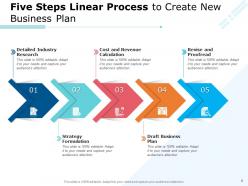
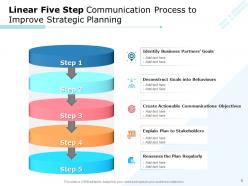
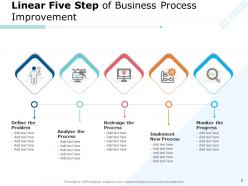
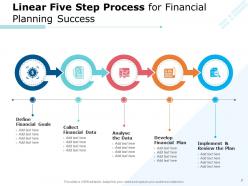
Linear Process 5 Steps Strategic Management Analyse Information Business




Try Before you Buy Download Free Sample Product
 Impress Your
 Audience
 100%
100% Editable
 Save Hours
 of Time


Our Linear Process 5 Steps Strategic Management Analyse Information Business are topically designed to provide an attractive backdrop to any subject. Use them to look like a presentation pro.
People who downloaded this PowerPoint presentation also viewed the following :
Linear Process 5 Steps Strategic Management Analyse Information Business with all 12 slides:
Use our Linear Process 5 Steps Strategic Management Analyse Information Business to effectively help you save your valuable time. They are readymade to fit into any presentation structure.


FAQs for Linear Process 5 Steps Strategic Management
Key components of a strategic management framework include vision and mission development, environmental analysis, strategy formulation, implementation planning, and performance evaluation. These elements work together by establishing clear direction, assessing competitive landscapes, and aligning resources, with many organizations finding that this comprehensive approach ultimately delivers sustainable competitive advantage and improved operational efficiency.
Organizations can effectively align resources with strategic goals through strategic planning processes, resource allocation frameworks, performance measurement systems, and regular strategic reviews. By implementing portfolio management techniques, establishing clear KPIs, and conducting quarterly alignment assessments, companies streamline resource deployment, minimize waste, and enhance operational efficiency, ultimately delivering competitive advantage and measurable business outcomes.
Environmental scanning serves as the foundation for strategic decision-making by systematically monitoring external trends, competitor activities, regulatory changes, technological developments, and market dynamics. This continuous intelligence-gathering enables organizations to identify emerging opportunities and threats early, adapt their strategies proactively, and maintain competitive advantage in increasingly volatile business environments.
SWOT analysis informs strategic decision-making by systematically evaluating internal strengths and weaknesses against external opportunities and threats, enabling organizations to align capabilities with market conditions. Through this strategic assessment, businesses can prioritize resource allocation, identify competitive advantages, and develop targeted strategies that leverage strengths while mitigating risks, ultimately delivering more informed decisions and sustainable growth.
Stakeholder analysis is crucial for strategic planning because it identifies key individuals and groups who can influence or are affected by organizational decisions, ensuring comprehensive stakeholder mapping and engagement strategies. This process enables organizations to anticipate potential resistance, secure necessary support, and align strategic objectives with stakeholder expectations, ultimately delivering more feasible implementation plans and sustainable competitive advantage through enhanced stakeholder buy-in.
Competitive forces shape strategic direction by determining market positioning, resource allocation, pricing strategies, and innovation priorities across industries. Through Porter's Five Forces analysis, organizations assess supplier power, buyer influence, and competitive rivalry, with companies in sectors like telecommunications and retail finding that strategic responses to these pressures ultimately drive differentiation and sustainable competitive advantage.
Best practices for implementing strategic initiatives include establishing clear communication channels, aligning leadership commitment, creating detailed implementation roadmaps, setting measurable milestones, and fostering cross-functional collaboration. These approaches streamline execution by ensuring accountability, maintaining momentum, and enabling real-time adjustments, with many organizations finding that consistent stakeholder engagement and resource allocation ultimately deliver faster implementation and sustainable competitive advantage.
Organizations measure strategic management effectiveness through key performance indicators, balanced scorecards, financial metrics, customer satisfaction scores, and employee engagement surveys. These measurement frameworks enable companies to track progress against strategic objectives, identify performance gaps, and make data-driven adjustments, with many enterprises finding that regular strategic reviews ultimately deliver improved operational efficiency and sustained competitive advantage.
Organizations face challenges including unclear communication of strategic goals, insufficient resource allocation, resistance to change, lack of employee buy-in, and inadequate performance monitoring systems. These execution barriers often result from disconnected leadership teams, competing priorities, and rigid organizational structures, with many companies finding that strategic alignment and consistent stakeholder engagement ultimately determine implementation success.
Corporate culture significantly impacts strategic management success by influencing employee engagement, decision-making processes, communication effectiveness, and change adaptability throughout organizations. Companies with aligned cultures experience smoother strategy implementation, with many finding that strong cultural foundations enhance execution speed, reduce resistance to strategic initiatives, and ultimately deliver sustainable competitive advantage across diverse market conditions.
Technology drives strategic advantage through artificial intelligence, cloud computing, data analytics, automation platforms, and digital transformation initiatives. These solutions streamline operations by reducing costs, accelerating decision-making, and enhancing customer experiences, with many organizations finding that strategic technology adoption ultimately delivers competitive differentiation and sustainable growth in increasingly dynamic markets.
Organizations adapt their strategies through continuous market monitoring, scenario planning, agile decision-making frameworks, diversified portfolio management, and stakeholder feedback integration. Through strategic pivots and flexible resource allocation, companies like Netflix transitioning from DVDs to streaming and banks adopting digital platforms demonstrate how adaptive strategies enable sustained competitive advantage while minimizing disruption risks.
**INPUT**: What strategies can be employed for innovation and maintaining a competitive edge? **OUTPUT**: Innovation strategies include continuous R&D investment, strategic partnerships, agile development processes, customer-centric design thinking, and fostering organizational cultures that encourage experimentation. These approaches streamline product development cycles, enhance market responsiveness, and deliver breakthrough solutions, with many organizations finding that combining internal innovation labs with external collaborations ultimately accelerates competitive differentiation. [Word count: 53 words]
A balanced scorecard approach enhances strategic performance management by integrating financial metrics with customer satisfaction, internal processes, and learning perspectives, creating comprehensive organizational alignment. This strategic combination enables companies to track leading indicators alongside traditional financial measures, streamline decision-making across departments, and accelerate performance improvements, with many organizations finding that balanced scorecards deliver greater operational efficiency and competitive advantage.
Leadership plays a pivotal role in strategic management by setting clear vision, fostering organizational alignment, driving change management, and ensuring resource allocation across departments. Effective leaders facilitate strategic success by communicating goals transparently, empowering cross-functional teams, and maintaining stakeholder engagement, with many organizations finding that strong leadership directly correlates with improved strategic outcomes and competitive positioning.
-
Use of icon with content is very relateable, informative and appealing.
-
Appreciate the research and its presentable format.
-
Amazing product with appealing content and design.
-
Excellent template with unique design.
-
Great experience, I would definitely use your services further.
-
Unique design & color.
-
Great product with effective design. Helped a lot in our corporate presentations. Easy to edit and stunning visuals.
-
Excellent template with unique design.
-
Out of the box and creative design.