


Linux Kernel As Layer Of Android Architecture Android App Development




Try Before you Buy Download Free Sample Product
 Impress Your
 Audience
 100%
100% Editable
 Save Hours
 of Time


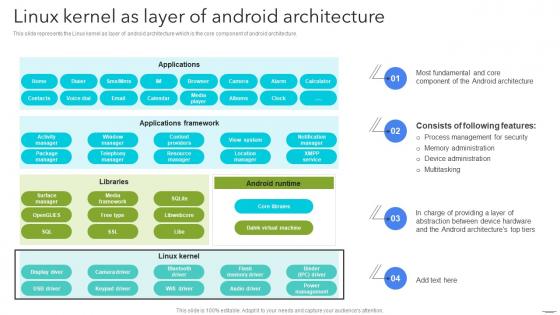
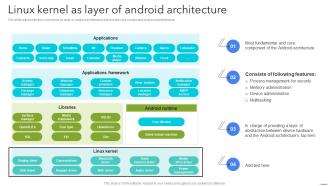
This slide represents the Linux kernel as layer of android architecture which is the core component of android architecture.
People who downloaded this PowerPoint presentation also viewed the following :
Linux Kernel As Layer Of Android Architecture Android App Development with all 6 slides:
Use our Linux Kernel As Layer Of Android Architecture Android App Development to effectively help you save your valuable time. They are readymade to fit into any presentation structure.





FAQs for Linux Kernel As Layer Of Android Architecture
The Linux kernel manages core system functions including process scheduling, memory management, device drivers, file system operations, and network communications. Through these capabilities, organizations across industries streamline server operations, enhance system reliability, and reduce infrastructure costs, with many enterprises finding that kernel-level optimization ultimately delivers improved performance and operational efficiency.
The Linux kernel handles memory management through virtual memory systems, page tables, memory mapping, swap space allocation, and the buddy system allocator. These mechanisms enable efficient RAM utilization, process isolation, and dynamic allocation, with many enterprise servers and embedded systems finding that kernel-level optimization delivers faster application performance, reduced memory fragmentation, and enhanced system stability under heavy workloads.
Monolithic kernels run all system services in a single address space with direct function calls, while microkernels isolate services in separate user-space processes communicating through message passing. Monolithic architectures like Linux deliver faster performance through reduced overhead, while microkernels enhance system stability and security, with many embedded systems and real-time applications finding microkernels enable better fault isolation and modular updates.
The Linux kernel supports process scheduling and multitasking through its Completely Fair Scheduler (CFS), which dynamically allocates CPU time using virtual runtime calculations, priority levels, and time slices. This sophisticated scheduling mechanism enables organizations to run multiple applications simultaneously while maintaining system responsiveness, ultimately delivering enhanced operational efficiency and resource optimization across enterprise environments.
System calls are programming interfaces that enable user applications to request services from the Linux kernel, including file operations, process management, memory allocation, and network communication. These calls act as controlled gateways between user space and kernel space, allowing applications to access hardware resources safely through standardized functions, with many enterprise systems finding that this architecture delivers enhanced security, system stability, and efficient resource management.
The Linux kernel maintains security through multiple access control mechanisms, including file permissions, user and group management, capability-based security, and mandatory access control systems like SELinux. These integrated security layers work by restricting process privileges, controlling resource access, and enforcing policy-driven permissions, with many enterprise organizations finding that this multi-layered approach delivers robust protection while maintaining operational flexibility.
Device drivers serve as essential interfaces between the Linux kernel and hardware components, enabling seamless communication by translating kernel commands into hardware-specific instructions and managing resource allocation. These drivers streamline system operations across diverse industries, with financial institutions, healthcare facilities, and manufacturing systems leveraging optimized drivers to enhance performance, minimize downtime, and ultimately deliver more reliable computing experiences.
The Linux kernel manages file systems through the Virtual File System (VFS) layer, which provides a unified interface for different storage types, handles file operations, manages disk I/O scheduling, and coordinates memory caching. Through VFS abstraction, organizations can seamlessly integrate multiple storage solutions like ext4, XFS, and network filesystems, while advanced I/O schedulers optimize performance for enterprise applications, ultimately delivering faster data access and improved system reliability.
Kernel versioning and patches present both stability challenges and opportunities, with major releases introducing new features while minor patches address security vulnerabilities and bug fixes. While frequent patching can temporarily disrupt operations, organizations in banking, healthcare, and manufacturing find that systematic update strategies minimize downtime, enhance security compliance, and ultimately deliver more resilient infrastructure and competitive operational advantage.
The Linux kernel implements network protocols through its network stack, managing TCP/IP, UDP, and various routing protocols via layered architecture, socket interfaces, and device drivers. This comprehensive implementation enables organizations across telecommunications, cloud services, and enterprise networks to deliver scalable networking solutions, streamlined packet processing, and robust connectivity, ultimately providing cost-effective infrastructure and enhanced network performance.
Open-source development in the Linux kernel delivers enhanced security through transparent code review, accelerated innovation via global collaboration, reduced costs by eliminating licensing fees, and greater customization flexibility for specific organizational needs. This collaborative approach enables rapid bug fixes, continuous improvements, and widespread community support, with many enterprises finding that open-source solutions provide superior reliability, scalability, and long-term strategic advantages over proprietary alternatives.
The Linux kernel manages interrupts through interrupt handlers that pause current processes to address urgent hardware requests, while device drivers facilitate hardware communication via system calls, memory mapping, and direct hardware access. Through interrupt service routines and device abstraction layers, servers and embedded systems achieve faster response times, efficient resource allocation, and seamless hardware integration, ultimately delivering optimized performance.
Kernel modules enable dynamic extension of Linux functionality without requiring complete system reboots or kernel recompilation, supporting device drivers, file systems, and network protocols. This modular architecture streamlines system administration and hardware compatibility across diverse environments, with organizations finding that loadable modules significantly reduce downtime while enhancing operational flexibility and resource efficiency.
The Linux kernel enables virtualization and containerization through namespaces, cgroups, KVM hypervisor support, and control groups that isolate processes and manage resource allocation. These technologies streamline deployment by providing hardware abstraction, process isolation, and efficient resource distribution, with many organizations finding that containerized applications deliver faster scaling, reduced overhead, and enhanced operational efficiency across development environments.
**INPUT**: What tools are commonly used to analyze and monitor kernel performance? **OUTPUT**: Common Linux kernel performance analysis tools include perf, ftrace, SystemTap, eBPF, and top/htop for real-time monitoring. These tools enable system administrators to identify bottlenecks, trace system calls, and monitor resource utilization, with many organizations finding that comprehensive kernel analysis ultimately delivers enhanced system reliability and optimized performance across enterprise environments.
-
The website is jam-packed with fantastic and creative templates for a variety of business concepts. They are easy to use and customize.
-
I am glad to have come across Slideteam. I was searching for some unique presentations and templates for my business. There are a lot of alternatives available here.