


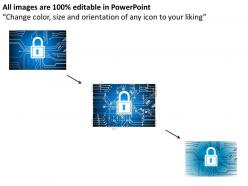
Lock with network circuit for internet security ppt slides





Try Before you Buy Download Free Sample Product
 Impress Your
 Audience
 100%
100% Editable
 Save Hours
 of Time


Make a strong case for internet security by incorporating this visually remarkable and impactful presentation design in your PPT slides on digital security strategy wherein you could be marketing a security product to prospective clients or delineating the details of the workings of a security framework as a security expert in your organization. You can use this PPT presentation slide while giving a demonstration to employees of your client on the do’s and don’ts of using internet at the workplace to prevent inadvertent sharing of crucial information related to business decisions, exposure to malware and cyber-attacks on critical information infrastructure due to security breaches. Showcase your products on internet security and network security which are relevant to enterprise level applications, provide optimal arrangement for availability of information, enhance cyber security and provide training to the workforce using this eye catching PowerPoint presentation template with its simple yet effective graphics depicting the centrality of security to the success of digital plans. Break out of the box with our Lock With Network Circuit For Internet Security Ppt Slides. Go beyond conventional approaches.
People who downloaded this PowerPoint presentation also viewed the following :
Lock with network circuit for internet security ppt slides with all 5 slides:
Our Lock With Network Circuit For Internet Security Ppt Slides team do all the groundwork before hand. They are dedicated and conscientious.




FAQs for Lock with network circuit for internet
Primary components of a network security lock circuit include authentication modules, encryption processors, access control units, intrusion detection sensors, and firewall integration interfaces. These components work together by validating user credentials, encrypting data transmissions, and monitoring network traffic, with many financial institutions and healthcare organizations finding that this layered approach significantly reduces security breaches while maintaining operational efficiency.
A lock circuit enhances network security by preventing unauthorized access, blocking malicious traffic, and creating controlled entry points with automated authentication protocols. Through these integrated mechanisms, organizations can significantly reduce breach risks, streamline security monitoring, and maintain continuous protection across their infrastructure, while enabling faster threat detection and response capabilities that ultimately deliver stronger operational resilience.
Network security lock circuits address vulnerabilities including unauthorized access attempts, data interception, malware infiltration, DDoS attacks, and insider threats through real-time monitoring and automated response mechanisms. These systems enhance cybersecurity by implementing immediate traffic isolation, suspicious activity detection, and access control enforcement, with many financial institutions and healthcare organizations finding that proactive circuit-based security significantly reduces breach incidents while maintaining operational continuity.
Hardware-based lock circuits utilize dedicated physical components like cryptographic processors, tamper-resistant modules, and secure enclaves, while software-based solutions rely on encryption algorithms, authentication protocols, and access control programs. Hardware approaches deliver enhanced security through physical isolation and faster processing speeds, whereas software solutions offer greater flexibility and cost-effectiveness, with many organizations finding that hybrid implementations optimize both protection and scalability.
Encryption in network security lock circuits involves converting data into coded formats using algorithms like AES, RSA, and elliptic curve cryptography to prevent unauthorized access during transmission. These cryptographic methods create secure communication channels by scrambling sensitive information, enabling banks, hospitals, and financial institutions to protect customer data, transaction details, and confidential records, ultimately delivering enhanced security and regulatory compliance.
Network security lock circuits integrate with existing cybersecurity protocols by operating at the hardware level beneath software-based security measures, creating layered defense mechanisms through physical access controls, encrypted communication pathways, and automated threat isolation. These circuits enhance traditional firewalls, intrusion detection systems, and authentication protocols by providing hardware-enforced security gates, ultimately delivering faster threat response and reducing vulnerabilities that software-only approaches might miss.
Access control mechanisms serve as the authentication and authorization backbone of network security lock circuits, determining who can access specific network resources, when access is permitted, and what actions are allowed. These mechanisms integrate role-based permissions, multi-factor authentication, and real-time monitoring to create layered security barriers, with organizations across banking, healthcare, and government sectors finding that robust access controls significantly reduce breach risks while maintaining operational efficiency.
Authentication methods in lock circuits employ multi-factor verification, biometric scanning, encrypted key cards, PIN validation, and time-based access tokens to ensure secure entry. These technologies streamline access control by eliminating unauthorized entry, reducing security breaches, and providing detailed audit trails, with many financial institutions and corporate facilities finding that layered authentication ultimately delivers enhanced operational security while maintaining user convenience.
Best practices for testing and maintaining network security lock circuit reliability include regular penetration testing, automated monitoring systems, firmware updates, access log audits, and failover mechanism validation. These practices enhance security by identifying vulnerabilities early, ensuring consistent performance, and maintaining system integrity, with many organizations finding that proactive maintenance significantly reduces breach risks while delivering stronger network protection.
IoT devices significantly impact network security lock circuit design by requiring enhanced authentication protocols, distributed access management, and real-time monitoring capabilities. These circuits must now accommodate thousands of connected devices while maintaining robust encryption, seamless integration with cloud-based systems, and adaptive threat detection, ultimately delivering scalable security infrastructure that supports organizational growth.
Physical security measures complement network security lock circuits through access controls like biometric scanners, surveillance cameras, environmental monitoring systems, and secured server rooms that prevent unauthorized hardware tampering. These integrated approaches create layered protection, with many financial institutions and healthcare facilities finding that combining physical barriers with digital circuit safeguards ultimately delivers comprehensive security and reduces both cyber and physical breach vulnerabilities.
A compromised network security lock circuit can lead to unauthorized access, data breaches, system manipulation, operational disruptions, and cascading security failures across connected infrastructure. These vulnerabilities particularly impact critical sectors like healthcare, financial services, and manufacturing, where breaches can result in stolen patient records, fraudulent transactions, and production shutdowns, ultimately compromising business continuity and competitive positioning.
Lock circuits achieve scalability through modular architecture, distributed processing capabilities, load balancing mechanisms, and flexible authentication protocols that adapt to increasing user demands. These systems enable organizations to seamlessly expand security coverage across multiple network segments, data centers, and geographic locations, while maintaining consistent protection standards and performance levels, ultimately delivering cost-effective security that grows with business needs.
Latest advancements in lock circuit technology include quantum-resistant encryption modules, biometric authentication integration, zero-trust verification protocols, AI-powered anomaly detection, and blockchain-based access validation. These technologies enhance network security by preventing unauthorized access, detecting intrusion attempts in real-time, and automating threat response, with financial institutions and healthcare organizations finding significantly improved data protection and regulatory compliance.
Organizations balance usability and security in network lock circuits through adaptive authentication, granular access controls, and user-friendly security protocols that minimize friction while maintaining protection. By implementing context-aware systems that adjust security levels based on user behavior, location, and risk assessment, companies streamline operations while ensuring robust network defense, ultimately delivering seamless user experiences without compromising critical infrastructure security.
-
Colors used are bright and distinctive.
-
Thanks for all your great templates they have saved me lots of time and accelerate my presentations. Great product, keep them up!