


Logistics Training Progress Analysis Dashboard




Try Before you Buy Download Free Sample Product
 Impress Your
 Audience
 100%
100% Editable
 Save Hours
 of Time


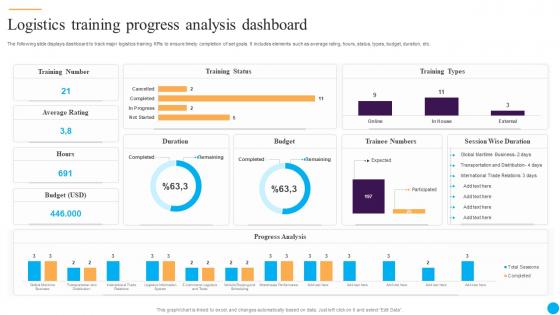
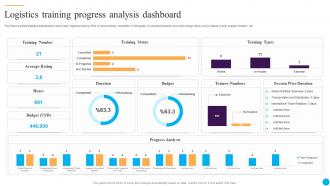
The following slide displays dashboard to track major logistics training KPIs to ensure timely completion of set goals. It includes elements such as average rating, hours, status, types, budget, duration, etc.
People who downloaded this PowerPoint presentation also viewed the following :
Logistics Training Progress Analysis Dashboard with all 7 slides:
Use our Logistics Training Progress Analysis Dashboard to effectively help you save your valuable time. They are readymade to fit into any presentation structure.






FAQs for Logistics Training
Effective logistics training programs include supply chain fundamentals, inventory management systems, transportation optimization, warehouse operations, and technology integration platforms. These components work together by enhancing operational efficiency, reducing costs, and improving delivery accuracy, with many organizations finding that comprehensive training ultimately delivers faster customer service and significant competitive advantage.
Technology enhances logistics training outcomes by providing interactive simulations, real-time data analytics, and personalized learning paths that adapt to individual employee needs and skill levels. Through VR warehouse simulations and AI-powered platforms, companies streamline knowledge retention, reduce training costs, and accelerate skill development, with many organizations finding that employees achieve proficiency 40% faster than traditional methods.
Hands-on experience plays a crucial role in logistics training by bridging theoretical knowledge with practical application, enabling trainees to develop critical problem-solving skills, operational efficiency, and real-world decision-making capabilities. Through simulated warehouse operations, supply chain management exercises, and transportation coordination activities, professionals gain essential competencies that enhance performance and streamline logistics processes across industries.
Different industries approach logistics training by focusing on sector-specific regulations, technology requirements, and operational priorities unique to their markets. Healthcare emphasizes cold chain management and pharmaceutical compliance, while automotive focuses on just-in-time delivery and supply chain integration, with retail prioritizing last-mile optimization and seasonal demand planning, ultimately delivering industry-relevant expertise.
Key metrics for evaluating logistics training success include performance indicators like delivery times, accuracy rates, cost reduction percentages, employee productivity scores, and customer satisfaction ratings. These measurements enable organizations to assess training effectiveness by tracking operational improvements, reduced error rates, and enhanced supply chain efficiency, with many companies finding that comprehensive metric tracking delivers measurable ROI and competitive advantage.
Logistics training can be tailored through multilingual content delivery, role-specific modules, flexible scheduling options, and diverse learning formats including digital, hands-on, and visual approaches. Many organizations enhance effectiveness by incorporating cultural sensitivity training, mentorship programs, and adaptive assessment methods, while leveraging technology platforms that accommodate different skill levels, ultimately improving workforce engagement and operational efficiency.
Logistics and supply chain certification options include APICS Supply Chain Operations Reference (SCOR), Certified Supply Chain Professional (CSCP), Certified in Production and Inventory Management (CPIM), Six Sigma certifications, and Project Management Professional (PMP). These credentials enhance career advancement by validating expertise, improving operational efficiency, and increasing earning potential, with many organizations prioritizing certified professionals for strategic supply chain roles.
Compliance training integrates seamlessly into logistics training frameworks by addressing regulatory requirements, safety protocols, documentation standards, and industry-specific mandates throughout operational modules. This strategic combination ensures logistics professionals understand transportation regulations, customs procedures, and environmental standards while developing core competencies, ultimately delivering operational efficiency and regulatory adherence in increasingly complex supply chain environments.
Best practices for onboarding new logistics employees include comprehensive safety training, hands-on warehouse operations experience, transportation management system tutorials, inventory control procedures, and vendor relationship protocols. These structured approaches streamline integration by reducing errors, accelerating productivity, and enhancing operational efficiency, with many logistics organizations finding that systematic onboarding ultimately delivers faster employee competency and improved supply chain performance.
Simulations and role-playing enhance logistics training by creating realistic scenarios that mirror supply chain challenges, warehouse operations, and crisis management situations. These interactive methods enable trainees to practice decision-making, develop problem-solving skills, and build confidence in handling complex logistics operations, ultimately delivering improved performance and reduced operational errors in real-world environments.
Common logistics training challenges include complex supply chain processes, technology integration difficulties, regulatory compliance requirements, cross-functional coordination issues, and rapid industry changes. These obstacles can be overcome through hands-on simulations, modular learning approaches, and real-world case studies, with many organizations finding that interactive training platforms and mentorship programs significantly enhance knowledge retention and operational readiness.
Logistics training programs stay updated through industry partnerships, continuous curriculum reviews, technology integration, expert guest lectures, and real-time case study incorporation. Many organizations collaborate with logistics companies, trade associations, and technology providers to ensure their programs reflect current supply chain innovations, regulatory changes, and emerging practices, ultimately delivering workforce-ready professionals with relevant skills.
Continuous learning significantly enhances logistics sector performance by improving supply chain efficiency, reducing operational costs, and accelerating digital transformation adoption. Through updated training programs, logistics professionals master emerging technologies like AI-driven route optimization and automated inventory management, while organizations experience faster delivery times, reduced waste, and improved customer satisfaction, ultimately delivering competitive advantage in an increasingly complex global marketplace.
Organizations measure ROI for logistics training through key performance indicators like reduced transportation costs, improved delivery times, decreased inventory holding costs, and enhanced customer satisfaction scores. These metrics, combined with training expenses versus productivity gains, enable companies across manufacturing, retail, and distribution sectors to quantify improvements in operational efficiency, ultimately delivering measurable competitive advantage and cost savings.
Logistics training should prioritize communication, problem-solving, adaptability, teamwork, and customer service skills, as these enable professionals to coordinate complex supply chains effectively. These competencies streamline operations by enhancing vendor relationships, resolving disruptions quickly, and maintaining service quality, with many logistics organizations finding that strong soft skills ultimately deliver improved efficiency and customer satisfaction.
-
Crisp and neat slides. Makes it fun and easier to curate presentations.
-
Very unique, user-friendly presentation interface.