


Long term financial plan 10 years powerpoint slides




Try Before you Buy Download Free Sample Product
 Impress Your
 Audience
 100%
100% Editable
 Save Hours
 of Time


Our Long Term Financial Plan 10 Years Powerpoint Slides have an impelling impact. Even disbelievers begin to come around.
People who downloaded this PowerPoint presentation also viewed the following :
Content of this Powerpoint Presentation
Description:
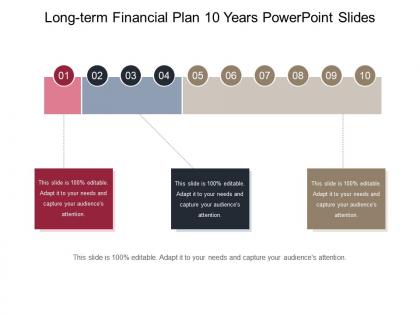
The image shows a PowerPoint slide titled "Long-term Financial Plan 10 Years PowerPoint Slides." It features a timeline with numbered points from 01 to 10, signifying a decade-long plan. Each point on the timeline is connected to a larger colored box, likely meant to detail specific strategies or milestones for each year. The slide emphasizes that it is entirely editable, allowing the presenter to customize the content for their specific financial planning needs.
Text Elements:
1. Title:
"Long-term Financial Plan 10 Years PowerPoint Slides" indicates the subject is a decade-long financial strategy.
2. Subtitle:
Repeated emphasis on the slide's editable nature suggests adaptability for various planning scenarios.
Use Cases:
This type of slide is versatile and can be utilized across numerous industries for strategic planning.
1. Finance:
Use: Outlining investment strategies.
Presenter: Financial Planner
Audience: Investors, Financial Analysts
2. Corporate Strategy:
Use: Presenting company's 10-year growth plan.
Presenter: Strategy Officer
Audience: Board Members, Stakeholders
3. Government:
Use: Detailing long-term budget allocations.
Presenter: Policy Maker
Audience: Government Officials, Public
4. Education:
Use: Planning for institutional development.
Presenter: University Administrator
Audience: Faculty, Education Boards
5. Healthcare:
Use: Forecasting healthcare system advancements.
Presenter: Healthcare Administrator
Audience: Medical Staff, Policy Makers
6. Non-Profit:
Use: Setting goals for long-term initiatives.
Presenter: Non-Profit Director
Audience: Donors, Volunteers
7. Technology:
Use: Roadmapping technology lifecycle and innovation.
Presenter: CTO
Audience: R&D Teams, Investors
Long term financial plan 10 years powerpoint slides with all 5 slides:
Take their breath away with our Long Term Financial Plan 10 Years Powerpoint Slides. Dazzle them with your brilliance.


FAQs for Long term financial plan 10
Key components of a long-term financial plan include goal setting, budgeting, investment strategy, risk management, and retirement planning. These elements work together by establishing clear financial objectives, allocating resources strategically, and building wealth over time, with many organizations and individuals finding that comprehensive planning delivers greater financial stability and competitive advantage.
Assessing your current financial situation involves calculating net worth, analyzing cash flow patterns, reviewing debt obligations, evaluating investment performance, and examining insurance coverage. This comprehensive review enables individuals and businesses to identify financial strengths and gaps, ultimately informing strategic decisions about resource allocation, risk management, and growth opportunities for sustainable long-term planning.
Risk tolerance fundamentally determines asset allocation, investment timeline, and diversification strategies within long-term financial planning, influencing whether portfolios emphasize growth stocks, bonds, or balanced approaches. It guides strategic decisions across retirement planning, wealth accumulation, and legacy building, with many investors finding that properly assessed risk tolerance ultimately delivers sustainable returns while maintaining emotional comfort throughout market fluctuations.
Long-term financial goals should be prioritized by evaluating urgency, impact, and feasibility, focusing on retirement planning, debt elimination, emergency reserves, and wealth accumulation strategies. Through strategic assessment and timeline mapping, individuals and organizations can balance competing objectives like education funding, property investments, and business expansion, ultimately delivering financial security and sustainable growth in an increasingly complex economic landscape.
Diversified investment strategies for long-term stability include index fund portfolios, dollar-cost averaging, asset allocation across stocks and bonds, real estate investments, and retirement account maximization. These approaches streamline wealth building by reducing market timing risks, minimizing fees, and leveraging compound growth, with many financial advisors finding that consistent contributions ultimately deliver sustainable returns and enhanced financial security.
Long-term financial plans should be reviewed annually at minimum, with adjustments made during major life changes like marriage, career transitions, market volatility, or economic shifts. Many financial advisors recommend quarterly check-ins to assess progress against goals, rebalance portfolios, and adapt strategies, ultimately ensuring the plan remains aligned with evolving circumstances and delivers sustained financial growth.
Life changes like marriage or having children significantly impact long-term financial planning by altering income structures, expense priorities, insurance needs, tax situations, and investment timelines. These transitions require strategic plan adjustments, with many families finding that shared financial goals, increased emergency funds, and education savings become essential priorities, ultimately delivering more comprehensive wealth-building strategies and enhanced financial security.
Accounting for inflation in long-term financial planning involves incorporating annual inflation rates into projections, adjusting target amounts upward, and selecting inflation-resistant investments like real estate, stocks, and Treasury Inflation-Protected Securities. Financial planners increasingly recommend diversified portfolios with growth assets, regular plan reviews, and escalating contribution strategies, ultimately ensuring purchasing power preservation and enabling clients to maintain their desired lifestyle despite rising costs over decades.
Financial planning tools include Mint, YNAB, Personal Capital, QuickBooks, and FinancialEdge, alongside comprehensive platforms like MoneyGuidePro and eMoney Advisor. These technologies streamline budgeting, investment tracking, and scenario modeling by automating data integration, providing real-time analytics, and enabling strategic forecasting, with many financial advisors and institutions finding that robust software ultimately delivers enhanced client experiences and operational efficiency.
Diversification is crucial in long-term investment strategies as it reduces portfolio risk, minimizes volatility, and enhances returns by spreading investments across asset classes, sectors, and geographic regions. This strategic approach enables investors to weather market downturns, capitalize on different growth opportunities, and achieve more consistent performance, with many financial advisors finding that diversified portfolios ultimately deliver superior risk-adjusted returns over time.
Tax implications in long-term financial planning include capital gains taxes, retirement account distributions, estate taxes, tax-deferred versus tax-free growth strategies, and changing tax brackets over time. These considerations significantly impact wealth accumulation by influencing investment timing, account selection, and withdrawal strategies, with many financial planners finding that strategic tax planning ultimately enhances overall returns and preserves more wealth for future goals.
Debt management integrates into long-term financial strategy through systematic repayment prioritization, strategic refinancing, and balanced allocation between debt reduction and wealth building. Organizations and individuals increasingly find that consolidating high-interest obligations, maintaining optimal debt-to-income ratios, and leveraging tax-advantaged repayment methods ultimately enhances cash flow while accelerating financial goals.
Retirement planning serves as the foundation of holistic financial planning by establishing long-term savings targets, determining investment strategies, and influencing current spending decisions. This strategic approach helps individuals balance immediate financial needs with future security goals, while optimizing tax advantages through retirement accounts, ultimately delivering financial independence and enabling organizations to offer competitive employee benefits that enhance workforce retention.
Individuals can balance emergency savings with long-term investments by establishing a tiered approach, prioritizing three to six months of expenses in accessible accounts while simultaneously contributing to retirement funds, index funds, and diversified portfolios. This strategic combination enables financial security through emergency preparedness and wealth building, with many finding that automated contributions to both emergency funds and investment accounts ultimately delivers comprehensive financial stability and long-term growth potential.
Professional resources for long-term financial planning include certified financial planners (CFPs), registered investment advisors (RIAs), fee-only planners, estate planning attorneys, and tax professionals. These specialists streamline wealth management by providing personalized strategies, portfolio optimization, and regulatory compliance guidance, with many organizations finding that strategic advisor partnerships ultimately deliver enhanced financial outcomes and competitive positioning in increasingly complex markets.
-
Use of different colors is good. It's simple and attractive.
-
Best Representation of topics, really appreciable.