


Louvre museum landmark vector in paris city powerpoint presentation ppt template




Try Before you Buy Download Free Sample Product
 Impress Your
 Audience
 100%
100% Editable
 Save Hours
 of Time


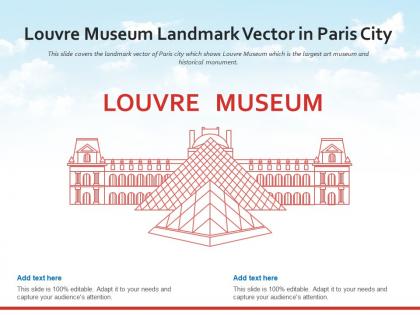
This slide covers the landmark vector of Paris city which shows Louvre Museum which is the largest art museum and historical monument.
People who downloaded this PowerPoint presentation also viewed the following :
Louvre museum landmark vector in paris city powerpoint presentation ppt template with all 2 slides:
Use our Louvre Museum Landmark Vector In Paris City Powerpoint Presentation PPT Template to effectively help you save your valuable time. They are readymade to fit into any presentation structure.
FAQs for Louvre museum landmark vector in paris city powerpoint
The Louvre's key milestones include its 1190 origins as a medieval fortress, transformation into a royal palace under Francis I, opening as a public museum in 1793 during the French Revolution, Napoleon's expansions, and the iconic glass pyramid addition in 1989. These developments showcase how cultural institutions evolve by adapting to changing societal needs, expanding accessibility, and embracing architectural innovation, ultimately delivering enhanced visitor experiences and global cultural leadership.
The Louvre's architecture showcases its transformation through medieval fortress foundations, Renaissance palace additions, classical courtyards, and modern glass pyramid integration. This architectural evolution demonstrates how institutions can successfully blend historical preservation with contemporary functionality, with many museums finding that strategic renovations enhance visitor experiences while maintaining cultural authenticity, ultimately delivering both operational efficiency and educational impact.
The Louvre's predominant collection themes include ancient civilizations, European paintings from the 13th-19th centuries, decorative arts, sculptures, and Egyptian antiquities. These diverse collections span over 9,000 years of art history, with major strengths in French royal collections, Mediterranean cultures, and masterworks from Renaissance masters, ultimately delivering comprehensive cultural education and attracting millions seeking artistic heritage globally.
The Louvre curates exhibits by combining iconic masterpieces with rotating thematic displays, multilingual interpretations, and digital storytelling technologies that resonate across cultures. Through strategic partnerships with international institutions, immersive audio guides, and culturally diverse programming, the museum delivers accessible art experiences while preserving historical authenticity, ultimately attracting millions of global visitors annually.
Technology at the Louvre enhances visitor experiences through digital guides, interactive displays, virtual reality tours, mobile applications, and augmented reality features. These innovations streamline navigation, provide multilingual content, and deliver immersive storytelling, with many museums finding that such digital integration significantly improves visitor engagement while reducing crowding around popular exhibits.
The Louvre houses iconic masterpieces including Leonardo da Vinci's Mona Lisa, the ancient Venus de Milo sculpture, Eugène Delacroix's Liberty Leading the People, and the mysterious Winged Victory of Samothrace. These works span centuries of artistic achievement, from Renaissance portraiture and ancient Greek sculpture to revolutionary French romanticism, ultimately delivering cultural experiences that attract millions of visitors annually and establish the museum's position as the world's most visited art institution.
The Louvre preserves cultural heritage through advanced conservation techniques, climate-controlled environments, digital archiving, scholarly research, and strategic acquisition programs. By maintaining over 35,000 artworks spanning millennia, the museum enables global access to humanity's artistic legacy while continuously developing restoration technologies, ultimately delivering educational experiences and cultural continuity for future generations.
The Louvre faces conservation challenges including climate control management, visitor impact mitigation, aging infrastructure limitations, funding constraints for specialized treatments, and balancing public access with artwork protection. These preservation demands require strategic resource allocation, advanced environmental monitoring systems, and specialized expertise, with many major museums finding that proactive conservation programs ultimately deliver enhanced artwork longevity and improved visitor experiences while maintaining cultural heritage integrity.
The Louvre promotes educational initiatives through guided school tours, interactive workshops, digital learning resources, teacher training programs, and curriculum-aligned art activities. These programs enhance cultural literacy by connecting students with masterworks like the Mona Lisa and Egyptian artifacts, while many educators find that museum partnerships significantly enrich classroom learning and inspire lifelong cultural appreciation.
The Louvre addresses accessibility through wheelchair-accessible entrances, elevators to all floors, tactile tours for visually impaired visitors, sign language interpreters, and audio guides with accessibility features. These comprehensive accommodations enable museums worldwide to enhance visitor experiences by removing physical barriers, providing sensory alternatives, and ensuring cultural institutions remain inclusive, ultimately delivering broader audience engagement and demonstrating commitment to universal access in an increasingly diverse visitor landscape.
The Louvre has implemented digital innovation strategies, expanded global partnerships, enhanced visitor experiences through technology, diversified programming, and strengthened educational outreach. Through virtual tours, international collaborations like Louvre Abu Dhabi, and interactive exhibitions, the museum streamlines cultural accessibility while preserving traditional artistry, ultimately delivering broader engagement and competitive positioning in today's increasingly digital cultural landscape.
Temporary exhibitions at the Louvre significantly boost public interest by introducing fresh perspectives, contemporary relevance, and exclusive viewing opportunities that create urgency and excitement around visiting. These strategic exhibitions attract diverse audiences, generate substantial media attention, and enhance visitor engagement through innovative storytelling approaches, ultimately delivering increased attendance, broader cultural participation, and strengthened museum positioning in the competitive cultural landscape.
The Louvre's digital initiatives have dramatically expanded global access through virtual tours, high-resolution artwork databases, and interactive online exhibitions, reaching millions worldwide who cannot visit physically. These platforms have revolutionized cultural engagement by enabling remote education, supporting academic research, and fostering international cultural appreciation, with many educational institutions finding that digital access enhances learning outcomes and cultural literacy globally.
The Louvre collaborates internationally through traveling exhibitions, joint research projects, digital partnerships, and cultural exchange programs with institutions worldwide. These strategic alliances enable sharing of masterpieces, archaeological discoveries, and conservation expertise across continents, with partner museums in Abu Dhabi, Tokyo, and major European capitals finding that collaborative initiatives enhance visitor experiences while expanding global cultural access.
Running a museum of the Louvre's scale involves substantial operational costs including staffing, security, conservation, and facility maintenance, balanced against diverse revenue streams from admissions, memberships, retail, and exhibitions. These financial considerations require strategic resource allocation and innovative funding approaches, with many major cultural institutions finding that digital initiatives, corporate partnerships, and expanded programming ultimately deliver enhanced visitor experiences while ensuring long-term sustainability.
-
Excellent products for quick understanding.
-
Designs have enough space to add content.
-
Wonderful templates design to use in business meetings.
-
Much better than the original! Thanks for the quick turnaround.