


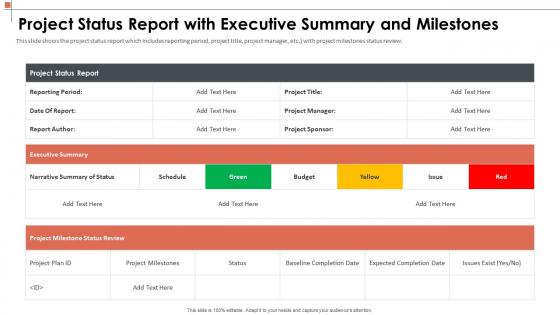
Manage the project scoping to describe project status report with executive summary and milestones




Try Before you Buy Download Free Sample Product
 Impress Your
 Audience
 100%
100% Editable
 Save Hours
 of Time


This slide shows the project status report which includes reporting period, project title, project manager, etc. with project milestones status review.
People who downloaded this PowerPoint presentation also viewed the following :
Manage the project scoping to describe project status report with executive summary and milestones with all 6 slides:
Use our Manage The Project Scoping To Describe Project Status Report With Executive Summary And Milestones to effectively help you save your valuable time. They are readymade to fit into any presentation structure.





FAQs for Manage the project scoping to describe project status report with executive
**INPUT**: What are the key components of an effective project scope statement? **OUTPUT**: Effective project scope statements include clear objectives, detailed deliverables, defined boundaries, acceptance criteria, assumptions, and constraints that guide project execution. These components work together by establishing measurable outcomes, preventing scope creep, and aligning stakeholder expectations, with many organizations finding that comprehensive scope statements ultimately deliver faster project completion and reduced resource conflicts. [Word count: 55 words]
Project scope encompasses all work required to deliver a project, including planning, execution, monitoring, and closure activities, while product scope defines the specific features, functions, and characteristics of the deliverable itself. In software development, for example, project scope covers development phases, testing protocols, and deployment strategies, whereas product scope focuses on user interface design, functionality requirements, and performance specifications, with many organizations finding that clear distinction between both scopes prevents scope creep and enhances delivery success.
Requirements gathering techniques include stakeholder interviews, workshops and brainstorming sessions, document analysis, surveys and questionnaires, and prototype reviews. These methods enhance project clarity by capturing diverse perspectives, identifying critical functionalities, and establishing clear expectations, with many organizations finding that combining multiple techniques delivers more comprehensive requirements and reduces costly scope changes during project execution.
Stakeholder alignment during scoping requires structured communication through regular workshops, clear documentation of requirements, and collaborative prioritization sessions that address conflicting objectives early. These approaches streamline decision-making by establishing shared understanding, managing expectations proactively, and creating transparent approval processes, with many organizations finding that systematic stakeholder engagement ultimately delivers faster project launches and reduced scope changes.
Assumptions and constraints serve as foundational parameters that define project boundaries, resource limitations, timeline expectations, and operational conditions during the scoping phase. These elements help project managers establish realistic deliverables, allocate resources effectively, and set stakeholder expectations, while identifying potential risks early, ultimately enabling more accurate planning and successful project outcomes across industries.
A well-defined project scope significantly enhances project success by establishing clear boundaries, deliverables, timelines, and resource requirements from the outset. This clarity minimizes scope creep, reduces miscommunication among stakeholders, and enables better budget control, with many organizations finding that comprehensive scoping ultimately delivers projects on time and within budget while meeting quality expectations.
Common pitfalls include unclear objectives, inadequate stakeholder consultation, underestimating resource requirements, insufficient risk assessment, and lack of change control processes. These oversights streamline project failures by creating scope creep, budget overruns, and timeline delays, with many organizations finding that thorough upfront scoping ultimately delivers better outcomes and competitive advantage.
Managing scope creep requires establishing clear project boundaries, implementing formal change control processes, maintaining regular stakeholder communication, and documenting all scope modifications with impact assessments. Through structured governance frameworks, project managers can evaluate requested changes against original objectives, timeline implications, and budget constraints, while ensuring stakeholders understand the trade-offs, ultimately delivering projects within agreed parameters and maintaining competitive advantage through disciplined execution.
Project scoping tools include work breakdown structure templates, scope statement frameworks, requirements gathering matrices, stakeholder analysis charts, and project charter templates. These resources streamline documentation by standardizing format, ensuring comprehensive coverage of deliverables and constraints, with many project managers finding that structured templates reduce scope creep while enhancing stakeholder alignment and project clarity.
Changes to project scope post-approval should be managed through formal change control processes, including impact assessment, stakeholder approval, and documentation updates. This structured approach enables organizations to evaluate cost implications, timeline adjustments, and resource requirements systematically, while maintaining project integrity and stakeholder alignment, ultimately delivering controlled flexibility without compromising strategic objectives.
Project scope execution metrics include schedule adherence, budget variance, deliverable quality scores, scope creep frequency, and stakeholder satisfaction ratings. These measurements enable project managers to identify deviations early, optimize resource allocation, and maintain timeline integrity, with many organizations finding that consistent metric tracking ultimately delivers improved project outcomes and enhanced client relationships.
Validating scope with stakeholders involves conducting structured review sessions, creating detailed scope documents with clear deliverables and timelines, and securing formal sign-offs from key decision-makers. Through collaborative workshops and iterative feedback cycles, project managers ensure alignment across departments, minimize scope creep risks, and establish accountability frameworks, ultimately delivering projects that meet expectations while maintaining stakeholder buy-in throughout execution.
Documenting scope exclusions prevents misunderstandings, manages stakeholder expectations, and establishes clear project boundaries from the outset. This practice significantly reduces scope creep, minimizes disputes during execution, and enables project managers to maintain focus on deliverables, with many organizations finding that formal exclusion documentation ultimately delivers smoother project workflows and stronger client relationships.
Project scope alignment with organizational strategy occurs through strategic mapping, stakeholder engagement, resource prioritization, and continuous monitoring against key business objectives. Organizations achieve this by conducting strategic assessments during project initiation, establishing clear governance frameworks, and implementing regular review cycles, ultimately ensuring projects deliver measurable value and competitive advantage while supporting long-term growth.
Best practices for communicating scope include creating detailed scope statements, using visual project maps, conducting regular alignment meetings, establishing clear change control processes, and maintaining accessible documentation. These approaches streamline understanding by ensuring transparency, facilitating collaboration, and minimizing misalignment, with many organizations finding that consistent scope communication ultimately delivers faster project execution and enhanced stakeholder satisfaction.
-
Informative design.
-
I discovered this website through a google search, the services matched my needs perfectly and the pricing was very reasonable. I was thrilled with the product and the customer service. I will definitely use their slides again for my presentations and recommend them to other colleagues.