


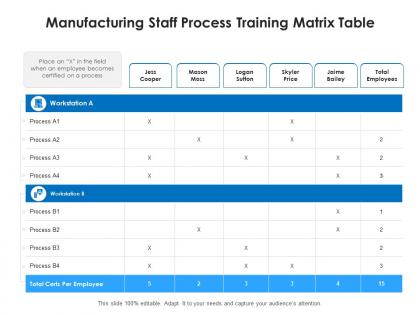
Manufacturing staff process training matrix table




Try Before you Buy Download Free Sample Product
 Impress Your
 Audience
 100%
100% Editable
 Save Hours
 of Time


Our Manufacturing Staff Process Training Matrix Table are topically designed to provide an attractive backdrop to any subject. Use them to look like a presentation pro.
People who downloaded this PowerPoint presentation also viewed the following :
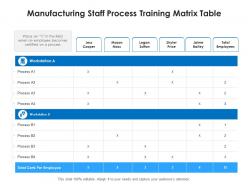
Manufacturing staff process training matrix table with all 2 slides:
Use our Manufacturing Staff Process Training Matrix Table to effectively help you save your valuable time. They are readymade to fit into any presentation structure.
FAQs for Manufacturing staff process
A manufacturing training matrix is a comprehensive tool that maps employee skills against required competencies for specific roles, equipment, and processes within manufacturing operations. It enables organizations to identify skill gaps, streamline workforce development, and ensure regulatory compliance, while enhancing operational efficiency, reducing training costs, and maintaining consistent quality standards across production lines.
Determining key competencies involves analyzing job roles, identifying critical skills gaps, assessing safety requirements, evaluating regulatory compliance needs, and reviewing production quality standards. Through competency mapping and stakeholder input, manufacturing organizations streamline workforce development, enhance operational efficiency, and ensure consistent performance across departments, ultimately delivering improved productivity and reduced training costs.
Best practices for developing an effective manufacturing training matrix include conducting comprehensive skills assessments, mapping roles to specific competencies, establishing clear learning pathways, integrating hands-on and digital training methods, and implementing regular progress tracking. This strategic approach enables manufacturers to streamline workforce development, reduce operational downtime, and enhance production quality, with many organizations finding that structured training matrices significantly improve employee retention and overall manufacturing efficiency.
A manufacturing training matrix enhances workforce productivity and safety by systematically identifying skill gaps, standardizing training protocols, and ensuring comprehensive competency development across all operational areas. This structured approach enables manufacturers to reduce workplace accidents, minimize equipment downtime, and accelerate employee proficiency, with many organizations finding that strategic training alignment ultimately delivers measurable improvements in both operational efficiency and safety compliance.
Technology streamlines training matrix development through learning management systems, skills assessment platforms, automated tracking tools, data analytics software, and digital competency mapping solutions. These systems enhance operational efficiency by identifying skill gaps automatically, personalizing learning paths for individual employees, and maintaining real-time compliance records, ultimately delivering faster workforce development and strategic competitive advantage across manufacturing operations.
A manufacturing training matrix should be updated quarterly to bi-annually, depending on technology changes, regulatory requirements, and operational shifts within your organization. Many manufacturing facilities find that regular reviews every 3-6 months ensure alignment with evolving safety standards, equipment updates, and skill requirements, ultimately maintaining workforce competency and operational efficiency.
Methods include pre and post-training assessments, skill demonstrations, performance metrics tracking, supervisor evaluations, and employee feedback surveys. These assessment approaches streamline training effectiveness measurement by comparing baseline competencies with post-training results, monitoring on-the-job performance improvements, and gathering multi-source feedback, ultimately delivering data-driven insights that enhance program ROI and workforce development outcomes.
A training matrix supports compliance by systematically tracking required certifications, mandatory training schedules, regulatory updates, and competency assessments for each role. Manufacturing organizations use these matrices to ensure ISO standards adherence, safety protocol compliance, and quality control requirements, while automatically flagging certification renewals and gaps, ultimately delivering audit readiness and regulatory confidence across operations.
Companies face challenges including resistance to change from employees, initial setup costs and time investment, maintaining current information across evolving processes, and ensuring consistent training delivery across multiple locations. While these implementation hurdles require strategic planning, many manufacturers find that systematic approaches, phased rollouts, and strong leadership support ultimately streamline workforce development and enhance operational efficiency.
A training matrix assists in identifying skill gaps by systematically mapping current employee competencies against required job skills, revealing discrepancies through visual assessment tools, competency frameworks, and performance evaluations. Through this strategic analysis, manufacturing organizations can pinpoint specific technical deficiencies, prioritize training investments, and develop targeted upskilling programs, ultimately enhancing operational efficiency and workforce capability.
A manufacturing training matrix facilitates career progression by mapping skill requirements across roles, identifying development gaps, creating structured advancement pathways, and establishing competency benchmarks for promotions. This strategic approach enables employees to visualize their career trajectory while providing managers with clear frameworks for succession planning, ultimately delivering enhanced retention rates and internal mobility opportunities that strengthen organizational talent pipelines.
Organizations can tailor their training matrix by implementing tiered learning pathways, competency-based assessments, role-specific modules, mentorship programs, and flexible delivery methods that accommodate varying experience levels. Manufacturing companies increasingly use adaptive learning platforms and cross-functional training approaches, enabling beginners to build foundational skills while advanced workers enhance specialized expertise, ultimately delivering improved productivity and streamlined workforce development.
Key metrics include training completion rates, skill assessment scores, production quality improvements, safety incident reductions, and employee retention rates. These metrics enable manufacturers to measure knowledge transfer effectiveness, operational efficiency gains, and workforce development ROI, with many organizations finding that comprehensive measurement systems ultimately deliver enhanced productivity, reduced errors, and stronger competitive positioning in increasingly complex manufacturing environments.
Visual elements enhance manufacturing training matrix communication by incorporating color coding for skill levels, icons for different competencies, progress bars for completion tracking, and flowcharts for learning pathways. These design features streamline information processing, reduce training time, and improve knowledge retention, with many manufacturing facilities finding that visual matrices increase employee engagement and accelerate skill development across production teams.
Employee feedback serves as the cornerstone for developing effective manufacturing training matrices, providing insights into skill gaps, training effectiveness, process challenges, and real-world application needs. Through surveys, focus groups, and performance reviews, manufacturers can identify specific competency requirements, refine training content, and ensure programs align with actual production demands, ultimately creating more targeted development pathways that enhance both worker confidence and operational efficiency.
-
Great product with effective design. Helped a lot in our corporate presentations. Easy to edit and stunning visuals.