


Market Action Plan With Advertising And Public Relations




Try Before you Buy Download Free Sample Product
 Impress Your
 Audience
 100%
100% Editable
 Save Hours
 of Time


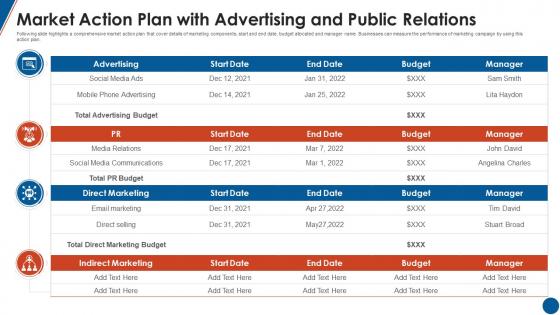
Following slide highlights a comprehensive market action plan that cover details of marketing components, start and end date, budget allocated and manager name. Businesses can measure the performance of marketing campaign by using this action plan.
People who downloaded this PowerPoint presentation also viewed the following :
Market Action Plan With Advertising And Public Relations with all 6 slides:
Use our Market Action Plan With Advertising And Public Relations to effectively help you save your valuable time. They are readymade to fit into any presentation structure.





FAQs for Market Action Plan With Advertising
**INPUT**: What are the key components of an effective market action plan? **OUTPUT**: Effective market action plans include market analysis, target audience segmentation, competitive positioning, strategic objectives, tactical implementation timelines, and performance metrics. These components work together by enabling organizations to streamline resource allocation, enhance customer targeting, and deliver measurable results, with many businesses finding that comprehensive planning ultimately accelerates market penetration and sustainable competitive advantage.
Market analysis for action planning involves evaluating target demographics, competitor strategies, industry trends, customer behavior patterns, and market size potential through surveys, focus groups, and data analytics. This comprehensive research enables businesses to identify market gaps, assess competitive positioning, and understand customer needs, ultimately delivering strategic insights that inform product development, pricing strategies, and go-to-market approaches.
Target audience identification serves as the foundation for market action plans, determining messaging strategies, channel selection, budget allocation, product positioning, and competitive differentiation approaches. Through detailed demographic and psychographic analysis, businesses can craft tailored campaigns that resonate with specific customer segments, ultimately delivering higher conversion rates, improved ROI, and sustainable market penetration across diverse industries.
Setting measurable objectives requires defining specific, quantifiable goals with clear timelines, target metrics, and performance indicators like revenue growth, market share increase, or customer acquisition rates. These objectives should align with broader business strategy while incorporating tracking mechanisms, regular review periods, and adjustment protocols, enabling organizations to monitor progress effectively, optimize resource allocation, and demonstrate tangible results to stakeholders.
Competitive analysis strategies include market intelligence gathering, pricing analysis, product benchmarking, customer feedback monitoring, and social media tracking. These approaches enable organizations to assess competitor positioning, identify market gaps, and anticipate strategic moves, with many companies finding that systematic competitor evaluation ultimately delivers improved market positioning and competitive advantage.
Market segmentation significantly influences action plan development by enabling targeted resource allocation, customized messaging strategies, and prioritized market approaches based on specific customer demographics, behaviors, and needs. Through strategic segmentation, organizations can streamline their marketing efforts, enhance campaign effectiveness, and deliver more personalized customer experiences, ultimately achieving higher conversion rates and competitive advantage in increasingly diverse markets.
Digital project management platforms like Asana and Monday.com, CRM systems such as Salesforce, marketing automation tools including HubSpot, analytics dashboards, and collaboration software streamline market action plan implementation effectively. These technologies enhance coordination by centralizing task tracking, automating campaign workflows, and providing real-time performance insights, with many organizations finding that integrated toolsets reduce execution time while improving strategic alignment.
Assessing market action risks involves conducting thorough competitor analysis, financial impact modeling, regulatory compliance reviews, customer feedback assessment, and scenario planning for various outcomes. Through systematic risk evaluation frameworks, organizations can identify potential market shifts, resource constraints, and implementation challenges, while developing contingency strategies that minimize exposure and maximize competitive positioning in dynamic market environments.
Key metrics include revenue growth, market share expansion, customer acquisition costs, conversion rates, and return on investment (ROI). These performance indicators enable organizations to assess strategic effectiveness by monitoring sales velocity, competitive positioning, and resource efficiency, with many companies finding that tracking both leading and lagging indicators ultimately delivers comprehensive insights into market penetration success.
Market action plans should be reviewed quarterly and updated annually, with major revisions triggered by significant market shifts, competitive changes, or performance deviations from targets. This strategic approach enables organizations to maintain agility in increasingly dynamic markets, with many companies finding that regular reviews enhance responsiveness, optimize resource allocation, and ultimately deliver sustained competitive advantage through proactive adaptation.
Social media marketing serves as a critical channel for audience engagement, brand awareness, content distribution, customer feedback, and competitive intelligence within modern market action plans. Through targeted campaigns and real-time interactions, organizations streamline customer acquisition, enhance brand loyalty, and accelerate market penetration, with many businesses finding that strategic social media integration ultimately delivers measurable ROI and sustained competitive advantage.
Customer feedback integration involves systematic collection through surveys, social listening, sales data analysis, focus groups, and direct customer interviews to identify market response patterns. This continuous feedback loop enables businesses to adjust pricing strategies, refine product positioning, and optimize marketing channels, with many organizations finding that regular customer input dramatically improves campaign effectiveness and market penetration rates.
Common pitfalls include inadequate market research, unrealistic timelines, insufficient budget allocation, lack of clear metrics, and poor stakeholder alignment. These oversights often derail implementation by creating resource constraints, missed opportunities, and strategic misalignment, with many organizations finding that comprehensive planning and regular monitoring ultimately delivers more sustainable growth and competitive advantage.
A market action plan should directly support your overall business strategy by reflecting your core objectives, target markets, competitive positioning, and resource allocation priorities. The strategic combination ensures consistent messaging across all channels, optimized budget distribution, and measurable outcomes that advance broader company goals, with many organizations finding that this alignment ultimately delivers enhanced operational efficiency and sustainable competitive advantage.
Partnerships enhance market action plan execution by providing access to new customer segments, sharing marketing costs and resources, leveraging complementary expertise, and accelerating market entry timelines. Through strategic alliances, companies streamline distribution channels, enhance product offerings, and minimize operational risks, with many organizations finding that collaborative approaches ultimately deliver broader market reach and competitive advantage.
-
Good research work and creative work done on every template.
-
Commendable slides with attractive designs. Extremely pleased with the fact that they are easy to modify. Great work!