


Market Activity Report For Real Estate Sector




Try Before you Buy Download Free Sample Product
 Impress Your
 Audience
 100%
100% Editable
 Save Hours
 of Time


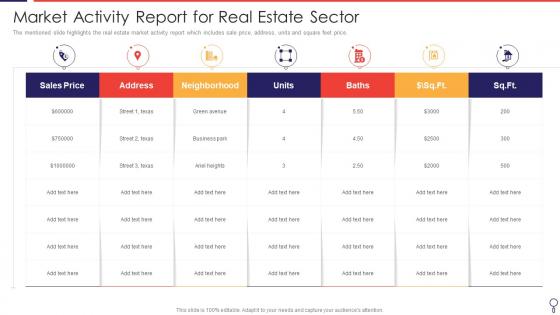
The mentioned slide highlights the real estate market activity report which includes sale price, address, units and square feet price.
People who downloaded this PowerPoint presentation also viewed the following :
Market Activity Report For Real Estate Sector with all 6 slides:
Use our Market Activity Report For Real Estate Sector to effectively help you save your valuable time. They are readymade to fit into any presentation structure.





FAQs for Market Activity Report For
Key indicators for assessing real estate market activity include inventory levels, average days on market, price trends, mortgage rates, and sales volume. These metrics work together to reveal market conditions, with many real estate professionals finding that tracking inventory alongside pricing data provides the clearest picture of whether markets favor buyers or sellers, ultimately enabling more strategic investment decisions.
Interest rates significantly influence buyer sentiment by affecting affordability, purchasing power, and market timing decisions, with higher rates typically dampening enthusiasm while lower rates stimulate activity. Through mortgage cost calculations and monthly payment considerations, prospective buyers increasingly delay purchases during rate spikes, while many financial institutions and real estate professionals find that even modest rate changes can shift buyer behavior from active searching to market-waiting strategies.
Economic conditions fundamentally drive real estate trends through interest rates, employment levels, inflation rates, and consumer confidence measures. During economic growth, lower unemployment and rising incomes boost housing demand, while recessions typically reduce buyer activity, with markets like commercial real estate in major cities experiencing significant fluctuations based on broader economic health.
Demographic shifts significantly influence real estate demand through changing population age structures, income levels, household formations, and migration patterns across regions. Growing tech hubs like Austin experience increased demand from younger professionals, while retirement destinations see surges in senior housing needs, ultimately creating distinct market opportunities that enable developers and investors to strategically target emerging demographic trends.
Investors can capitalize on emerging real estate opportunities through market research, diversification across property types, leveraging technology for data analysis, forming strategic partnerships, and timing market cycles effectively. These approaches enable identification of undervalued assets, emerging neighborhoods, and shifting demographics, with many investors finding that combining traditional analysis with PropTech tools delivers enhanced portfolio performance and competitive advantage.
Inventory levels significantly influence home prices through supply and demand dynamics, with low inventory typically driving prices upward while high inventory creates downward pressure on pricing. In competitive markets like San Francisco or Austin, limited housing stock enables sellers to command premium prices and receive multiple offers, while areas with oversupply often see price reductions and extended market times, ultimately delivering strategic advantages to buyers seeking negotiating power.
Remote work has significantly reduced demand for traditional office spaces while increasing interest in flexible, hybrid-friendly environments and suburban locations. Many organizations are downsizing headquarters, renegotiating leases, and investing in collaborative spaces that support intermittent occupancy, with commercial real estate markets increasingly adapting through mixed-use developments and technology-enhanced facilities.
Technology and data analytics revolutionize real estate through predictive pricing models, automated property valuations, virtual tours, AI-powered market forecasting, and blockchain transactions. These innovations streamline operations by reducing transaction times, enhancing buyer experiences, and improving investment decisions, with many real estate firms finding that data-driven approaches deliver competitive advantages and significantly better market positioning.
Governmental policies significantly impact real estate development through zoning regulations, building codes, tax incentives, environmental requirements, and permitting processes. These regulations shape project feasibility, construction timelines, and development costs, with many developers finding that proactive policy engagement and compliance strategies enable faster approvals, reduced costs, and ultimately deliver competitive advantages in securing prime development opportunities.
First-time homebuyers face challenges including high property prices, limited inventory, intense competition, strict lending requirements, and rising interest rates. These market conditions create barriers by reducing affordability, limiting options, and requiring larger down payments, with many buyers finding that strategic timing, pre-approval, and flexible location preferences ultimately enhance their competitive advantage.
The luxury real estate segment often demonstrates greater resilience during market fluctuations, with high-net-worth buyers maintaining purchasing power through economic uncertainties, while average market segments experience more pronounced volatility tied to interest rates and employment conditions. Many luxury markets deliver sustained demand through international buyers, cash transactions, and limited inventory, ultimately creating competitive advantages that enable premium pricing and faster recovery cycles compared to broader residential sectors.
Emerging sustainable real estate trends include green building certifications, renewable energy integration, smart home technologies, water conservation systems, and carbon-neutral construction materials. These developments enhance property values, reduce operational costs, and attract environmentally conscious buyers, with many developers finding that sustainable features deliver competitive advantages while meeting increasingly stringent environmental regulations.
Real estate professionals can leverage social media for market insight by monitoring local community groups, analyzing trending hashtags, tracking competitor listings, and engaging with neighborhood discussions. Platforms like Facebook, Instagram, and LinkedIn reveal buyer preferences, price sensitivities, and emerging market trends, with many agents finding that social listening enhances their understanding of hyperlocal demand patterns and client expectations.
Housing bubble signs include rapidly rising prices exceeding income growth, speculative buying, excessive lending practices, high price-to-rent ratios, and widespread market euphoria. Investors can identify these patterns by monitoring affordability metrics, construction activity, and lending standards, with many financial institutions finding that combining multiple indicators delivers more accurate assessments, ultimately enabling strategic positioning before market corrections occur.
Seasonal trends significantly impact real estate activity through spring and summer peaks when families prefer moving, children's school schedules align, and weather conditions favor property viewings and relocations. These cyclical patterns influence buyer behavior by creating competitive spring markets with higher prices, strategic fall negotiations with motivated sellers, and reduced winter inventory, with many real estate professionals finding that timing strategies around seasonal demand ultimately delivers optimal outcomes for both buyers and sellers.
-
You can rely on SlideTeam whenever you run out of designs for your presentation. Thank you so much SlideTeam!
-
You can rely on SlideTeam whenever you run out of designs for your presentation. Thank you so much SlideTeam!