


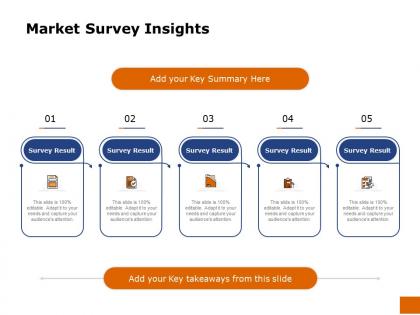
Market survey insights ppt powerpoint presentation gallery templates




Try Before you Buy Download Free Sample Product
 Impress Your
 Audience
 100%
100% Editable
 Save Hours
 of Time


Our Market Survey Insights Ppt Powerpoint Presentation Gallery Templates are explicit and effective. They combine clarity and concise expression.
People who downloaded this PowerPoint presentation also viewed the following :
Market survey insights ppt powerpoint presentation gallery templates with all 2 slides:
Give your audience a fulfilling experience. They will find our Market Survey Insights Ppt Powerpoint Presentation Gallery Templates elevating.
FAQs for Market survey insights ppt powerpoint
Effective digital market survey methods include online questionnaires, social media polling, mobile app surveys, video interviews, and interactive web forms. These approaches streamline data collection by reaching broader audiences, reducing costs, and enabling real-time analytics, with many organizations finding that combining multiple digital channels delivers deeper consumer insights and faster market intelligence for competitive advantage.
Businesses can ensure representative survey samples through stratified sampling methods, demographic quotas, multiple distribution channels, geographic diversification, and response weighting techniques. These approaches enable organizations to capture diverse perspectives across age groups, income levels, and regional markets, with many companies finding that combining online panels with targeted outreach ultimately delivers more reliable insights and strategic competitive advantage.
Key metrics to analyze include response rates, satisfaction scores, purchase intent levels, brand perception ratings, and demographic breakdowns across customer segments. These measurements enable businesses to identify market opportunities, assess competitive positioning, and refine product strategies, with many organizations finding that combining quantitative data with qualitative feedback delivers deeper consumer insights and strategic advantages.
Cultural differences significantly impact survey interpretation through varying communication styles, social desirability biases, response patterns, and contextual understanding of concepts like satisfaction or importance. These variations manifest differently across regions, with collectivist cultures often showing acquiescence bias while individualist societies display extreme response tendencies, ultimately requiring culturally adapted methodologies to ensure accurate global market insights and strategic decision-making.
Online tools and software streamline market survey processes by automating data collection, enabling real-time analytics, facilitating broader audience reach, and providing advanced reporting capabilities. These technologies enhance operational efficiency through faster deployment, reduced manual errors, and comprehensive data visualization, with many organizations finding that digital survey platforms deliver significantly lower costs, accelerated insights, and improved respondent engagement compared to traditional methods.
Businesses leverage market survey insights by identifying customer preferences, analyzing demand patterns, understanding price sensitivity, and recognizing market gaps to refine their product portfolios. These insights enable companies to customize features, adjust pricing strategies, and develop targeted solutions, with many retailers and tech firms finding that data-driven product tailoring significantly enhances customer satisfaction and competitive positioning.
Researchers should be aware of confirmation bias, leading questions, response bias, social desirability bias, and anchoring bias when designing surveys. These biases can skew results by influencing how participants interpret and respond to questions, with many market research teams finding that neutral wording, randomized answer choices, and pilot testing help minimize these effects, ultimately delivering more accurate insights and reliable data for strategic decision-making.
Qualitative data from market surveys complements quantitative data by providing context, motivations, and deeper understanding behind numerical trends, revealing the "why" that statistics alone cannot capture. Through focus groups, open-ended responses, and interviews, businesses uncover customer emotions, preferences, and decision-making processes, while quantitative metrics provide scale and measurability, ultimately delivering comprehensive insights that enable strategic decision-making and competitive advantage.
Recent market surveys reveal emerging trends including increased digital-first shopping preferences, sustainability-conscious purchasing decisions, personalized experience expectations, subscription-based service adoption, and social commerce engagement. These behavioral shifts are reshaping retail strategies across industries, with many organizations finding that consumers increasingly prioritize convenience, environmental responsibility, and authentic brand connections, ultimately driving businesses to enhance omnichannel experiences and sustainable practices.
Companies use segmentation to analyze market survey results by dividing respondents into distinct groups based on demographics, behaviors, preferences, and purchasing patterns, enabling more targeted insights. This approach allows businesses to identify specific customer needs, tailor marketing strategies, and develop products that resonate with particular segments, ultimately delivering more personalized experiences and competitive advantage.
Mobile surveys face challenges including screen size limitations, shorter attention spans, and varying device capabilities, while traditional methods struggle with higher costs, slower response times, and geographic constraints. These can be mitigated by designing responsive mobile interfaces, using mixed-method approaches, and leveraging automation tools, ultimately delivering broader reach and faster insights while maintaining data quality across diverse respondent segments.
**INPUT**: How does the frequency of market surveys affect the relevance of the data gathered? **OUTPUT**: Market survey frequency directly impacts data relevance by ensuring insights reflect current consumer behaviors, market conditions, and competitive landscapes, with more frequent surveys capturing rapid shifts in preferences and trends. Organizations conducting quarterly or bi-annual surveys, particularly in fast-moving sectors like technology and retail, find that regular data collection enables more agile decision-making and strategic pivots, ultimately delivering competitive advantage through timely market intelligence. [Word count: 60 words]
Companies can increase survey response rates through personalized invitations, mobile-optimized designs, shorter questionnaires, incentive programs, and strategic timing based on audience behavior. These approaches streamline participation by reducing friction, enhancing accessibility, and demonstrating value to respondents, with many organizations finding that combining multiple strategies ultimately delivers response rates 40-60% higher than standard approaches.
Survey insights influence branding and marketing strategies by revealing customer preferences, identifying market gaps, and uncovering audience pain points that shape messaging and positioning. These data-driven findings enable companies to refine brand identity, optimize campaign targeting, and develop products that resonate with specific demographics, ultimately delivering stronger market differentiation and customer engagement.
Ethical considerations shape market survey design through informed consent protocols, data privacy safeguards, transparent methodology disclosure, unbiased question formulation, and secure data storage practices. These frameworks enable organizations to build consumer trust, ensure regulatory compliance, and deliver more accurate insights, with many financial services and healthcare companies finding that ethical approaches ultimately enhance response rates and data quality while minimizing legal risks.
No Reviews