


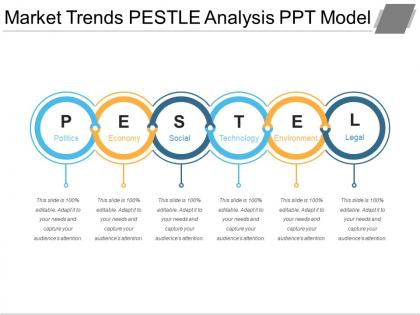
Market trends pestle analysis ppt model




Try Before you Buy Download Free Sample Product
 Impress Your
 Audience
 100%
100% Editable
 Save Hours
 of Time


Attract customers galore with our Market Trends Pestle Analysis Ppt Model. The crowds will continue to grow big.
People who downloaded this PowerPoint presentation also viewed the following :
Market trends pestle analysis ppt model with all 5 slides:
Identify factors causing disparity with our Market Trends Pestle Analysis Ppt Model. Create identical conditions for all.




FAQs for Market trends pestle
PESTLE analysis comprises Political, Economic, Social, Technological, Legal, and Environmental factors that systematically evaluate external business influences. These components interrelate dynamically, with political decisions affecting economic policies, social trends driving technological adoption, and environmental regulations creating legal frameworks, ultimately enabling organizations to anticipate market shifts and strategic opportunities.
Businesses can effectively gather data for PESTLE analysis through government databases, industry reports, regulatory updates, economic forecasts, social surveys, and technology trend analyses. Financial institutions use economic indicators for risk assessment, while healthcare organizations monitor regulatory changes and demographic shifts, ultimately enabling strategic decision-making and competitive positioning in dynamic markets.
PESTLE analysis informs strategic planning by identifying external factors across political, economic, social, technological, legal, and environmental dimensions that could impact business operations. This comprehensive assessment enables companies to anticipate market shifts, regulatory changes, and emerging opportunities, while helping organizations adapt their strategies proactively, ultimately delivering competitive advantage and sustainable growth.
Political factors in PESTLE analysis influence market entry strategies by determining regulatory requirements, trade policies, tax structures, and government stability that affect business operations. Companies must evaluate political risks, compliance costs, and policy changes when selecting entry modes, with many multinational corporations finding that stable political environments enable faster expansion and sustainable competitive advantage.
Technological analysis in PESTLE enables organizations to identify emerging innovations, assess digital disruption risks, and anticipate market shifts through systematic evaluation of technological developments. By analyzing automation trends, AI adoption, and digital transformation patterns, companies across sectors like retail, manufacturing, and financial services can strategically position themselves ahead of competitors, ultimately delivering improved operational efficiency and enhanced customer experiences.
Economic variables identified in PESTLE analysis directly influence pricing strategies through inflation rates, consumer spending power, currency fluctuations, interest rates, and economic growth patterns. Companies leverage these insights to adjust pricing models, optimize market positioning, and maintain competitive advantage, with many retail and manufacturing organizations finding that economic data enables strategic pricing decisions that enhance profitability while meeting customer expectations.
Environmental factors have significantly influenced companies like Unilever shifting to sustainable packaging to meet consumer demand, Tesla capitalizing on clean energy trends, and McDonald's eliminating plastic straws globally. These strategic pivots demonstrate how environmental considerations drive operational changes, product innovation, and supply chain adaptations, with many organizations finding that proactive environmental responsiveness delivers competitive advantage and enhanced brand loyalty.
Social factors in PESTLE analysis significantly influence consumer behavior through demographic shifts, cultural values, lifestyle changes, and evolving social attitudes. These factors shape purchasing decisions by affecting product preferences, brand loyalty, and consumption patterns, with companies like Nike adapting marketing strategies to align with social movements, while retailers modify offerings based on changing family structures, ultimately enabling businesses to anticipate market demands and enhance customer engagement.
PESTLE analysis limitations include static snapshots that may quickly become outdated, subjective interpretations of external factors, potential oversight of interconnected variables, and difficulty quantifying qualitative insights into actionable strategies. While these challenges exist, organizations can enhance accuracy by conducting regular updates, incorporating diverse analytical perspectives, and combining PESTLE with complementary frameworks, ultimately delivering more comprehensive strategic planning.
PESTLE analysis integrates seamlessly with SWOT by providing external environment insights that inform opportunities and threats, while combining with Porter's Five Forces to analyze how political, economic, and social factors influence competitive dynamics. This strategic combination enables organizations to develop comprehensive market strategies, with many consulting firms and corporations finding that integrated frameworks deliver deeper insights, enhanced risk assessment, and more robust strategic planning than standalone approaches.
Key political indicators businesses should monitor include regulatory policy shifts, election outcomes, trade agreement changes, government stability measures, and legislative priorities affecting their sectors. Through systematic tracking of these factors, organizations in healthcare, finance, and manufacturing can anticipate regulatory changes, adjust strategic planning accordingly, and maintain competitive advantage in increasingly dynamic political environments.
Companies leverage PESTLE analysis to enhance sustainability initiatives by evaluating political regulations, economic incentives, social expectations, technological innovations, legal requirements, and environmental impacts across their operations. This comprehensive assessment enables organizations to identify strategic opportunities, align sustainability goals with stakeholder expectations, and develop competitive advantages, with many finding that systematic analysis ultimately delivers measurable environmental benefits and enhanced brand reputation.
Businesses should adapt their PESTLE analysis by conducting more frequent reviews, incorporating real-time data monitoring, expanding geographic scope, and integrating scenario planning for multiple futures. Companies increasingly use digital tools and cross-functional teams to track rapid shifts, with many organizations moving from annual to quarterly assessments, ultimately enabling faster strategic pivots and enhanced competitive positioning.
Small businesses can utilize PESTLE analysis by identifying market gaps, regulatory advantages, and technological opportunities that larger corporations may overlook due to their size and complexity. Through focused analysis, small businesses can pivot quickly to capitalize on political changes, economic shifts, and social trends, while leveraging local environmental factors and legal niches, ultimately delivering agility and specialized customer experiences that larger competitors cannot easily replicate.
Emerging trends for PESTLE analysis include artificial intelligence regulations, climate change policies, remote work legislation, cryptocurrency frameworks, and social media governance. These developments significantly impact business operations across sectors, with companies in financial services, healthcare, and retail finding that incorporating digital transformation policies, sustainability mandates, and evolving consumer privacy expectations delivers competitive advantage and strategic foresight.
-
Easy to edit slides with easy to understand instructions.
-
Nice and innovative design.