


Marketing And Advertising Campaign Communication Plan Schedule




Try Before you Buy Download Free Sample Product
 Impress Your
 Audience
 100%
100% Editable
 Save Hours
 of Time


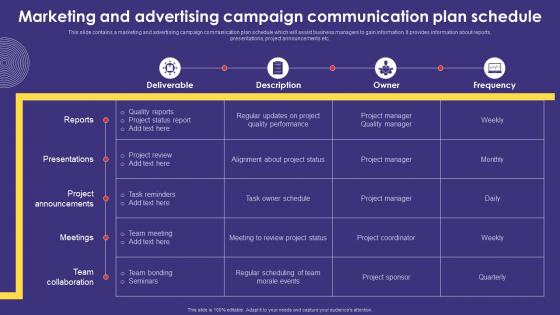
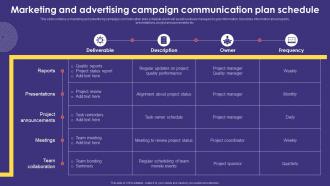
This slide contains a marketing and advertising campaign communication plan schedule which will assist business managers to gain information. It provides information about reports, presentations, project announcements etc.
People who downloaded this PowerPoint presentation also viewed the following :
Marketing And Advertising Campaign Communication Plan Schedule with all 6 slides:
Use our Marketing And Advertising Campaign Communication Plan Schedule to effectively help you save your valuable time. They are readymade to fit into any presentation structure.





FAQs for Marketing And Advertising Campaign
Key components include target audience analysis, clear messaging strategy, channel selection, budget allocation, timeline development, and performance metrics. These elements work together by ensuring consistent brand messaging across multiple touchpoints, optimizing resource allocation, and enabling measurable results, with many organizations finding that strategic integration of these components delivers enhanced customer engagement and stronger competitive positioning.
Businesses measure marketing communication success through key performance indicators including conversion rates, brand awareness metrics, customer engagement levels, return on investment calculations, and lead generation statistics. Through digital analytics platforms, surveys, and sales tracking, companies streamline performance evaluation, enhance strategic decision-making, and optimize resource allocation, with many organizations finding that integrated measurement approaches deliver significantly improved campaign effectiveness and competitive advantage.
Audience segmentation enables marketers to tailor messages, channels, and timing to specific customer groups based on demographics, behaviors, preferences, and needs. By dividing broader markets into targeted segments, companies like retail brands and financial services deliver more personalized campaigns, improve engagement rates, and optimize resource allocation, ultimately achieving higher conversion rates and stronger customer relationships.
Social media integrates into marketing communication strategies by enabling targeted audience engagement, real-time customer interactions, and amplified brand messaging across multiple platforms. Through strategic content calendars, paid advertising campaigns, and community management, businesses streamline customer touchpoints, enhance brand visibility, and drive measurable conversions, with many organizations finding that integrated social approaches deliver significantly higher engagement rates and cost-effective customer acquisition.
Common pitfalls include unclear target audience definition, inconsistent messaging across channels, unrealistic budget allocation, lack of measurable objectives, and poor timing coordination. These mistakes often result from insufficient market research, inadequate cross-team collaboration, and failure to align with broader business goals, with many organizations finding that comprehensive planning and regular strategy reviews significantly improve campaign effectiveness and ROI.
Brand messaging influences marketing communication by establishing consistent tone, value propositions, and key themes across all channels, from advertising and social media to email campaigns and sales presentations. This strategic consistency enables companies to build stronger brand recognition, enhance customer trust, and differentiate themselves from competitors, with many organizations finding that unified messaging significantly improves campaign effectiveness and customer engagement rates.
Startups can leverage social media marketing, content creation, email campaigns, influencer partnerships, and community engagement to build effective communication plans on minimal budgets. These strategies enable cost-effective brand building through organic reach, targeted messaging, and authentic relationships, with many startups finding that consistent, value-driven content ultimately delivers stronger customer connections than expensive traditional advertising.
Visual elements enhance marketing communication plans by increasing engagement, improving message retention, simplifying complex information, and strengthening brand recognition across multiple channels. Through infographics, videos, and branded graphics, companies streamline their messaging while delivering faster comprehension and emotional connection, with many organizations finding that visual-first strategies significantly boost campaign performance and customer response rates.
Push marketing involves proactively delivering messages to consumers through advertising, direct mail, sales promotions, and trade shows, while pull marketing attracts customers through content marketing, SEO, social media engagement, and brand building. Push strategies work best for new product launches, time-sensitive promotions, and B2B sales cycles, while pull approaches excel for long-term brand building, customer retention, and industries where trust and expertise drive purchasing decisions.
Market research informs marketing communication plans by identifying target audience preferences, optimal messaging channels, competitor strategies, and market positioning opportunities. Through consumer surveys, focus groups, and behavioral analytics, organizations can tailor their communication approaches, select effective media platforms, and craft resonant messages, ultimately delivering higher engagement rates and improved campaign ROI.
Consistency in messaging across marketing channels builds brand recognition, establishes trust, and reinforces core value propositions through unified communication. This strategic approach enables companies to deliver cohesive customer experiences, minimize confusion, and strengthen brand recall, with many organizations finding that consistent messaging increases revenue visibility and enhances competitive positioning in increasingly crowded markets.
Storytelling engages audiences by creating emotional connections, making complex messages relatable, and building memorable brand experiences that resonate across different customer segments. Through narrative-driven campaigns, companies in sectors like retail and healthcare can transform product features into compelling customer journeys, ultimately delivering stronger engagement rates, improved brand recall, and deeper audience loyalty.
Key metrics include brand awareness levels, engagement rates, conversion percentages, customer acquisition costs, and return on marketing investment across channels. These measurements enable organizations to optimize their communication strategies by identifying high-performing campaigns, reallocating resources effectively, and enhancing customer touchpoints, with many companies finding that integrated tracking ultimately delivers improved ROI and stronger market positioning.
A marketing communication plan adapts through continuous market research, flexible messaging strategies, multi-channel optimization, real-time performance monitoring, and agile campaign adjustments. These approaches enable organizations to pivot messaging, reallocate budgets, and modify tactics quickly, with many brands finding that data-driven adaptability delivers sustained engagement and competitive advantage in increasingly dynamic markets.
Cross-departmental collaboration enhances marketing communication plans through aligned messaging, shared customer insights, coordinated campaign timing, integrated resource allocation, and unified brand representation. Sales teams provide frontline customer feedback, product teams ensure accurate feature communication, and customer service identifies pain points, ultimately delivering consistent experiences across all touchpoints while maximizing campaign effectiveness and ROI.
-
What an exhaustive collection of templates you guys have there in slideteam. Impressive!!!
-
Innovative and attractive designs.