


Marketing Mix Travel Agency Company Profile





Try Before you Buy Download Free Sample Product
 Impress Your
 Audience
 100%
100% Editable
 Save Hours
 of Time


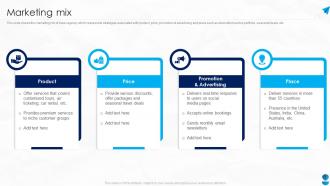
This slide shows the marketing mix of travel agency which represents strategies associated with product, price, promotion and advertising and place such as diversified service portfolio, seasonal deals, etc.
People who downloaded this PowerPoint presentation also viewed the following :
Marketing Mix Travel Agency Company Profile with all 6 slides:
Use our Marketing Mix Travel Agency Company Profile to effectively help you save your valuable time. They are readymade to fit into any presentation structure.





FAQs for Marketing Mix Travel
The key components include product (travel packages, destinations, accommodations), price (competitive rates, dynamic pricing strategies), place (online platforms, physical offices, travel partners), and promotion (digital marketing, social media campaigns, influencer partnerships). These elements work together by creating comprehensive customer experiences, streamlining booking processes, and building brand visibility, with many travel agencies finding that strategic integration ultimately delivers higher customer satisfaction and competitive market positioning.
Travel agencies can utilize the 4Ps by offering diverse packages and personalized experiences (Product), implementing dynamic pricing strategies with competitive rates (Price), establishing both physical locations and robust digital platforms (Place), and leveraging social media campaigns with influencer partnerships (Promotion). This strategic combination enables agencies to enhance customer experiences, streamline booking processes, and maximize market reach, with many finding that integrated approaches ultimately deliver higher conversion rates and sustainable competitive advantage.
Digital marketing serves as the cornerstone of modern travel agencies' marketing mix, encompassing social media campaigns, search engine optimization, email marketing, influencer partnerships, and targeted advertising across multiple platforms. Through these digital channels, travel agencies streamline customer acquisition, enhance personalized experiences, and deliver real-time engagement, with many agencies finding that integrated digital strategies significantly reduce marketing costs while expanding their global reach and competitive advantage.
Travel agencies can differentiate through specialized niche expertise, personalized customer experiences, exclusive partnerships with local providers, innovative technology integration, and value-added services like 24/7 support. These strategies enable agencies to command premium pricing, build customer loyalty, and establish competitive advantages, with many boutique agencies finding that specialized focus on specific destinations or traveler demographics delivers stronger market positioning than generic offerings.
Travel agencies employ tiered pricing, dynamic pricing based on demand fluctuations, package bundling, early booking discounts, and segment-specific pricing strategies. These approaches enable agencies to attract budget-conscious travelers through competitive rates, premium customers through exclusive packages, and business clients through flexible booking options, ultimately delivering enhanced market penetration and revenue optimization across diverse customer segments.
Travel agencies should diversify distribution channels through online booking platforms, direct website sales, social media marketing, partner travel agents, and mobile applications. This multi-channel approach enables agencies to reach broader audiences, reduce dependency on single platforms, and optimize booking conversions, while many agencies finding that strategic channel combinations ultimately deliver enhanced customer accessibility and operational efficiency.
Digital content marketing, social media engagement, influencer partnerships, personalized email campaigns, and user-generated content have emerged as the most effective promotional tactics for travel agencies. These strategies enhance customer engagement by showcasing authentic experiences, building trust through peer recommendations, and delivering targeted offers, with many agencies finding that combining visual storytelling with personalized communication significantly increases bookings and customer loyalty.
Customer experiences and testimonials primarily enhance the promotion element of travel agencies' marketing mix by providing authentic social proof, building credibility, and influencing potential travelers' decisions through peer recommendations. These testimonials streamline trust-building across digital platforms, referral programs, and content marketing, with many agencies finding that positive customer stories significantly boost conversion rates, enhance brand reputation, and deliver competitive advantage in an increasingly crowded marketplace.
Social media influences travel agencies' marketing mix by enhancing product visibility through user-generated content, enabling dynamic pricing strategies, expanding distribution channels beyond traditional platforms, and facilitating targeted promotional campaigns. Through Instagram showcases and Facebook advertising, agencies streamline customer engagement, accelerate booking processes, and deliver personalized experiences, with many travel businesses finding that social platforms ultimately reduce acquisition costs while building stronger customer relationships.
Partnerships and collaborations are essential for travel agencies, enabling expanded destination portfolios, enhanced service offerings, and shared marketing resources while reducing operational costs. Through strategic alliances with airlines, hotels, local tour operators, and technology providers, agencies deliver comprehensive travel experiences, access broader customer bases, and leverage combined expertise, ultimately creating competitive advantages and more compelling value propositions for travelers.
Innovative travel products include personalized AI-curated itineraries, virtual reality destination previews, sustainable eco-tourism packages, multi-generational family experiences, and digital nomad workation bundles. These offerings differentiate agencies by addressing evolving customer preferences, enhancing booking confidence through immersive previews, and targeting emerging market segments, ultimately delivering competitive advantage and increased customer loyalty.
Travel agencies maintain balance by integrating digital campaigns with traditional touchpoints, combining social media advertising with local partnerships, print materials with personalized online experiences, and virtual consultations with in-person events. This strategic approach enables agencies to reach diverse customer segments across multiple channels while maximizing engagement, with many finding that hybrid strategies deliver enhanced brand visibility and stronger customer relationships.
Seasonal trends significantly impact travel agencies' marketing mix strategies by requiring dynamic pricing adjustments, targeted promotional campaigns, and flexible service offerings throughout the year. Agencies strategically enhance winter ski packages while promoting summer beach destinations, adjust distribution channels for peak booking periods, and modify advertising spend timing, ultimately delivering optimized revenue streams and competitive positioning in fluctuating demand cycles.
Travel agencies should adapt their marketing mix by offering sustainable tour packages with eco-certified accommodations, implementing carbon offset programs, and partnering with environmentally responsible local operators. Through digital-first promotion highlighting green credentials and transparent sustainability practices, agencies can attract eco-conscious travelers while differentiating themselves in an increasingly environmentally aware market, ultimately delivering competitive advantage and enhanced customer loyalty.
Travel agencies should track conversion rates from inquiries to bookings, customer acquisition costs across channels, average booking value, customer lifetime value, and brand awareness metrics. These measurements enable agencies to optimize their promotional strategies, pricing models, and distribution partnerships by identifying which marketing elements deliver the highest ROI, ultimately enhancing operational efficiency and competitive positioning in an increasingly digital travel landscape.
-
I was never satisfied with my own presentation design but SlideTeam has solved that problem for me. Thank you SlideTeam!
-
I am glad to have come across Slideteam. I was searching for some unique presentations and templates for my business. There are a lot of alternatives available here.