


Marketing plan for real estate project powerpoint presentation slides





Try Before you Buy Download Free Sample Product
 Impress Your
Audience
 100%
Editable
 Save Hours
of Time


Marketing in real estate is as important as other products or services as it maximizes the potential eyes your property will get in front of any channel. The structured plan helps you to identify how you might attract genuine prospects from it. Here is a professionally designed template on Marketing Plan for Real Estate project that will guide you in targeting the market smartly, also encourage your customers to purchase that property. The purpose of this proposal is to get as many qualified buyers through a new and unique marketing plan. Firms can assign a new budget for a new marketing plan and create a new strategy to increase qualified leads. One can present their actual performance and targets for the industry using tables, charts, and infographics. This template lets you exhibit the current marketing plans effect using line charts and presents the companys vision, mission, and objectives. You can display the team members responsible for the project with their names, roles, designation, etc. Businesses get to demonstrate their various marketing goals and ways to achieve them. The proposal shows market segmentation for real estate projects to focus on target buyer client persona. Talk to our experts for all your queries and get access to the market bests template. Download the proposal and book a free demo now.
People who downloaded this PowerPoint presentation also viewed the following :
Content of this Powerpoint Presentation
Slide 1: This slide displays the title i.e. 'Marketing Plan for Real Estate Project' and your Company Name.
Slide 2: This skide presents the agenda for the project.
Slide 3: This slide exhibits the table of contents for the project.
Slide 4: This slide showcases the title for current situation.
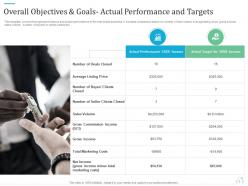
Slide 5: This slide covers the target performance and actual performance of the real estate business.
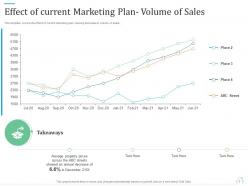
Slide 6: This slide covers the effect of current marketing plan causing decrease in volume of sales.,
Slide 7: This slide displays the title for vision, team and objectives related to project.
Slide 8: This slide covers the specifically, do we want our real estate business to achieve or accomplish in the midterm and long-term?
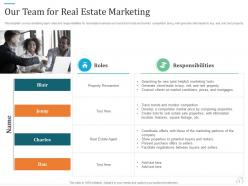
Slide 9: This slide covers marketing team roles and responsibilities for real estate business like track trends along with generate client leads to buy, sell, & rent property.
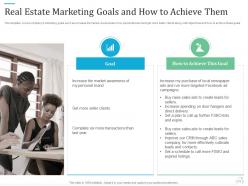
Slide 10: This slide covers company’s marketing goals such as increase the market awareness of our personal brand and get more seller clients along with objectives.
Slide 11: This slide presents the title for identification & analysis.
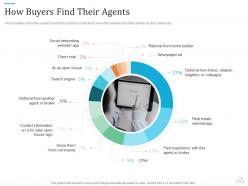
Slide 12: This slide covers the research result of company conducted to know the preferences of the clients/ buyers/ sellers etc.
Slide 13: This slide covers Segmentation is done based on the mentioned parameters such as geographic, demographic, psychographic and referral etc.
Slide 14: This slide exhibits the title for identify your target client.
Slide 15: This slide covers details about who specifically be company’s target customers such as First-time home buyers, Home sellers, renters and details about them.
Slide 16: This slide covers buyer client's persona including location age, income, interested in which type of house and political affiliations etc.
Slide 17: This slide covers seller clients persona including location age, income, interested in which type of house and political affiliations etc.
Slide 18: This slide displays the title for self evaluation.
Slide 19: This slide exhibits the title for USP of real estate company.
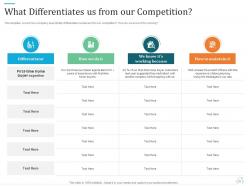
Slide 20: This slide covers how company specifically differentiate ourselves from our competition? How do we know if it’s working?
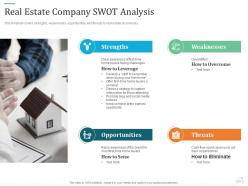
Slide 21: This slide covers strengths, weaknesses, opportunities, and threats to real estate businesses.
Slide 22: This slide displays the title for evaluating competitors.
Slide 23: This slide covers real estate company’s primary competition for this market.
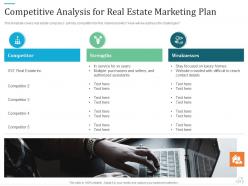
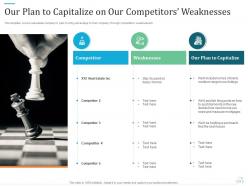
Slide 24: This slide covers real estate company’s plan to bring advantage to their company through competitors weakness etc.
Slide 25: This slide presents the title for marketing planning.
Slide 26: This slide covers real estate company’s marketing materials and methods that will be used to reach our target audience.
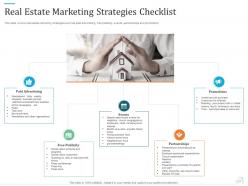
Slide 27: This slide covers real estate marketing strategies such as paid advertising, free publicity, events, partnerships and promotions
Slide 28: This slide covers real estate social media marketing plan along with strategy, and outreach tactics.
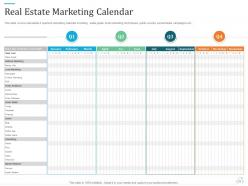
Slide 29: This slide covers real estate 4 quarters marketing calendar including sales goals, local marketing techniques, public events, social media campaigns etc.
Slide 30: This slide covers marketing budget for various categories such as content creation, social advertising, social engagement, software/tools, promotions and contests.
Slide 31: This slide covers real estate company most effective methods of lead generation along with kind of return we see from each
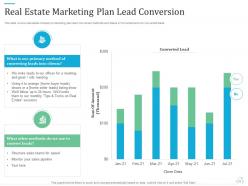
Slide 32: This slide covers real estate company’s marketing plan lead conversion methods and status of converted and non converted leads
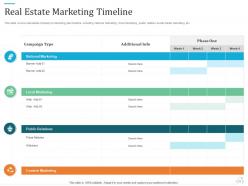
Slide 33: This slide covers real estate company’s marketing plan timeline including national marketing, local marketing, public relation social media marketing etc.
Slide 34: This slide exhibits the title for sales forecasts and performance measuring.
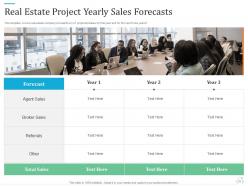
Slide 35: This slide covers real estate company’s breakdown of projected sales for this year and for the next three years.
Slide 36: This slide covers real estate company’s Key performance indicators that are used to measure customer services for real estate company.
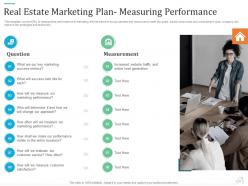
Slide 37: This slide covers KPI’s to measure the performance of marketing efforts where to focus was time and resources to meet the goals.
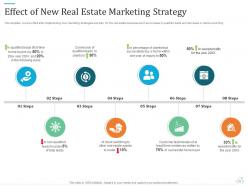
Slide 38: This slide covers effect after implementing new marketing strategies and plan for the real estate business such as increase in qualified leads and decrease in
Slide 39: This slide displays the title for dashboards.
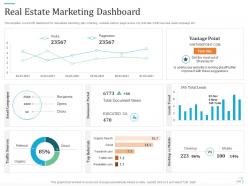
Slide 40: This slide covers KPI dashboard for real estate marketing plan including website visitors, page review, top referrals, traffic sources, email campaign etc.
Slide 41: This slide covers real estate marketing plan KPI’s including metrics such as targets vs actual sales , properties sold , sales by agents etc.
Slide 42: This is the icons slide for the project.
Slide 43: This slide displays the title for additional slides.
Slide 44: This slide showcases the vision, mission, strategies and goals of your company.
Slide 45: This slide exhibits about the company.
Slide 46: This slide showcases details of team members responsibke for the project.
Slide 47: This slide exhibits the goals of the company.
Slide 48: This slide exhibits the linear process of the company.
Slide 49: This slide exhibits the venn of the company.
Slide 50: This slide showcases the posts related to past experiences of clients.
Slide 51: This slide exhibits the yearly timeline of the company.
Slide 52: This slide displays the 30-60-90 days plan for your project.
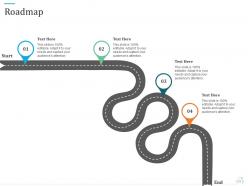
Slide 53: This slide exhibits the roadmap of the company.
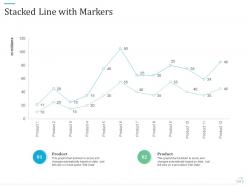
Slide 54: This slide explains the stacked line charts for different products.
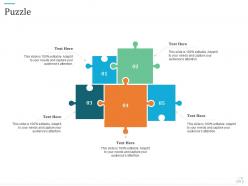
Slide 55: This slide explains the puzzle for your company.
Slide 56: This slide presents the SWOT of your company.
Slide 57: This is the thank you slide and displays the contact details of the company i.e. office address, contact number, etc.
Marketing plan for real estate project powerpoint presentation slides with all 57 slides:
Use our Marketing Plan For Real Estate Project Powerpoint Presentation Slides to effectively help you save your valuable time. They are readymade to fit into any presentation structure.























FAQs for Marketing plan for real estate project
So you'll need target audience analysis, clear objectives, competitive research, and your marketing mix - the 4 Ps thing (product, price, place, promotion). Budget's probably most critical though since that determines what you can actually pull off. Most people totally skip competitive research but honestly it's huge. Also timelines and specific tactics for each channel. Oh and metrics to track if it's working or not. Start with nailing your target audience first - everything builds from there. Once you know who you're reaching and what they actually care about, the rest gets way easier to figure out.
Honestly, market research is just getting the real info instead of shooting in the dark. You'll figure out who actually buys your stuff and what makes them tick. That way your messaging doesn't fall flat. It also shows you where competitors are screwing up - which is honestly pretty satisfying to see. You can spot market gaps too. The pricing piece is huge because you'll know what people will actually pay vs. what you think they should pay. Best channels to reach them become obvious. Just don't treat the data like gospel though. Keep testing and tweaking based on what you learn.
Okay so audience segmentation is literally the foundation of everything you do marketing-wise. Don't make the mistake of sending identical messages to your whole list - I've watched companies burn through budgets doing exactly that. Break people into groups based on demographics, what they actually do, or what problems they're facing. Then craft different messages for each segment. Way better results, less money down the drain. Honestly, even just starting with 2-3 solid segments will change your conversion rates completely. You'll actually connect with people instead of shouting into the void.
Honestly, figure out what you actually want first - like 30% more brand awareness or 500 leads per quarter. Skip the vague "grow our presence" stuff, it's basically meaningless. Pick KPIs that match those goals directly. Want leads? Track conversion rates and cost per lead, not follower counts (learned that the hard way). I used to obsess over every metric until I realized most were just distracting me from what mattered. Stick to maybe 3-5 KPIs that actually tell you if you're crushing it or failing.
Honestly, I swear by the 70-20-10 breakdown - put most of your money (70%) into stuff that's already working for you, then 20% improving what you've got, and 10% testing weird new ideas. Track your customer acquisition cost vs what they'll actually spend with you over time. Sounds obvious but so many people mess this up. Oh, and definitely keep like 15-20% as a buffer. You'll need it when something suddenly takes off and you want to double down fast. The key thing is making sure every dollar you spend connects to something you can actually measure. That way you're not just throwing money around hoping something sticks.
Dude, check your actual customer data first - where are they *really* spending time? Instagram, LinkedIn during their coffee break, old-school industry emails? I swear, half the businesses I know jumped on TikTok because everyone said they should, but their customers are like 45-year-old B2B buyers who've never opened the app. Pick 2-3 channels max to start. Track what actually drives sales, not just engagement vanity metrics. Oh, and don't spread yourself too thin - that's how you end up posting mediocre content everywhere instead of killing it somewhere specific.
Track stuff like conversion rates, cost per acquisition, and ROI - those actually matter for your bottom line. Email open rates and social engagement tell you if people care about what you're putting out there. Website traffic's good too, especially for content stuff. Honestly? Skip follower counts unless they're buying from you. Customer lifetime value is huge but most people forget about it. Set up maybe 6-7 metrics you can check weekly so you're not flying blind. Way better to catch problems early than realize months later your campaigns were trash.
Here's my take: put quarterly checkpoints in your marketing plan and leave some budget open for random opportunities that pop up. Watch engagement rates and traffic patterns - they'll warn you before things go sideways. TikTok caught us completely off guard because we'd already blown through our budget (ugh). I check industry news every week now and have clear triggers for when to switch tactics. Oh, and test small first! Like really small. You don't want to dump money into something that tanks. Those early signals matter way more than waiting for final results.
Figure out what pain point you're actually solving first - that's your starting point. Then get super specific about how you fix it differently than everyone else. Don't just say "better service" because that's what literally everyone claims. I hate when companies use words like "innovative" - it means nothing, honestly. Be concrete about results instead. Like, what exact outcome do people get? Test it with real customers too, because what sounds good in your head might be confusing to them. Your final pitch should be simple enough that someone could repeat it to their friend without stumbling over the words.
Figure out where your people actually spend time online first - don't spread yourself too thin everywhere. Instagram's great for brand stuff, LinkedIn if you're doing B2B, and TikTok for Gen Z (though I still don't totally get the algorithm). Make content that actually fits each platform instead of posting the same thing across all of them. Consistency beats perfection every time. Get a content calendar going and stick to it, even when you don't feel like it. Check your analytics regularly - double down on what's working and ditch the rest. Honestly, most people overthink this way too much.
Honestly, content marketing is way more effective than those annoying ads everyone skips. Start with whatever format feels natural to you - maybe blog posts or short videos. The trick is actually helping people solve problems instead of just pushing your stuff constantly. Pick where your customers already spend time online and show up there regularly. I'd focus on one type of content first though, otherwise you'll burn out trying to do everything. Share what you know best. Once you see what gets people engaged, do more of that. It's basically like being the helpful friend in your industry - people remember that and trust you for it.
Honestly, short-form video is where it's at right now - TikTok, Reels, all that stuff. People also want everything personalized these days, which makes sense but is kinda exhausting from a marketing perspective. Sustainability messaging isn't optional anymore either (seriously, even my neighbor asks about eco-friendly packaging now). Community building is massive too. Instead of just pushing ads, brands need to make people feel like they're part of something. I'd probably audit what you're doing now and pick one area to really focus on first. Don't try to do everything at once - that's a recipe for burnout.
Dude, SEO is actually a game-changer for getting your stuff seen by people who are already looking for it. I'd start with keyword research - figure out what people are actually googling. Google Keyword Planner is free (though SEMrush is better if you can swing it). Then just work those keywords into your pages and blog posts naturally. Honestly? Go for long-tail keywords first - way easier to rank for "best pizza delivery downtown Seattle" than just "pizza." The whole thing seems intimidating but it's really just about answering questions your customers actually have. Oh, and don't forget your meta descriptions!
Budget overruns are the obvious one - campaigns always cost more than planned. Then there's performance falling flat, competitors copying your moves, or market shifts like recessions killing spending power. Team stuff matters too - what if your star designer quits mid-campaign? Tech platforms love screwing with algorithms (Instagram's the worst for this). Your messaging could totally backfire and create a PR nightmare. Economic stuff can blindside you fast. The key is writing this all down beforehand with backup plans, because when things go sideways you won't have time to think clearly.
Honestly, just work backwards from your launch date - makes everything way clearer. Map out your main marketing stuff first, then break it into phases: pre-launch, launch, post-launch. Don't forget dependencies though! Like your content team needs to wrap up blog posts before social can do their thing. I'm obsessed with Trello for this, but a basic spreadsheet works too. Monthly milestones are good, then chop those into weekly tasks. Oh, and always add buffer time because literally everything takes longer than you think it will.
-
Great quality slides in rapid time.
-
The Designed Graphic are very professional and classic.
-
Understandable and informative presentation.
-
Top Quality presentations that are easily editable.