


Marketing Plan For Retail Bank Branches





Try Before you Buy Download Free Sample Product
 Impress Your
 Audience
 100%
100% Editable
 Save Hours
 of Time


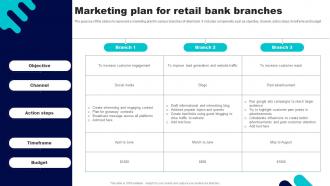
The purpose of this slide is to represent a marketing plan for various branches of retail bank. It includes components such as objective, channel, action steps, timeframe and budget.
People who downloaded this PowerPoint presentation also viewed the following :
Marketing Plan For Retail Bank Branches with all 6 slides:
Use our Marketing Plan For Retail Bank Branches to effectively help you save your valuable time. They are readymade to fit into any presentation structure.





FAQs for Marketing Plan For
A successful retail banking marketing plan includes comprehensive market analysis, targeted customer segmentation, competitive positioning strategies, multi-channel campaign development, and robust performance metrics. These components work together by identifying high-value customer segments, developing personalized financial solutions, and leveraging digital platforms alongside traditional banking channels, ultimately delivering enhanced customer acquisition, improved retention rates, and measurable revenue growth across diverse banking services.
Retail banks differentiate themselves through personalized digital experiences, competitive product offerings, exceptional customer service, strategic partnerships, and community engagement initiatives. By leveraging data analytics for targeted marketing, streamlining mobile banking platforms, and offering specialized services like financial wellness programs, banks create distinctive value propositions that foster customer loyalty and competitive advantage.
Customer segmentation enables retail banks to tailor marketing strategies by demographics, financial behaviors, product usage patterns, and lifecycle stages, creating personalized campaigns that resonate with specific customer groups. Through targeted approaches, banks deliver relevant product recommendations, customized communication channels, and strategic pricing models, ultimately enhancing customer acquisition rates and retention while maximizing cross-selling opportunities across diverse market segments.
Data analytics enhances retail banking targeting by analyzing customer transaction histories, demographic patterns, spending behaviors, and life stage indicators to create precise customer segments. Through predictive modeling and machine learning algorithms, banks can deliver personalized product recommendations, optimize campaign timing, and customize messaging across digital channels, ultimately increasing conversion rates and customer engagement while reducing marketing costs.
Social media platforms, email marketing, search engine optimization, content marketing, and mobile app advertising are most effective for reaching retail banking customers. These channels streamline customer acquisition by delivering personalized financial content, targeted promotional offers, and seamless account access, with many banks finding that integrated digital approaches significantly enhance customer engagement and ultimately drive higher conversion rates.
Retail banks can leverage social media by sharing educational financial content, responding promptly to customer inquiries, showcasing community involvement, offering personalized financial tips, and creating interactive campaigns around financial wellness. Through strategic social media engagement, banks streamline customer communication, build trust through transparency, and deliver enhanced digital experiences, with many institutions finding that consistent, value-driven content significantly strengthens customer relationships and competitive positioning.
Retail banking marketing compliance requires implementing robust review processes, training staff on advertising regulations, maintaining transparent pricing disclosures, ensuring data privacy protection, and establishing audit trails for all campaigns. Financial institutions must navigate complex regulations like Truth in Lending Act and GDPR requirements, with many banks finding that proactive compliance frameworks ultimately streamline campaign approvals while minimizing regulatory risks.
Retargeting campaigns improve retail banking customer acquisition by re-engaging prospects who previously visited banking websites, viewed loan products, or abandoned account applications. These targeted advertisements deliver personalized messaging about specific services like mortgages, credit cards, or savings accounts, with many banks finding that retargeted prospects convert at significantly higher rates than cold audiences, ultimately reducing acquisition costs and accelerating customer onboarding processes.
Effective retail banking loyalty programs incorporate personalized rewards based on customer behavior, tiered benefits that encourage account growth, financial education components, and seamless digital integration across all touchpoints. These programs resonate by offering practical value like fee waivers, higher interest rates, and exclusive financial advisory services, with many banks finding that relationship-focused rewards significantly enhance customer retention and cross-selling opportunities.
Retail banks can effectively utilize customer feedback by analyzing survey data, social media sentiment, transaction patterns, and service interactions to identify pain points and preferences. Through advanced analytics platforms, banks streamline product development, personalize messaging, and enhance digital experiences, with many financial institutions finding that feedback-driven strategies deliver higher engagement rates and ultimately strengthen customer loyalty while reducing acquisition costs.
Emerging retail banking trends include digital-first customer experiences, AI-powered personalization, embedded finance solutions, sustainable banking products, and omnichannel service integration. These technologies enhance customer engagement by streamlining account management, delivering targeted financial recommendations, and enabling seamless cross-platform interactions, with many banks finding that proactive digital strategies significantly improve customer retention and competitive positioning.
**INPUT**: How can partnerships and collaborations enhance the marketing efforts of retail banks? **OUTPUT**: Partnerships enhance retail banking marketing by expanding customer reach, sharing acquisition costs, and leveraging complementary expertise through fintech collaborations, retailer alliances, and cross-industry partnerships. These strategic combinations enable banks to access new demographics, offer integrated financial services within existing customer journeys, and deliver enhanced digital experiences, while reducing marketing expenses and accelerating market penetration in an increasingly competitive landscape. [Word count: 59 words]
Content marketing educates retail banking customers by simplifying complex financial products, addressing common concerns through blogs and videos, and building trust through transparent communication. Through targeted content strategies, banks enhance customer understanding of mortgages, savings accounts, and investment options, while reducing support inquiries and accelerating product adoption, ultimately delivering better customer experiences and increased engagement.
Retail banks can measure marketing campaign success through customer acquisition metrics, conversion rates, digital engagement analytics, brand awareness surveys, and return on investment calculations. These measurement approaches enable banks to track loan applications, credit card sign-ups, and mobile app downloads while optimizing campaign performance, with many financial institutions finding that comprehensive analytics ultimately deliver improved customer targeting and enhanced marketing efficiency.
Retail banks should adopt strategies including local event sponsorships, financial literacy workshops, community partnership programs, neighborhood branch initiatives, and social media community building. These approaches enhance brand visibility while delivering genuine value, with many institutions finding that active community involvement, combined with educational content and grassroots marketing, ultimately strengthens customer loyalty and drives sustainable local market growth.
-
Excellent Designs.
-
Content of slide is easy to understand and edit.