


Marketing Strategy Roadmap For Retail Company




Try Before you Buy Download Free Sample Product
 Impress Your
 Audience
 100%
100% Editable
 Save Hours
 of Time


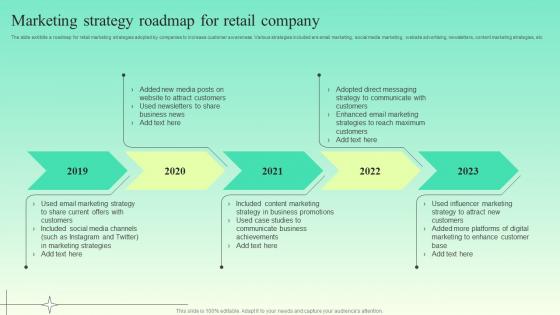
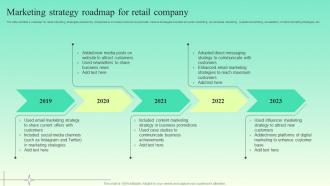
The slide exhibits a roadmap for retail marketing strategies adopted by companies to increase customer awareness. Various strategies included are email marketing, social media marketing, website advertising, newsletters, content marketing strategies, etc
People who downloaded this PowerPoint presentation also viewed the following :
Marketing Strategy Roadmap For Retail Company with all 6 slides:
Use our Marketing Strategy Roadmap For Retail Company to effectively help you save your valuable time. They are readymade to fit into any presentation structure.





FAQs for Marketing Strategy Roadmap
Key components of an effective marketing strategy roadmap include target audience analysis, competitive positioning, channel selection, budget allocation, and performance metrics. These elements work together by aligning resources with market opportunities, streamlining campaign execution, and enabling data-driven optimization, with many organizations finding that strategic roadmaps deliver measurable ROI improvements and sustainable competitive advantage.
A marketing strategy roadmap aligns with business objectives by mapping marketing initiatives to revenue goals, customer acquisition targets, and market expansion plans. Through strategic milestone planning, companies streamline campaign timing with product launches, sales cycles, and budget allocations, ultimately delivering measurable ROI and competitive advantage in increasingly dynamic markets.
Tools for creating marketing strategy roadmaps include Gantt chart software like Microsoft Project, visual collaboration platforms such as Miro and Lucidchart, strategic planning tools like Roadmunk, and presentation software including PowerPoint with timeline templates. These technologies streamline campaign planning, resource allocation, and stakeholder alignment by enabling real-time collaboration, automated progress tracking, and dynamic visual updates, with many marketing teams finding that integrated roadmap tools ultimately enhance cross-functional coordination and accelerate campaign execution timelines.
Marketing strategy roadmaps should be reviewed quarterly and updated annually, with additional revisions triggered by significant market shifts, competitive changes, or performance deviations. This cadence enables organizations to maintain strategic alignment while adapting to evolving customer behaviors, emerging technologies, and business priorities, ultimately delivering sustained competitive advantage and optimized resource allocation.
Market research provides the foundational insights that inform target audience identification, competitive positioning, market opportunities, and customer behavior patterns within a marketing strategy roadmap. Through comprehensive data analysis, businesses can prioritize high-impact initiatives, allocate resources strategically, and anticipate market shifts, ultimately delivering more targeted campaigns and stronger ROI across their marketing investments.
Measurable goals integrate into marketing strategy roadmaps through specific KPIs, defined timelines, milestone checkpoints, and performance tracking systems that align with business objectives. These quantifiable targets enable marketing teams to monitor campaign effectiveness, adjust tactics based on real-time data, and demonstrate ROI to stakeholders, ultimately delivering strategic accountability and competitive advantage.
Effective communication of marketing strategy roadmaps requires clear visual presentations, regular progress updates, stakeholder-specific messaging, defined success metrics, and transparent timelines. Through structured quarterly reviews and targeted dashboards, organizations streamline alignment across departments, enhance resource allocation, and minimize miscommunication, with many companies finding that consistent stakeholder engagement ultimately delivers stronger campaign execution and measurable ROI improvements.
**INPUT**: How can you ensure that different teams collaborate effectively on the marketing strategy roadmap? **OUTPUT**: Effective collaboration on marketing strategy roadmaps requires establishing clear communication protocols, shared accountability structures, and unified goal-setting frameworks across all participating teams. Through regular cross-functional meetings, integrated project management platforms, and transparent reporting systems, organizations streamline coordination between sales, marketing, product, and customer success teams, ultimately delivering consistent messaging and accelerated campaign execution. [Word count: 54]
Common pitfalls when drafting marketing strategy roadmaps include lack of clear objectives, unrealistic timelines, insufficient budget allocation, poor audience targeting, and inadequate performance metrics. These oversights often result in misaligned campaigns and wasted resources, with many organizations finding that addressing these foundational elements upfront streamlines execution, enhances ROI, and ultimately delivers more cohesive customer experiences across all channels.
A marketing strategy roadmap can be tailored by segmenting audiences based on demographics, behaviors, preferences, and purchasing patterns, then customizing messaging, channels, and timing accordingly. Through targeted content strategies, retail brands enhance customer engagement while financial services streamline lead nurturing, with many organizations finding that audience-specific roadmaps deliver higher conversion rates and improved ROI.
Essential metrics include conversion rates, customer acquisition cost, return on investment, brand awareness levels, and customer lifetime value. These measurements enable organizations to assess campaign effectiveness, optimize resource allocation, and demonstrate strategic impact, with many companies finding that tracking these metrics ultimately delivers enhanced decision-making capabilities and sustained competitive advantage.
Consumer behavior analysis influences marketing strategy roadmaps by identifying target audience preferences, purchasing patterns, decision-making triggers, and channel behaviors that guide strategic planning. These insights enable marketers to prioritize high-impact initiatives, allocate resources toward proven customer touchpoints, and sequence campaigns based on buyer journey stages, ultimately delivering more personalized experiences and improved conversion rates.
Incorporating digital marketing trends delivers enhanced customer targeting, real-time analytics, cost-effective campaigns, improved engagement rates, and greater scalability across channels. These strategic integrations enable organizations to optimize resource allocation, respond quickly to market shifts, and personalize customer experiences, with many companies finding that trend-responsive roadmaps ultimately deliver competitive advantage and measurable ROI growth.
A marketing strategy roadmap aligns immediate tactical initiatives with overarching strategic objectives by establishing clear timelines, resource allocation, and performance metrics across multiple horizons. Through integrated planning, organizations can execute quarterly campaigns while building brand equity and market position, with many companies finding that structured roadmaps deliver both quick wins and sustainable competitive advantage.
Feedback loops integrate into marketing strategy roadmaps through regular performance reviews, customer surveys, campaign analytics, A/B testing protocols, and stakeholder input sessions. These mechanisms enable marketers to identify optimization opportunities, adjust targeting parameters, and refine messaging strategies in real-time, with many organizations finding that systematic feedback integration delivers improved ROI and enhanced customer engagement across campaigns.
-
I came across many PowerPoint presentations with excellent creatives and I believe they would be beneficial to my work.
-
Unique design & color.