


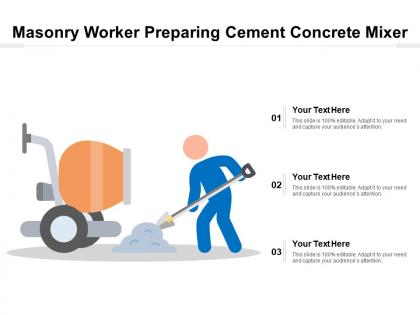
Masonry worker preparing cement concrete mixer




Try Before you Buy Download Free Sample Product
 Impress Your
 Audience
 100%
100% Editable
 Save Hours
 of Time


Our Masonry Worker Preparing Cement Concrete Mixer are explicit and effective. They combine clarity and concise expression.
People who downloaded this PowerPoint presentation also viewed the following :
Masonry worker preparing cement concrete mixer with all 2 slides:
Give your audience a fulfilling experience. They will find our Masonry Worker Preparing Cement Concrete Mixer elevating.

FAQs for Masonry worker preparing
Fundamental masonry materials include brick, stone, concrete blocks, mortar, and reinforcing steel, each contributing distinct structural and aesthetic properties. These materials deliver exceptional durability through compressive strength, weather resistance, and thermal mass, with many commercial buildings, residential developments, and infrastructure projects finding that proper material selection significantly reduces maintenance costs while enhancing long-term structural integrity.
Mortar selection significantly impacts masonry wall strength through bond quality, compressive capacity, and weather resistance, with stronger mortars like Type S providing enhanced structural performance while weaker lime-based options offer flexibility for older buildings. Through proper mortar matching, construction projects achieve optimal load distribution, moisture management, and thermal movement accommodation, with many architects finding that strategic mortar selection ultimately delivers improved longevity and reduced maintenance costs.
Traditional masonry relies on lime mortar, hand-cut stones, and time-intensive manual methods, while modern techniques utilize Portland cement, engineered blocks, and power tools for faster construction. These approaches present both heritage preservation opportunities and efficiency demands, with many construction firms finding that combining traditional craftsmanship with modern materials delivers enhanced durability and competitive project timelines.
Masonry contributes to energy efficiency through thermal mass properties, natural insulation capabilities, and strategic design integration that regulates indoor temperatures. By absorbing heat during warm periods and releasing it gradually, masonry walls reduce HVAC demands in commercial buildings and residential structures, with many architects finding that stone and brick construction delivers significant energy cost reductions.
Local building codes influence masonry practices by establishing structural requirements, material specifications, seismic standards, and safety protocols that vary by geographic region and climate conditions. These regulations shape construction methods, mortar mix ratios, and reinforcement techniques, with contractors in earthquake-prone areas like California adopting enhanced steel reinforcement systems, while northern regions prioritize freeze-thaw resistance, ultimately ensuring structural integrity and community safety.
Masonry offers significant environmental benefits including thermal mass that reduces energy consumption, longevity that minimizes replacement needs, recyclability of materials like brick and stone, and lower embodied carbon compared to steel or concrete. These sustainable characteristics enable construction projects to achieve better energy efficiency ratings, reduce long-term operational costs, and meet increasingly stringent green building standards, with many commercial developers finding that masonry delivers both environmental performance and competitive market advantage.
Maintaining older masonry structures requires regular inspection, repointing deteriorated mortar joints, cleaning with appropriate methods, and addressing water infiltration issues through proper drainage and sealant application. Historic buildings, churches, and institutional facilities increasingly benefit from specialized restoration techniques that preserve original materials while enhancing structural integrity, ultimately extending building lifespan and reducing long-term maintenance costs.
Common masonry challenges include weather delays, material quality inconsistencies, skilled labor shortages, project timeline pressures, and safety compliance requirements. These obstacles can be overcome through strategic planning, comprehensive training programs, and reliable supplier partnerships, with many contractors finding that investing in workforce development and advanced scheduling tools ultimately delivers improved project efficiency and competitive advantage.
Designing a masonry façade requires considering structural load-bearing capacity, thermal performance, moisture management, aesthetic integration, and local building codes. These factors work together by ensuring durability, energy efficiency, and weather resistance, with many commercial developers finding that strategic material selection and proper detailing ultimately deliver reduced maintenance costs and enhanced building performance.
Seismic and weather resistance requirements significantly influence masonry design through reinforced structural systems, flexible mortar joints, proper drainage integration, and strategic material selection. These specifications enable buildings to withstand environmental stresses while maintaining structural integrity, with many architects finding that modern masonry techniques deliver enhanced safety, reduced maintenance costs, and improved longevity in challenging climates.
Current masonry research focuses on self-healing concrete using bacteria or microcapsules, 3D-printed masonry units, bio-based materials from agricultural waste, and smart bricks with integrated sensors. These innovations enhance structural durability, reduce construction timelines, and enable predictive maintenance, with many construction companies finding that advanced materials deliver significant cost savings and improved building performance.
Masonry significantly enhances aesthetic appeal through texture variation, color diversity, pattern flexibility, dimensional depth, and timeless elegance. These elements work together by creating visual interest, establishing architectural character, and delivering sophisticated facades, with many commercial buildings, residential developments, and institutional projects finding that masonry provides distinctive identity while maintaining long-term visual value.
Masonry plays a crucial role in sustainable architecture through its thermal mass properties, durability, and use of natural materials like stone, brick, and recycled concrete. These materials enhance energy efficiency by regulating indoor temperatures, reducing heating and cooling costs, while delivering long-lasting structures that minimize resource consumption, with many green building projects finding significant operational savings.
Technology improves masonry efficiency through automated brick-laying robots, laser-guided alignment systems, Building Information Modeling (BIM) for precise planning, and augmented reality for real-time guidance. These innovations streamline construction by reducing manual labor, minimizing material waste, and accelerating project timelines, with commercial developers finding significantly faster completion rates and enhanced precision.
Best practices for reinforcing masonry structures in disaster-prone areas include installing steel reinforcement bars, adding concrete bond beams, using flexible mortar joints, implementing base isolation systems, and incorporating shear walls. These structural enhancements streamline seismic resistance, improve wind load distribution, and minimize structural failure risks, with many construction firms finding that strategic reinforcement ultimately delivers enhanced safety compliance and long-term building resilience.
No Reviews