


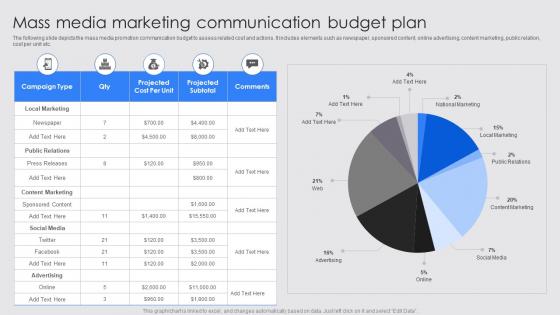
Mass Media Marketing Communication Budget Plan




Try Before you Buy Download Free Sample Product
 Impress Your
 Audience
 100%
100% Editable
 Save Hours
 of Time


The following slide depicts the mass media promotion communication budget to assess related cost and actions. It includes elements such as newspaper, sponsored content, online advertising, content marketing, public relation, cost per unit etc.
People who downloaded this PowerPoint presentation also viewed the following :
Mass Media Marketing Communication Budget Plan with all 7 slides:
Use our Mass Media Marketing Communication Budget Plan to effectively help you save your valuable time. They are readymade to fit into any presentation structure.





FAQs for Mass Media Marketing
Key components include target audience demographics, media channel costs, campaign duration, creative production expenses, and performance measurement tools. These elements work together by ensuring strategic resource allocation across television, radio, and print platforms, with many organizations finding that balancing reach and frequency ultimately delivers maximum brand exposure and competitive market positioning.
Businesses can determine ideal media allocation through audience analytics, channel performance metrics, cost-per-acquisition analysis, and competitive benchmarking across platforms. By testing different combinations and measuring ROI from television, digital, print, and radio investments, organizations streamline budget efficiency while maximizing reach, ultimately delivering stronger brand visibility and customer engagement in increasingly competitive markets.
Key metrics include reach and frequency, brand awareness lift, cost per impression (CPM), return on advertising spend (ROAS), and attribution modeling across channels. These measurements enable organizations to track campaign performance, optimize media spend allocation, and demonstrate clear connections between mass media investments and business outcomes, with many companies finding that integrated tracking delivers significantly improved budget efficiency and strategic decision-making capabilities.
Seasonal trends significantly influence mass media marketing budgets through demand fluctuations, consumer behavior shifts, and competitive timing across different industries. Retail companies increase spending dramatically during holiday seasons, while travel businesses peak during summer months, and financial services firms boost budgets during tax season, ultimately requiring strategic budget allocation to maximize ROI during high-conversion periods.
Emerging technologies like programmatic advertising, AI-driven analytics, marketing automation platforms, augmented reality experiences, and connected TV significantly reshape budget allocation by enabling precise audience targeting, real-time optimization, and cross-platform measurement. These innovations help marketers streamline campaign management, reduce wasteful spending, and enhance ROI tracking, with many organizations finding that strategic technology investments ultimately deliver more efficient resource allocation and competitive advantage in an increasingly complex media landscape.
Small businesses can maximize their mass media marketing budgets through strategic local targeting, niche audience focus, collaborative partnerships, and leveraging cost-effective digital platforms like social media and streaming services. While larger corporations have broader reach, smaller businesses often achieve higher ROI by concentrating resources on specific demographics and geographic areas, with many finding that targeted local radio, community partnerships, and digital-first approaches deliver better customer acquisition costs and stronger community engagement than dispersed mass campaigns.
Budget optimization strategies include audience segmentation, A/B testing ad creatives, focusing on high-performing channels, leveraging organic content amplification, and implementing real-time performance monitoring. These approaches enable marketers to maximize reach and engagement by reallocating resources toward proven tactics, with many organizations finding that strategic budget reallocation delivers significantly better ROI than simply increasing spending.
Audience segmentation significantly influences budgeting decisions by determining channel allocation, geographic distribution, and creative resource requirements across different demographic groups. Organizations strategically distribute investments based on segment value, media consumption patterns, and conversion potential, with retail brands and financial services finding that targeted budget allocation delivers higher ROI, improved engagement rates, and ultimately more cost-effective customer acquisition.
Common pitfalls include underestimating production costs, failing to allocate funds for campaign testing, neglecting seasonal market fluctuations, overcommitting to single channels, and insufficient contingency planning. These budgeting oversights streamline by incorporating comprehensive cost analysis, diversified media allocation, and flexible resource management, with many organizations finding that strategic budget diversification ultimately delivers better ROI and sustained campaign performance.
Data analytics refines mass media marketing budgets by tracking campaign performance, identifying high-ROI channels, analyzing audience engagement patterns, and measuring conversion rates across different media platforms. Through real-time monitoring and predictive modeling, organizations can reallocate resources from underperforming channels to successful ones, optimize timing and frequency, and enhance targeting precision, ultimately delivering improved campaign effectiveness and reduced wasteful spending.
ROI evaluation criteria for mass media marketing include brand awareness metrics, reach and frequency measurements, conversion rates, customer acquisition costs, and sales attribution models. These assessments enable organizations to measure campaign effectiveness through tracking engagement levels, analyzing consumer behavior shifts, and calculating revenue generation, with many companies finding that combining traditional metrics with digital analytics delivers comprehensive insights into marketing performance and competitive positioning.
Businesses should adapt mass media budgets by implementing flexible allocation strategies, prioritizing high-ROI channels, diversifying across traditional and digital platforms, and establishing contingency reserves for economic shifts. Through data-driven decision making and agile budget reallocation, organizations can maintain brand visibility while optimizing spend efficiency, ultimately delivering sustained market presence and competitive advantage during economic uncertainty.
Digital transformation significantly shifts mass media marketing budgets from traditional channels like television, radio, and print toward digital platforms, social media advertising, programmatic buying, and data analytics tools. While this transition presents both challenges and opportunities, organizations increasingly find that digital channels deliver enhanced targeting capabilities, real-time performance measurement, and improved ROI, ultimately enabling more strategic resource allocation and competitive advantage.
Market competition significantly influences mass media budget allocation by driving increased spending on premium placements, accelerating campaign timelines, and requiring strategic diversification across multiple channels to maintain visibility. Companies in highly competitive sectors like telecommunications, automotive, and retail often allocate 20-40% more to mass media during peak periods, ultimately delivering stronger brand differentiation and market share protection.
Partnerships and collaborations enable organizations to share advertising costs, access complementary audiences, and leverage combined resources for greater reach and impact. Through strategic alliances, companies can co-create campaigns, cross-promote products, and split media buying expenses, with many brands finding that collaborative approaches deliver enhanced market penetration while significantly reducing individual marketing expenditures.
-
I was mind-blown by the services that SlideTeam provided me. Thanks a ton!
-
Unique design & color.