


Master Plan For Cleaning And Janitorial Department Facility Management And Maintenance




Try Before you Buy Download Free Sample Product
 Impress Your
 Audience
 100%
100% Editable
 Save Hours
 of Time


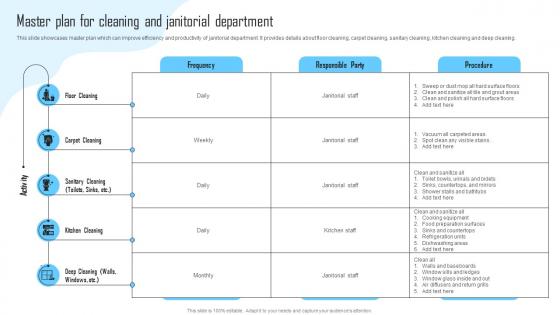
This slide showcases master plan which can improve efficiency and productivity of janitorial department. It provides details about floor cleaning, carpet cleaning, sanitary cleaning, kitchen cleaning and deep cleaning.
People who downloaded this PowerPoint presentation also viewed the following :
Master Plan For Cleaning And Janitorial Department Facility Management And Maintenance with all 6 slides:
Use our Master Plan For Cleaning And Janitorial Department Facility Management And Maintenance to effectively help you save your valuable time. They are readymade to fit into any presentation structure.





FAQs for Master Plan For Cleaning And Janitorial Department Facility
Key components include detailed cleaning schedules, staff training protocols, quality control systems, inventory management processes, and performance measurement tools. These elements work together by ensuring consistent service delivery, optimizing resource allocation, and maintaining high standards across facilities, with many organizations finding that structured cleaning management ultimately reduces costs while enhancing workplace health and productivity.
Technology enhances janitorial efficiency through IoT sensors for real-time monitoring, mobile apps for task management, automated scheduling systems, and data analytics for resource optimization. Smart restroom sensors, GPS tracking for staff coordination, and predictive maintenance tools streamline operations significantly, with many facilities finding faster response times and reduced operational costs.
Best practices for training cleaning staff include comprehensive orientation programs, hands-on technique demonstrations, safety protocol education, quality control standards, and regular performance evaluations. These training approaches enhance operational efficiency by establishing consistent procedures, reducing workplace accidents, and improving customer satisfaction, with many facilities finding that well-trained teams deliver faster services and maintain higher cleanliness standards consistently.
Cleaning schedules significantly enhance facility cleanliness and safety by ensuring consistent maintenance, preventing contamination buildup, and maintaining regulatory compliance across all areas. Through systematic scheduling, facilities like hospitals, offices, and manufacturing plants achieve reduced infection risks, improved air quality, and enhanced workplace safety, while minimizing emergency cleaning costs and ultimately delivering better employee experiences and operational efficiency.
Eco-friendly cleaning products include plant-based all-purpose cleaners, biodegradable degreasers, microfiber cloths, concentrated formulas, and non-toxic disinfectants made from natural ingredients like citrus and vinegar. These sustainable alternatives streamline operations by reducing chemical exposure, minimizing waste through concentrated formulas, and enhancing indoor air quality, with many facilities finding that green cleaning delivers cost savings while meeting increasingly stringent environmental standards.
Janitorial services address industry compliance by implementing specialized protocols, using certified cleaning products, maintaining detailed documentation, and training staff on sector-specific regulations. Healthcare facilities require medical-grade disinfection, food processing plants need HACCP-compliant sanitization, and manufacturing sites demand safety-focused cleaning procedures, with many organizations finding that professional services streamline regulatory adherence while reducing compliance risks.
Key metrics include cleanliness scores, customer satisfaction ratings, inspection pass rates, task completion times, and cost per square foot cleaned. These measurements enable facilities managers to optimize resource allocation, enhance service quality, and demonstrate value, with many organizations finding that combining efficiency metrics with quality assessments delivers improved operational performance and tenant satisfaction.
Effective communication between management and cleaning staff improves outcomes by establishing clear expectations, providing regular feedback, and creating open channels for reporting issues or suggestions. When managers actively listen to staff insights and communicate standards consistently, organizations experience higher quality cleaning, reduced turnover, improved efficiency, and enhanced workplace satisfaction, ultimately delivering better facility management and cost-effective operations.
Customer feedback serves as a critical quality control mechanism, identifying service gaps, scheduling preferences, specific cleanliness standards, and areas requiring additional attention or specialized cleaning protocols. Through systematic feedback collection, cleaning companies enhance service delivery, adjust resource allocation, and implement targeted improvements, while building stronger client relationships and ultimately delivering superior facility maintenance that meets evolving business needs.
Janitorial services adapt to facility usage changes through flexible scheduling systems, scalable staffing models, real-time occupancy monitoring, and dynamic resource allocation based on actual needs. Many commercial facilities now implement sensor-driven cleaning protocols and modular service contracts, enabling providers to efficiently scale operations up or down while maintaining consistent hygiene standards and optimizing costs.
Common cleaning management challenges include staff turnover, inconsistent quality standards, supply chain disruptions, scheduling conflicts, and budget constraints across diverse facility types. These obstacles can be overcome by implementing comprehensive training programs, establishing clear performance metrics, developing reliable vendor relationships, and utilizing digital management systems, with many organizations finding that strategic technology integration ultimately delivers improved operational efficiency and cost-effective service quality.
Routine inspections and audits ensure consistent cleaning quality by establishing standardized protocols, identifying performance gaps, and enabling immediate corrective actions. Through systematic evaluation schedules, facilities managers can monitor compliance across multiple locations, track service provider performance, and maintain health standards, while many organizations find that regular audits ultimately reduce costs and enhance operational efficiency.
Innovations shaping the cleaning industry's future include robotic cleaners, IoT-enabled monitoring systems, antimicrobial surface technologies, electrostatic spraying equipment, and AI-powered scheduling platforms. These technologies streamline operations by automating routine tasks, optimizing resource allocation, and enhancing sanitization effectiveness, with many facilities finding that strategic automation delivers significant cost reductions while improving service quality.
Leadership plays a crucial role in maintaining motivated cleaning staff by fostering clear communication, providing recognition and growth opportunities, and creating supportive work environments. Effective leaders in janitorial management enhance team morale through consistent feedback, competitive compensation packages, and professional development programs, ultimately delivering improved service quality, reduced turnover rates, and stronger client satisfaction across facilities.
Strategies include flexible staffing models, cross-training employees, seasonal contract partnerships, inventory management systems, and demand forecasting analytics. Through scalable workforce solutions and strategic resource allocation, cleaning companies can accommodate fluctuations in commercial buildings, educational institutions, and retail spaces, ultimately maintaining service quality while optimizing costs and enhancing operational efficiency.
-
Their professional templates are very impressive, even my manager was curious about the source. I am very grateful.
-
The best collection of PPT templates!! Totally worth the money.