


Medical systems flaws powerpoint presentation examples




Try Before you Buy Download Free Sample Product
 Impress Your
 Audience
 100%
100% Editable
 Save Hours
 of Time


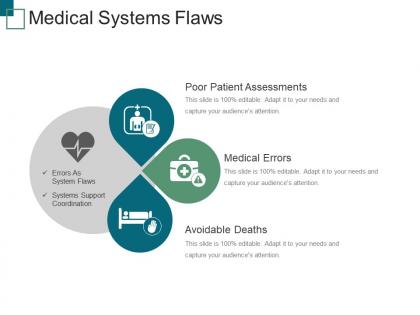
You could be a manager in the healthcare sector, running a hospital, nursing home or any medical facility. The ability to provide flawless services will come when you identify the flaws in the healthcare system in your organization which can be done best with this Medical Systems Flaws PowerPoint Presentation Example slide. This PPT helps you list down the systemic flaws in healthcare, for instance poor patient assessment, medical errors and avoidable deaths. The layout of the slide is simple and displays the information clearly. This healthcare problems template incorporates specially designed vector icons which make it an infographic slide. The design is attractive and is sure to gain the attention of the management. It will boost your confidence and support you to communicate your observations effectively. This issues in healthcare PPT can also be used to survey the healthcare facilities in a particular region or country too. You can present an in - depth analysis of the flaws and reasons for the failure of the healthcare services through this image. The slide can be downloaded at the ease of a click! Indulge your individual choice with our Medical Systems Flaws Powerpoint Presentation Examples. Freedom is an ideal it adheres to.
People who downloaded this PowerPoint presentation also viewed the following :
Medical systems flaws powerpoint presentation examples with all 5 slides:
Enhance existing infrastructure with our Medical Systems Flaws Powerpoint Presentation Examples. Add facilities that increase efficiency.




FAQs for Medical systems flaws
Common systemic flaws in healthcare delivery include fragmented care coordination, inadequate interoperability between systems, resource allocation inefficiencies, communication breakdowns, and inconsistent quality protocols. These challenges significantly impact patient safety, treatment continuity, and operational costs, with many healthcare organizations finding that integrated digital solutions and streamlined workflows enhance care coordination while reducing medical errors and improving patient experiences.
Administrative inefficiencies in medical systems drive up healthcare costs through redundant paperwork, fragmented billing processes, delayed claim processing, and poor coordination between departments. These inefficiencies create resource waste, extended patient wait times, and increased staffing requirements, with many hospitals finding that streamlining administrative workflows reduces operational costs by 15-30% while enhancing patient care delivery.
Data fragmentation hinders patient care by creating incomplete medical records, delayed diagnoses, and duplicated tests across different healthcare providers and systems. This fragmentation forces physicians to make decisions without complete patient histories, while hospitals and clinics waste resources on redundant procedures, ultimately compromising care quality and increasing costs for patients.
Technology can address medical system flaws through AI-powered diagnostics, electronic health records integration, telemedicine platforms, automated administrative processes, and predictive analytics for resource management. These solutions streamline patient care by reducing diagnostic errors, eliminating data silos, and optimizing workflow efficiency, with many hospitals finding that strategic technology adoption ultimately delivers faster treatment times, lower operational costs, and significantly improved patient outcomes.
Communication breakdown plays a central role in medical errors by creating information gaps during patient handoffs, medication administration, and care coordination between departments. These breakdowns occur through unclear documentation, rushed verbal exchanges, and fragmented systems, with hospitals and clinics finding that implementing structured communication protocols significantly reduces errors, enhances patient safety, and streamlines care delivery across medical teams.
Biases within healthcare systems create treatment disparities through unconscious assumptions about patient pain tolerance, symptom credibility, and treatment compliance based on race, gender, and socioeconomic status. These systemic biases result in delayed diagnoses, inadequate pain management, and reduced access to specialized care, with many healthcare organizations increasingly implementing bias training and standardized protocols to ensure equitable patient outcomes.
Inadequate medical training creates cascading system failures through increased diagnostic errors, prolonged patient treatment times, inefficient resource utilization, and compromised care coordination protocols. These deficiencies ultimately drive up operational costs, reduce patient satisfaction scores, and create liability risks, with many healthcare institutions finding that comprehensive training programs significantly enhance both clinical outcomes and system-wide efficiency.
Patient feedback can be effectively integrated through digital feedback platforms, real-time survey systems, patient advisory committees, data analytics tools, and structured follow-up protocols. Healthcare organizations streamline these approaches by implementing automated collection systems, creating actionable reporting dashboards, and establishing cross-departmental review processes, ultimately delivering enhanced patient experiences and operational improvements across medical facilities.
Ethical considerations include patient safety prioritization, equitable access to quality care, transparency in reporting system failures, accountability for medical errors, and balancing innovation with proven practices. Healthcare organizations must navigate these complex obligations while implementing improvements, with many hospitals finding that systematic approaches to addressing flaws ultimately enhance patient trust, reduce liability risks, and deliver more consistent clinical outcomes across diverse patient populations.
Regulatory policies drive healthcare flaw identification through mandatory reporting systems, compliance audits, quality metrics, and safety protocols. While these frameworks enhance patient safety and operational efficiency, they also present compliance challenges and resource demands, with many healthcare institutions finding that strategic regulatory alignment ultimately delivers improved care outcomes and competitive advantage.
Strategies to enhance collaboration include integrated electronic health records, multidisciplinary team meetings, shared decision-making protocols, cross-training programs, and unified communication platforms. These approaches streamline information sharing, reduce care fragmentation, and improve patient outcomes, with many hospitals finding that collaborative care models deliver faster diagnoses, reduced medical errors, and ultimately enhanced patient satisfaction across specialties.
Lack of transparency in medical systems undermines patient trust by creating information gaps around treatment decisions, pricing, and quality metrics, while compromising safety through reduced accountability and limited informed consent. Healthcare organizations increasingly find that transparent communication about procedures, costs, and outcomes enhances patient confidence, reduces medical errors, and ultimately delivers better care experiences and stronger provider-patient relationships.
Understaffing in healthcare facilities leads to increased medical errors, longer patient wait times, rushed consultations, delayed treatments, and reduced monitoring of critical patients. These staffing shortages ultimately compromise patient safety and care quality, with many hospitals finding that adequate staffing levels significantly improve patient outcomes, reduce readmission rates, and enhance overall healthcare delivery efficiency.
Interdisciplinary approaches resolve medical protocol flaws by combining clinical expertise with data analytics, systems engineering, and patient experience insights to identify gaps and optimize care pathways. Through collaborative teams integrating physicians, engineers, and technology specialists, healthcare organizations streamline diagnostic processes, reduce medical errors, and enhance treatment outcomes, ultimately delivering more efficient patient care and operational excellence.
Outdated medical technologies contribute to systemic inefficiencies through slow data processing, manual record-keeping, fragmented communication systems, and lack of integration between departments. These legacy systems create bottlenecks in patient care, increase administrative costs, and delay critical decision-making, with many hospitals finding that modernization significantly streamlines operations while enhancing patient outcomes and reducing overhead expenses.
-
Best way of representation of the topic.
-
Editable templates with innovative design and color combination.