


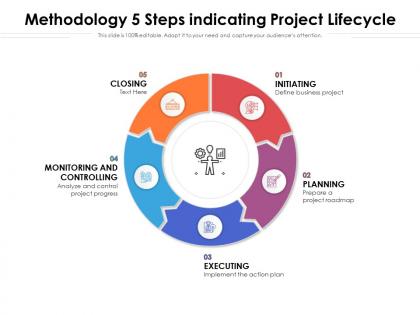
Methodology 5 steps indicating project lifecycle




Try Before you Buy Download Free Sample Product
 Impress Your
 Audience
 100%
100% Editable
 Save Hours
 of Time


Our Methodology 5 Steps Indicating Project Lifecycle are topically designed to provide an attractive backdrop to any subject. Use them to look like a presentation pro.
People who downloaded this PowerPoint presentation also viewed the following :
Methodology 5 steps indicating project lifecycle with all 2 slides:
Use our Methodology 5 Steps Indicating Project Lifecycle to effectively help you save your valuable time. They are readymade to fit into any presentation structure.
FAQs for Methodology 5 steps
Agile and Waterfall differ primarily in their approach to project phases, flexibility, and stakeholder involvement, with Waterfall following sequential, linear phases while Agile emphasizes iterative cycles and continuous collaboration. While Waterfall suits projects with well-defined requirements like construction or manufacturing, Agile enables software development teams and consulting firms to adapt quickly to changing client needs, ultimately delivering faster responses to market demands.
Organizations can determine the best project management methodology by evaluating project complexity, team size, timeline constraints, stakeholder requirements, and organizational culture. Through systematic assessment of these factors, companies in sectors like software development, construction, and healthcare can match methodologies to specific needs, ultimately delivering improved project outcomes, enhanced team productivity, and stronger competitive positioning.
Stakeholder engagement and communication serve as foundational elements across all project management methodologies, ensuring alignment, transparency, and project success through regular updates, feedback loops, and collaborative decision-making. While Agile emphasizes continuous stakeholder collaboration and daily communications, traditional methodologies like Waterfall rely on structured reporting phases, with many organizations finding that consistent stakeholder involvement significantly reduces project risks and enhances delivery outcomes.
PRINCE2 employs structured, upfront risk management with formal registers, quantitative assessments, and defined response strategies throughout project stages, while Agile integrates continuous risk identification through daily standups, sprint retrospectives, and iterative adaptation. PRINCE2 delivers comprehensive documentation and governance control, whereas Agile enables rapid response and team-driven mitigation, with many organizations finding that combining both approaches enhances overall project resilience and stakeholder confidence.
Scrum's advantages include enhanced team collaboration, faster delivery through sprints, improved adaptability to changes, increased transparency, and continuous feedback loops. However, it requires experienced team members, can struggle with unclear requirements, demands significant stakeholder involvement, and may face challenges in large organizations, with many software development and marketing teams finding that proper implementation ultimately delivers faster time-to-market and higher customer satisfaction.
Hybrid methodologies effectively combine Waterfall's structured planning and documentation with Agile's iterative development and flexibility, creating frameworks like Water-Scrum-Fall or Scaled Agile. Organizations in sectors like banking and healthcare leverage these approaches to maintain regulatory compliance while enabling rapid adaptation, ultimately delivering predictable timelines with enhanced responsiveness to changing requirements.
Project managers ensure successful methodology implementation by securing stakeholder buy-in, providing comprehensive team training, customizing processes to fit organizational needs, and establishing clear communication channels. Through gradual rollout phases, regular feedback sessions, and continuous performance monitoring, teams in sectors like construction, software development, and healthcare adapt more effectively, ultimately delivering improved project outcomes and enhanced operational efficiency.
Key metrics include schedule adherence, budget variance, scope creep percentage, team productivity rates, and stakeholder satisfaction scores. These measurements enable organizations to assess methodology performance across different project types, with many companies finding that combining quantitative metrics like delivery timelines with qualitative feedback ultimately delivers comprehensive insights for continuous improvement and strategic optimization.
Cultural factors significantly influence project management methodology selection through communication styles, hierarchy preferences, risk tolerance, and decision-making processes that vary across regions. Organizations in relationship-focused cultures often favor collaborative approaches like Scrum, while hierarchical societies may prefer structured methodologies like Waterfall, with many global companies finding that adapting methodologies to local cultural norms enhances team engagement and project success rates.
Techniques for tailoring project management methodologies include hybrid approach development, scalability adjustments, stakeholder requirement integration, risk profile customization, and resource constraint adaptation. Organizations increasingly combine elements from Agile, Waterfall, and Lean methodologies based on project complexity, timeline constraints, and team dynamics, with many finding that strategic customization enhances delivery efficiency while maintaining governance standards.
Technology tools enhance project management methodologies by automating task tracking, facilitating real-time collaboration, and providing comprehensive analytics dashboards. These platforms streamline workflow management, resource allocation, and progress monitoring, with many organizations finding that integrated software solutions significantly reduce project timelines while improving team coordination, ultimately delivering enhanced operational efficiency and competitive advantage in increasingly complex business environments.
Common challenges include resistance to change, insufficient training, tool integration difficulties, communication breakdowns, and timeline pressures during transition periods. Teams in sectors like software development and construction often find that gradual implementation, comprehensive training programs, and strong leadership support help overcome these obstacles, ultimately delivering improved collaboration, streamlined workflows, and enhanced project success rates.
Continuous improvement practices integrate into project management through regular retrospectives, iterative feedback loops, performance metrics analysis, and lessons learned documentation. These methodologies enable teams to identify inefficiencies, streamline processes, and enhance delivery outcomes, with many organizations finding that structured improvement cycles significantly reduce project timelines while improving quality and stakeholder satisfaction.
Training and development enhance project management methodology effectiveness by building team competencies, standardizing processes, and improving execution consistency across projects. Through comprehensive skill development programs, organizations streamline project workflows, reduce implementation errors, and accelerate delivery timelines, with many companies finding that well-trained teams deliver significantly better outcomes and competitive advantage.
Project management methodology significantly influences team dynamics by establishing clear communication channels, defined roles, decision-making processes, and collaborative frameworks that enhance coordination and accountability. Through structured approaches like Agile or Waterfall, teams experience improved transparency, reduced conflicts, and streamlined workflows, with many organizations finding that consistent methodologies deliver faster project completion, higher quality outcomes, and stronger team cohesion throughout complex initiatives.
-
Awesome use of colors and designs in product templates.