


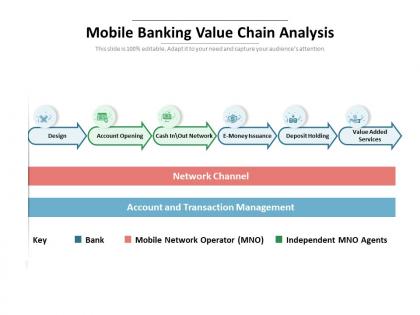
Mobile banking value chain analysis




Try Before you Buy Download Free Sample Product
 Impress Your
 Audience
 100%
100% Editable
 Save Hours
 of Time


Check on the latest from our Mobile Banking Value Chain Analysis stable. Our pedigree is improving by the day.
People who downloaded this PowerPoint presentation also viewed the following :
Mobile banking value chain analysis with all 2 slides:
Our Mobile Banking Value Chain Analysis are non chauvinistic. They are good for him and her.

FAQs for Mobile banking
Mobile banking offers consumers 24/7 account access, instant transactions, reduced travel time to branches, lower fees, and enhanced convenience through smartphone apps. These digital capabilities streamline financial management by enabling quick bill payments, real-time balance monitoring, and seamless money transfers, with many users finding that mobile platforms deliver faster services, better expense tracking, and ultimately greater control over their financial activities.
Mobile banking applications enhance user experience by providing 24/7 account access, instant fund transfers, mobile check deposits, real-time transaction alerts, and personalized financial insights. These features streamline banking operations while reducing wait times and branch visits, with many financial institutions finding that customers appreciate the convenience, speed, and control over their financial activities, ultimately delivering higher satisfaction rates and stronger customer loyalty.
Essential security measures for mobile banking applications include multi-factor authentication, end-to-end encryption, biometric verification, real-time fraud monitoring, and secure API protocols. These technologies work together by creating layered protection barriers, detecting suspicious activities instantly, and ensuring seamless user verification, with many financial institutions finding that comprehensive security frameworks ultimately enhance customer trust while reducing operational risks.
Demographic factors significantly influence mobile banking adoption through age preferences, income levels, educational background, and geographic location. Younger generations embrace mobile-first banking experiences, while higher-income, educated urban populations demonstrate greater adoption rates, with financial institutions increasingly tailoring their digital strategies to serve diverse demographic segments and bridge accessibility gaps.
Mobile banking apps can integrate with other fintech services through API connections, digital wallet partnerships, investment platform linking, budgeting tool synchronization, and cryptocurrency exchange access. These integrations streamline financial management by consolidating services, enabling seamless fund transfers, and providing comprehensive financial insights, with many banks finding that strategic partnerships ultimately deliver enhanced customer experiences and competitive advantage.
Mobile banking is revolutionizing personal finance management by enabling real-time account monitoring, instant transactions, automated budgeting tools, and seamless integration with financial planning apps. Through these digital capabilities, users can track spending patterns, receive immediate alerts, and make informed financial decisions instantly, while banks deliver enhanced customer experiences and operational efficiency, ultimately transforming traditional banking relationships.
Artificial intelligence enhances mobile banking through personalized recommendations, fraud detection, chatbots for customer service, predictive analytics, and automated transaction categorization. These AI-powered features streamline operations by reducing response times, minimizing security risks, and delivering tailored financial insights, with many banks finding that intelligent automation ultimately improves customer satisfaction while reducing operational costs.
Mobile banking enhances financial inclusion by providing affordable account access, enabling remote transactions, facilitating microfinance services, and reducing infrastructure barriers for underserved populations. Through smartphone technology, rural communities and low-income individuals can access banking services, transfer money, build credit histories, and participate in digital economies, ultimately delivering greater economic opportunities and financial security.
Mobile banking providers face regulatory challenges including data privacy compliance, anti-money laundering requirements, cross-border transaction regulations, cybersecurity standards, and consumer protection mandates. These regulatory frameworks vary significantly across jurisdictions, with many financial institutions finding that proactive compliance strategies, robust security infrastructure, and transparent reporting systems ultimately deliver competitive advantage and enhanced customer trust.
Mobile banking transforms brick-and-mortar institutions by driving digital service expansion, reducing operational costs, and enabling 24/7 customer engagement beyond physical locations. While traditional banks face decreased foot traffic, they're strategically leveraging mobile platforms to enhance customer experiences, streamline transactions, and deliver personalized financial services, ultimately maintaining competitive advantage in an increasingly digital landscape.
Users prioritize security features like biometric authentication and encryption, intuitive navigation, quick transaction processing, comprehensive account management, and 24/7 customer support when selecting mobile banking apps. These capabilities streamline daily financial tasks by enabling faster transfers, real-time notifications, and seamless bill payments, with many financial institutions finding that robust mobile experiences significantly enhance customer retention and competitive advantage.
Mobile banking applications promote sustainable financial habits through automated savings features, spending categorization tools, budgeting alerts, and goal-setting functionalities that encourage mindful money management. These digital platforms enhance financial literacy by providing real-time insights, personalized recommendations, and educational content, with many users finding that automated micro-investments and expense tracking ultimately deliver better long-term financial outcomes and increased savings rates.
Key trends shaping mobile banking's future include AI-powered personalization, biometric authentication, embedded finance, open banking APIs, and cryptocurrency integration. These innovations streamline customer experiences by delivering predictive insights, enhanced security, and seamless financial services integration, with banks increasingly finding that mobile-first strategies drive customer retention, reduce operational costs, and deliver competitive advantage in digital markets.
Mobile banking features vary significantly across regions, with Asian markets emphasizing QR code payments and super-app functionality, European systems prioritizing regulatory compliance and open banking integration, while African markets focus on SMS-based transactions and microfinance solutions. These regional adaptations reflect local payment preferences, regulatory frameworks, and infrastructure capabilities, with many financial institutions finding that culturally-aligned features drive higher adoption rates and customer engagement.
Blockchain technology enhances mobile banking through improved security protocols, faster cross-border transactions, reduced operational costs, and enhanced transparency in financial processes. Financial institutions increasingly leverage blockchain for secure peer-to-peer transfers, identity verification, and fraud prevention, while customers benefit from lower fees and instantaneous international payments, ultimately delivering competitive advantages in digital banking services.
No Reviews