


Monopoly Market Powerpoint Ppt Template Bundles




Try Before you Buy Download Free Sample Product
 Impress Your
 Audience
 100%
100% Editable
 Save Hours
 of Time


Discover the intricate dynamics of Monopoly Market with our comprehensive PowerPoint presentation. Unravel the complexities of Monopoly Market Analysis and explore the nuances of Monopoly Market Competition vis a vis Perfect Competition. Gain valuable insights into the Monopoly Market Structure and understand how it differs from other market types. Delve into the Causes of Monopoly Market, identifying key factors that lead to its formation. Our visually engaging slides and expertly curated content will equip you with a deeper understanding of monopolistic market behavior, pricing strategies, and its impact on consumer welfare and industry. Whether you are a student, researcher, or business professional, this PPT is an indispensable resource for mastering the fundamentals of Monopoly Market.
People who downloaded this PowerPoint presentation also viewed the following :
Monopoly Market Powerpoint Ppt Template Bundles with all 20 slides:
Use our Monopoly Market Powerpoint Ppt Template Bundles to effectively help you save your valuable time. They are readymade to fit into any presentation structure.













FAQs for Monopoly Market Powerpoint
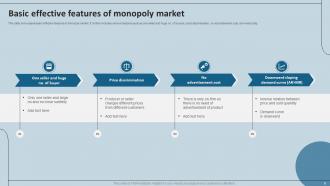
So basically, monopolies happen when one company controls everything for a product that doesn't really have substitutes. They put up crazy barriers to keep others out - patents, massive startup costs, that kind of thing. Makes them price makers instead of just taking whatever the market gives them. Pretty unfair advantage if you ask me. But they can't just charge whatever they want since people still have to actually buy it. Red flags to watch for: one big player dominating, unique product, and barriers so high that competitors won't even bother trying to break in.
Monopolies happen a few different ways. Companies grab control of key resources, or governments throw up regulatory barriers that block competition. Amazon's a perfect example - they jumped into cloud services early and just kept dumping money into it until nobody could catch up. Sometimes it's about massive upfront costs that scare competitors away (think electric companies). Other times companies just buy out their rivals. Honestly, patents and licenses are basically government-sanctioned monopolies. Look for industries where it's crazy expensive to get started - that's usually where you'll find them.
Ugh, monopolies are terrible for us. Higher prices, zero choices, and the service usually sucks because they know you can't leave. Sometimes they'll invest more in research or keep utilities running smoothly, but that's pretty much it. Most of the time you're just stuck getting screwed over. I mean, what are you gonna do - complain? They don't care since there's literally nowhere else to go. Your only real options are finding substitute products or hoping regulators actually do something about it. Which, let's be honest, takes forever.
So basically, monopolies can charge whatever they want because customers can't go anywhere else. When companies actually have to compete, they'll slash prices to steal customers from each other - you know how that works. But monopolies? They just set prices to maximize profit since you're stuck with them. Honestly, it's such BS from our perspective as consumers. Without real competition pushing them, they charge more and usually innovate way less too. Oh and when you're looking at any market situation, just check how many real options people actually have - that tells you everything.
So basically regulators jump in when monopolies start acting like jerks - stopping price gouging, breaking up companies that crush competition, stuff like that. Microsoft got hammered for this years ago. Short sentences work. They also watch mergers super closely so new monopolies don't even form. The whole point is protecting consumers without killing off successful businesses entirely. Oh and always check what regulatory stuff is happening in whatever market you're looking at - it totally changes how much pricing power companies actually have. Makes a huge difference in competitive dynamics too.
Honestly, monopolies are weird when it comes to innovation. Some get super lazy without competition - why bother with R&D when you're already winning? But then you've got others dumping their huge profits into crazy projects that startups could never afford. Look at Google's random moonshots or how AT&T built Bell Labs back in the day. The difference usually comes down to whether they're actually worried about future competition or regulators coming after them. I'd check how much they're spending on new development versus just coasting on what they already have.
Standard Oil and AT&T are the big ones everyone talks about. Back in the early 1900s, Standard Oil had like 90% of US oil refining locked down. AT&T ran telecommunications for decades. Both crushed competitors and hiked prices whenever they felt like it. Monopolies look efficient at first, but they end up killing innovation and screwing over consumers. The government eventually broke them both up, which actually created way better competition and services. Honestly, some of today's tech companies give me the same vibes - we might be heading down that road again.
Monopolies are terrible for consumers - you get one choice and that's it. Can't shop around for better prices or quality when there's literally nowhere else to go. The company controls everything and has zero incentive to innovate. I mean, why bother improving when customers are stuck with you? Plus they can jack up prices as high as they want, which screws over people who can't afford it. When you're looking at any market, just count how many real options consumers have. That'll tell you if it's actually competitive or not.
So monopolies stay on top through some pretty ruthless moves. First off, they make it ridiculously expensive for anyone new to enter the market - we're talking huge startup costs or exclusive deals with suppliers. Patents are another big one since they literally give legal protection for years. Then there's predatory pricing where they'll slash prices to destroy competitors, then bump everything back up once the competition's dead. Smart but brutal honestly. They also just buy out threats before they get too big. Oh and they control essential resources or have such massive scale that new companies can't even dream of competing. It's all about keeping others out basically.
So basically, monopolies charge different people different amounts for the exact same thing - pretty annoying when you think about it. They can do this because there's no real competition. Airlines are the worst offenders here, charging totally different prices for identical seats depending on when you book. Students get discounts, seniors too. Software companies do those weird tiered packages. The whole point? They're trying to squeeze out every dollar they can from each customer group. It's actually kind of brilliant business-wise, even though it sucks for us. Way more profitable than just having one set price for everyone.
Yeah, monopolies totally make inequality worse. They jack up prices because there's no competition forcing them to stay reasonable. Workers get screwed too - where else are they gonna go for jobs in that industry? Meanwhile the company owners are swimming in cash from all those inflated profits. It's honestly pretty messed up how much power they have. Consumers pay more, employees earn less, and all that extra money flows straight to the top. The whole thing just creates this cycle where the rich get richer while everyone else gets squeezed.
When monopolies smell competition, they get nasty fast. Price slashing is their go-to move - they'll burn money just to starve out newcomers. Then there's the legal warfare and lobbying for sketchy regulations that help them stay on top. Watch for exclusive supplier deals too, basically anything to block competitors from getting a foothold. Some will buy up threats before they even become real problems. Oh, and suddenly they'll "innovate" like crazy after years of doing nothing - funny how that works. If you see these tactics in a market, that company is definitely sweating bullets about losing their grip.
Monopolies are sketchy because they screw over consumers pretty badly. No competition means they can raise prices whenever they want and give you terrible service - where else are you gonna go? Innovation dies too since they don't need to try harder. All that money and power gets concentrated with just a few people, which honestly makes inequality way worse. They can also push around politicians more easily than smaller companies. Red flags to watch for: prices going up while quality stays the same (or gets worse), customer service going downhill, or when it's basically impossible for new companies to break into the market.
Yeah, monopolies are brutal for small businesses. They'll slash prices way below cost just to kill you off, then raise them once you're dead - seen it happen so many times. Getting suppliers becomes impossible since they lock up all the good deals. The worst part? They can bleed money in your sector while their other divisions keep them afloat. You literally can't compete with that kind of war chest. Your best bet is finding some weird niche they haven't noticed yet and making customers absolutely love you. Won't be easy though.
Look, different countries handle monopolies super differently and it's kinda wild. The EU loves smacking tech companies with massive fines - we're talking billions. Meanwhile the US broke up AT&T ages ago but now they're more focused on whether consumers actually get hurt. Europe's way more aggressive about companies getting too big, period. Agencies like the FTC and European Commission are constantly blocking mergers or investigating sketchy business moves. Honestly, if you're running anything international, you gotta watch these regulations because what's totally fine in America might cost you a fortune in Brussels.
-
I have just started downloading templates for my presentations and I must say this is a great design. It helped accelerate my presentation design process and made it more visually appealing.
-
“There is so much choice. At first, it seems like there isn't but you have to just keep looking, there are endless amounts to explore.”