


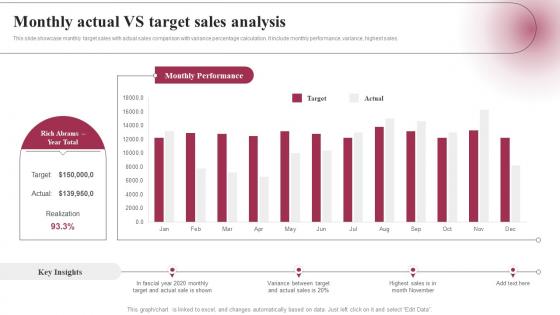
Monthly Actual VS Target Sales Analysis




Try Before you Buy Download Free Sample Product
 Impress Your
 Audience
 100%
100% Editable
 Save Hours
 of Time


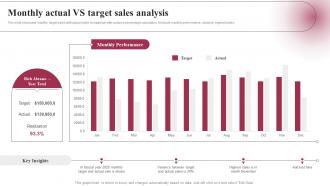
This slide showcase monthly target sales with actual sales comparison with variance percentage calculation. It include monthly performance, variance, highest sales.
People who downloaded this PowerPoint presentation also viewed the following :
Monthly Actual VS Target Sales Analysis with all 10 slides:
Use our Monthly Actual VS Target Sales Analysis to effectively help you save your valuable time. They are readymade to fit into any presentation structure.








FAQs for Monthly Actual VS
Honestly, focus on four key numbers: conversion rate, average deal size, sales cycle length, and revenue per rep. Everyone gets obsessed with total revenue but that's like judging a movie by box office alone - it doesn't tell you what's actually working. Your conversion rate shows if people care about what you're selling. Deal size tells you if you're going after the right customers. Cycle length? That's all about how smooth your process runs. Set baselines first, then check monthly so you can catch issues early instead of scrambling later.
Honestly, start with something like HubSpot or Salesforce - they'll track your pipeline automatically and spit out performance reports without you having to think about it. The analytics will show you what's actually moving the needle vs just keeping people busy. I'm weirdly obsessed with those dashboard widgets that break down conversion rates by lead source (probably says something about me lol). Mobile apps are clutch for logging calls on the spot. Some of the newer AI forecasting stuff can predict which deals will actually close, which is pretty wild. Just pick one tool that plays nice with whatever you're using now and expand from there.
Dude, sales training seriously makes a huge difference. I've watched teams jump from barely hitting 70% of their numbers to crushing their quotas consistently. Better objection handling, stronger lead qualification, bigger deals - it all flows from good training. You gotta cover both the hard stuff (product knowledge, your actual process) and soft skills like listening and negotiation. Oh and don't try to fix everything at once - that never works. Figure out where your team's weakest first, then tackle those gaps. It's honestly one of the fastest ways to boost revenue without hiring more people.
Honestly, data analytics just shows you what's actually happening vs what you think is happening with your sales. Track which leads convert best and spot customer patterns you'd never notice otherwise. Short sentences work. Your forecasting gets way more accurate too - no more guessing games. The personalization part is huge though, like tailoring your pitch based on actual data instead of gut feelings. I'd say pick 2-3 metrics and just watch them religiously for a month. Sounds boring but you'll start seeing trends that'll blow your mind. Way better than flying blind, trust me.
Honestly, most sales teams mess up the basics. They don't qualify leads properly, so you're wasting time on people who'll never buy. Follow-up is usually trash too - inconsistent and all over the place. Here's what really gets me though: reps jump into their pitch without even listening to what the prospect actually needs. It's just random spraying and praying at that point. CRM gets neglected, so nobody knows where deals stand. Without a clear process, everyone's doing their own thing. I'd start by looking at where your deals typically die - that'll show you the real problems fast.
Set goals that make your team stretch without breaking them - trust me, nothing's worse than watching everyone give up because targets feel impossible. I'd break those big annual numbers into monthly chunks so people actually see progress happening. Track the stuff they can control too, like calls made or demos booked, not just revenue. That way they're not sitting around waiting for deals to close to feel successful. And honestly? Always connect goals to real rewards. People need something concrete to work toward, whether that's commission bumps or just public recognition. The activity metrics thing really works btw.
Give feedback right after calls while it's still fresh in your mind. Real examples work way better than vague "nice work" stuff. Honestly, I think the sandwich method is kinda overrated - just be direct about what's working and what isn't. Set up regular check-ins instead of only meeting when things go wrong. Maybe try role-playing tough situations together? Oh and definitely celebrate their wins in front of everyone but keep the constructive stuff private. Track one specific thing per person so you can actually see if they're improving over time.
Honestly, CRMs are game-changers because they dump all your customer stuff in one spot instead of having it scattered everywhere. No more digging through old emails or losing that napkin where you wrote down someone's number (guilty). The pipeline view is clutch - you can see exactly where each deal stands. Automated follow-ups save your butt too. But here's the thing - the analytics are where it gets really good. You'll start seeing patterns in your best deals and catch opportunities that would've slipped by. Just throw all your contacts in there first and figure out the fancy stuff later.
Dude, collaboration is everything for hitting sales numbers. Your team shares leads and insights? Everyone gets smarter fast. When someone's stuck on technical details or needs a warm intro, they can just ask around instead of spinning their wheels. I read somewhere that collaborative teams hit like 108% of targets while lone wolves only get to 91% - pretty crazy difference. Oh and definitely do weekly sessions where people share wins and problems. Sounds cheesy but it actually works. You'll be surprised how much random stuff comes up that helps everyone.
Look, buyer behavior is basically your cheat sheet for figuring out what people actually want and when they want it. You can tailor your whole approach once you know their pain points and how they make decisions. No more generic pitches for everyone - that stuff doesn't work anyway. Track what happens in your best deals. What questions do they always ask? When do they get most engaged? Honestly, patterns start jumping out pretty fast. You'll spot objections before they even say them, and you'll know exactly what info they need at each stage. Makes positioning your solution way easier.
Look, forecasting isn't rocket science but it'll save your sanity. You can actually plan inventory instead of scrambling when stuff runs out. Plus your team gets real numbers for budgets and hiring decisions - way better than winging it. Spotting patterns is huge too. Like if sales always tank in July, you're ready for it. I learned this the hard way at my last job, honestly. Even basic monthly predictions make a difference. Your boss will thank you when there's actual data behind those quarterly meetings instead of just crossed fingers and good vibes.
Start with some one-on-one time to figure out what's actually broken - could be prospecting, handling objections, or just basic follow-up stuff. Role-play scenarios help tons here. Check if they're even using the CRM right (you'd be surprised how often that's the issue). Pair them with your best rep for shadowing. Sometimes it's motivational, sometimes it's their territory just sucks. Set clear 30-60-90 day goals with weekly check-ins. Oh, and definitely look at lead quality first - might not even be them. Create a solid improvement plan with real metrics they can hit.
Competition hits your sales in three main ways - conversion rates drop, deals take forever, and you end up cutting prices to close. Prospects shop around more when there's lots of options, which drags out your sales cycle. But honestly? Some competition isn't terrible. Forces your team to actually nail down what makes you different and get sharper at handling pushback. Your win rates bounce around depending on how well you stand out from the pack. I'd definitely start tracking when competitors come up in deals you lose - gives you a clear picture of where you're getting beat and what messaging needs work.
Look, good communication is what separates crushing it from barely hitting quota. Your reps build trust way faster when they're clear with prospects - objections become easier conversations instead of brick walls. Internally? Game changer. No more silos, everyone actually knows what's happening, and managers can coach properly instead of guessing. Honestly, I've watched mediocre teams become absolute units just from adding weekly huddles where people share real wins and losses. Role-playing helps too, though some reps hate it at first. Start small - maybe just 30-minute check-ins to get everyone talking.
Look, buyers change constantly and you've gotta keep up or you'll get left behind. I learned this the hard way tbh. New CRM tools, different selling approaches, industry shifts - it all matters for staying competitive. Your clients can totally tell when you actually understand their world vs just winging it. The job gets way less boring too when you're not stuck in the same routine forever. Pick one thing each quarter to get better at and see how it moves your numbers. Even small improvements add up over time.
-
SlideTeam’s readymade presentations have landed my unique images with my bosses in the past and it continues to reward me.
-
Requested a complete pitch deck. Delivered immediately and with high quality well researched content.