


Monthly Departments Comparative Expense Report




Try Before you Buy Download Free Sample Product
 Impress Your
 Audience
 100%
100% Editable
 Save Hours
 of Time


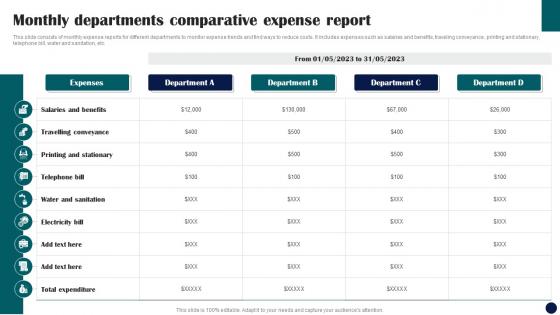
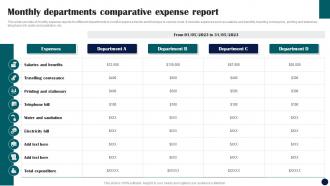
This slide consists of monthly expense reports for different departments to monitor expense trends and find ways to reduce costs. It includes expenses such as salaries and benefits, traveling conveyance, printing and stationary, telephone bill, water and sanitation, etc.
People who downloaded this PowerPoint presentation also viewed the following :
Monthly Departments Comparative Expense Report with all 6 slides:
Use our Monthly Departments Comparative Expense Report to effectively help you save your valuable time. They are readymade to fit into any presentation structure.





FAQs for Monthly Departments
Primary business expense categories include cost of goods sold, operating expenses, administrative costs, marketing and sales expenses, and capital expenditures. These categories enable organizations to streamline financial reporting, optimize resource allocation, and enhance budgeting accuracy, with many companies finding that systematic expense tracking ultimately delivers better cash flow management and competitive advantage.
Small businesses can effectively manage operational costs by implementing automated accounting systems, negotiating vendor contracts, optimizing energy consumption, and leveraging cloud-based technologies to reduce infrastructure expenses. Through strategic cost analysis and resource allocation, many small businesses streamline operations while maintaining service quality, ultimately delivering improved profit margins and competitive positioning in increasingly cost-conscious markets.
Expenses directly impact profitability by reducing net income, with operational costs, administrative overhead, and capital expenditures determining the gap between revenue and profit margins. Through strategic expense management, companies streamline operations, optimize resource allocation, and enhance competitive positioning, with many organizations finding that controlled spending while maintaining quality ultimately delivers sustainable growth and improved shareholder value.
Fixed expenses remain constant regardless of business activity levels, including rent, insurance, salaries, and loan payments, while variable expenses fluctuate with production or sales volume, such as raw materials, utilities, and commission costs. This distinction enables businesses to better forecast budgets, optimize cost structures, and make strategic pricing decisions, with many organizations finding that understanding these differences significantly improves cash flow management and operational planning during both growth periods and economic downturns.
Effective budgeting strategies include the 50/30/20 rule, zero-based budgeting, envelope method, automated savings transfers, and quarterly expense reviews. These approaches streamline financial planning by categorizing priorities, tracking spending patterns, and building emergency reserves, with many organizations and individuals finding that consistent monitoring and automated systems ultimately deliver better cash flow control and reduced financial stress.
Technology streamlines expense tracking through automated receipt scanning, real-time expense categorization, integrated approval workflows, and seamless accounting system integration. These solutions eliminate manual data entry, reduce processing time from weeks to hours, and provide instant visibility into spending patterns, with many organizations finding that automated expense management delivers significant cost savings and enhanced financial transparency.
Common expense monitoring pitfalls include inadequate tracking systems, delayed reporting, lack of categorization standards, insufficient approval workflows, and poor integration between departments. These challenges often result in budget overruns, duplicate payments, and missed cost-saving opportunities, with many organizations finding that manual processes significantly hinder their ability to maintain real-time financial visibility and control.
Understanding direct vs. indirect expenses enables businesses to accurately calculate product costs, profit margins, and resource allocation efficiency. This distinction helps organizations identify cost drivers, optimize pricing strategies, and make informed decisions about product lines, with many companies finding that precise expense categorization ultimately delivers better budgeting accuracy and competitive advantage.
Unexpected expenses significantly disrupt cash flow management by reducing available working capital, forcing businesses to delay payments, postpone investments, or seek emergency financing. These disruptions can strain vendor relationships, limit growth opportunities, and create cascading effects across operations, with many organizations finding that maintaining emergency reserves and flexible credit lines helps mitigate these impacts while preserving operational stability.
Businesses can leverage expense data to inform strategic decision-making by identifying spending patterns, benchmarking costs against industry standards, forecasting budget requirements, and pinpointing operational inefficiencies. Through advanced analytics, organizations streamline resource allocation, optimize vendor relationships, and enhance profitability projections, with many companies finding that data-driven expense insights ultimately deliver competitive advantages and improved financial performance.
Employee spending policies help regulate company expenses by establishing clear spending limits, defining approved expense categories, requiring pre-approval for large purchases, and implementing structured reimbursement processes. These policies enable organizations to maintain budget control, reduce unauthorized spending, and enhance financial transparency, with many companies finding that well-defined policies streamline expense management while ensuring compliance across departments.
Businesses can prepare for seasonal fluctuations by analyzing historical spending patterns, creating flexible budgets with variable expense categories, and establishing cash reserves during peak revenue periods. Through predictive forecasting and strategic resource allocation, companies in retail, hospitality, and agriculture can smooth operational disruptions, maintain steady cash flow, and ultimately gain competitive advantage by managing seasonal volatility more effectively than competitors.
Categorizing expenses for tax purposes enables accurate deduction claims, simplified audit preparation, better cash flow management, and compliance with IRS requirements. This systematic approach streamlines tax filing processes by organizing business costs, travel expenses, and operational expenditures, with many organizations finding that proper categorization reduces tax preparation time while maximizing legitimate deductions and minimizing audit risks.
Personal expenses are individual costs like groceries, entertainment, and personal insurance, while business expenses are operational costs including office rent, employee salaries, equipment, and professional services that generate revenue. Business expenses offer tax deductions and require detailed documentation for compliance, while personal expenses generally aren't deductible, with organizations finding that proper categorization streamlines financial reporting and maximizes operational efficiency.
Emerging trends include AI-powered receipt scanning, real-time expense tracking, mobile-first platforms, automated policy compliance, and integrated corporate card management. These technologies streamline expense reporting by eliminating manual data entry, providing instant visibility into spending patterns, and ensuring policy adherence, with many organizations finding that automated solutions reduce processing time by 75% while enhancing financial control.
-
The quality of the templates is as fine as it could get. It was a purchase well made!
-
Their products can save your time, effort and money. What else you need. All in one package for presentation needs!