


Monthly Social Media Plan Timeline




Try Before you Buy Download Free Sample Product
 Impress Your
 Audience
 100%
100% Editable
 Save Hours
 of Time


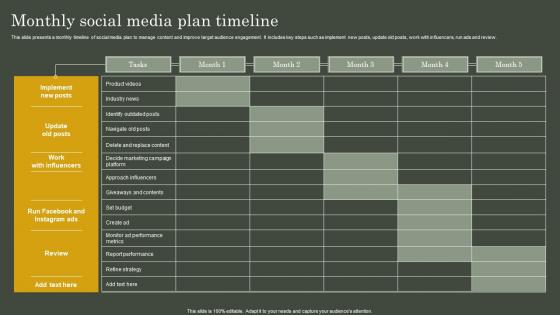
This slide presents a monthly timeline of social media plan to manage content and improve target audience engagement. It includes key steps such as implement new posts, update old posts, work with influencers, run ads and review.
People who downloaded this PowerPoint presentation also viewed the following :
Monthly Social Media Plan Timeline with all 6 slides:
Use our Monthly Social Media Plan Timeline to effectively help you save your valuable time. They are readymade to fit into any presentation structure.





FAQs for Monthly Social
A social media plan timeline should include brand awareness metrics, audience engagement targets, lead generation objectives, content publishing schedules, and performance review milestones. These goals enable organizations to streamline their social presence by establishing clear benchmarks, optimizing resource allocation, and measuring ROI effectively, with many businesses finding that structured timelines deliver improved customer engagement and competitive advantage.
Social media content should be reviewed weekly for performance metrics and engagement rates, with strategic adjustments made monthly to align with campaign goals and audience response patterns. Many brands find that quarterly comprehensive reviews enable significant pivots based on seasonal trends, platform algorithm changes, and competitive landscape shifts, ultimately delivering improved ROI and sustained audience growth.
Essential components include content calendar scheduling, campaign milestone markers, platform-specific posting frequencies, engagement monitoring checkpoints, and performance review periods. These elements streamline social media management by establishing clear posting rhythms, tracking campaign progress, and ensuring consistent brand presence, with many organizations finding that structured timelines enhance team coordination and ultimately deliver improved audience engagement and measurable ROI.
Businesses can incorporate seasonal trends by mapping key holidays, industry events, and cultural moments into their content calendar, aligning campaigns with peak engagement periods like Black Friday or back-to-school seasons. This strategic approach enables brands to capitalize on heightened consumer interest, create timely promotional opportunities, and drive significantly higher engagement rates, with many retailers finding that seasonal content delivers up to 40% better performance than standard posts.
Key metrics include engagement rates, reach and impressions, conversion rates, follower growth, click-through rates, and brand mention sentiment across all platforms. These analytics enable organizations to track campaign performance, optimize content strategy, and demonstrate ROI, with many businesses finding that consistent monitoring throughout their timeline delivers improved audience targeting, enhanced brand visibility, and ultimately stronger competitive positioning in their market.
Project management tools enhance social media plan timeline effectiveness by centralizing scheduling, automating task assignments, providing real-time progress tracking, and enabling seamless team collaboration across campaigns. These platforms streamline content workflows, minimize scheduling conflicts, and deliver comprehensive analytics, with many marketing teams finding that integrated dashboards ultimately accelerate campaign execution while maintaining strategic consistency.
Content themes serve as organizational frameworks that guide posting schedules, seasonal campaigns, product launches, brand messaging, and audience engagement strategies throughout your social media timeline. These themes enable businesses to maintain consistent brand voice while strategically aligning content with marketing objectives, industry events, and customer journey touchpoints, with many organizations finding that structured thematic planning enhances audience retention and drives measurable engagement across platforms.
A flexible social media plan timeline accommodates changes through buffer periods, modular content blocks, real-time monitoring systems, and agile approval processes that enable rapid pivots. By maintaining 20-30% unscheduled content slots and implementing streamlined decision-making workflows, organizations can seamlessly integrate trending topics, respond to market shifts, and capitalize on viral opportunities while maintaining strategic consistency and brand alignment.
The ideal social media plan timeline combines quarterly strategic planning with monthly tactical execution and annual goal-setting. This approach enables organizations to maintain strategic focus while adapting to platform changes, seasonal trends, and audience engagement patterns. Many businesses find that quarterly reviews streamline content optimization, campaign adjustments, and performance analysis, ultimately delivering consistent brand presence and measurable growth.
Teams ensure cross-platform consistency by establishing unified brand guidelines, creating centralized content calendars, and implementing standardized posting schedules across all channels. Through collaborative planning tools and regular cross-team reviews, organizations streamline messaging coordination, maintain visual identity alignment, and synchronize campaign launches, ultimately delivering cohesive brand experiences while enabling scalable social media management across multiple platforms.
Engagement strategies include hosting live events, creating countdown campaigns, running interactive polls, launching user-generated content contests, and sharing behind-the-scenes content aligned with timeline milestones. These approaches streamline audience interaction by building anticipation, encouraging participation, and fostering community connection, with many brands finding that strategic timing around key dates ultimately delivers higher engagement rates and stronger customer loyalty.
Visual representation of a social media plan timeline enhances team understanding by displaying campaign phases, content deadlines, platform-specific requirements, and resource allocation in an easily digestible format. These visual tools streamline coordination by enabling teams to identify dependencies, track progress against milestones, and anticipate bottlenecks, ultimately delivering improved accountability and execution across marketing initiatives.
Common pitfalls in creating a social media plan timeline include underestimating content creation time, setting unrealistic posting frequencies, neglecting platform-specific requirements, failing to account for approval processes, and ignoring seasonal fluctuations or industry events. These challenges can be avoided by building buffer time into schedules, conducting thorough audience research, establishing clear workflow processes, and maintaining flexible frameworks that accommodate unexpected opportunities, ultimately delivering more consistent engagement and sustainable growth across all social platforms.
A well-structured social media plan timeline typically allocates 60-70% of resources to content creation, including strategy development, production, and scheduling, while dedicating 30-40% to audience engagement activities like responding, community management, and relationship building. This strategic balance enables brands to maintain consistent posting schedules while fostering meaningful interactions, ultimately delivering stronger brand loyalty and higher conversion rates.
**INPUT**: What best practices can be applied for scheduling posts across different social media platforms in the timeline? **OUTPUT**: Best practices include analyzing platform-specific peak engagement times, maintaining consistent brand voice across channels, batching content creation, and leveraging scheduling tools for automation. Through strategic timing and cross-platform coordination, organizations streamline their social media operations while maximizing reach and engagement, with many brands finding that systematic scheduling delivers improved audience interaction and operational efficiency. [Word count: 56 words]
-
Easily Editable.
-
Excellent Designs.