


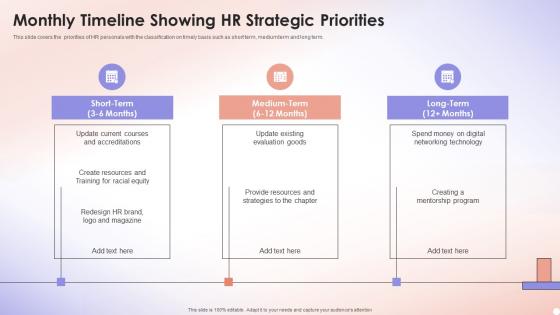
Monthly Timeline Showing Hr Strategic Priorities




Try Before you Buy Download Free Sample Product
 Impress Your
 Audience
 100%
100% Editable
 Save Hours
 of Time


This slide covers the priorities of HR personals with the classification on timely basis such as short term, medium term and long term.
People who downloaded this PowerPoint presentation also viewed the following :
Monthly Timeline Showing Hr Strategic Priorities with all 6 slides:
Use our Monthly Timeline Showing Hr Strategic Priorities to effectively help you save your valuable time. They are readymade to fit into any presentation structure.





FAQs for Monthly Timeline Showing
Key milestones in HR strategy timelines include talent acquisition planning, performance management system implementation, employee development program rollouts, compensation reviews, and organizational culture initiatives. These milestones enable companies to streamline workforce planning, enhance employee engagement, and improve retention rates, with many organizations finding that structured timelines deliver measurable improvements in productivity and competitive advantage.
Organizations align their HR strategy timeline with business goals by synchronizing recruitment, talent development, performance management, and succession planning with strategic business milestones and quarterly objectives. Through integrated workforce planning, companies like tech startups and manufacturing firms coordinate hiring surges with product launches, align training cycles with market expansion phases, ultimately delivering operational readiness and competitive advantage in increasingly dynamic business environments.
Data analytics enables HR leaders to make informed timeline decisions by analyzing workforce trends, performance metrics, recruitment patterns, and employee engagement scores. Through predictive analytics and real-time dashboards, organizations can identify optimal timing for talent acquisition, training programs, and organizational changes, while minimizing disruption and maximizing strategic outcomes, ultimately delivering more precise resource allocation and competitive advantage.
Organizations should revisit their HR strategy timeline quarterly for tactical adjustments and conduct comprehensive annual reviews for strategic realignment, while also updating during major business changes, market shifts, or organizational restructuring. This balanced approach enables companies to maintain agility in competitive environments, with many enterprises finding that regular reviews enhance workforce planning, improve talent retention, and ultimately deliver better alignment with evolving business objectives.
Companies face challenges including unclear objectives, insufficient stakeholder buy-in, resource constraints, resistance to change, and poor communication across departments when implementing HR strategy timelines. These obstacles can derail progress by creating misaligned priorities, delayed milestones, and reduced employee engagement, with many organizations finding that proactive change management and regular timeline adjustments ultimately deliver smoother implementations and better outcomes.
An HR strategy timeline improves employee engagement and retention by establishing clear career progression pathways, scheduling regular feedback cycles, and implementing strategic development milestones throughout the employee lifecycle. This structured approach enables organizations to proactively address retention challenges, deliver personalized growth opportunities, and create predictable advancement frameworks, with many companies finding that systematic timeline implementation reduces turnover while significantly enhancing employee satisfaction.
Best practices for visualizing HR strategy timelines include using milestone markers, color-coded phases, clear progress indicators, stakeholder touchpoints, and outcome metrics. These visual elements enhance presentation clarity by highlighting key implementation stages, resource allocation periods, and expected deliverables, with many organizations finding that well-structured timeline visuals improve executive buy-in and team alignment significantly.
External factors significantly influence HR strategy timelines by requiring adaptive planning, accelerated compliance measures, and strategic pivoting based on emerging conditions. Market volatility may compress recruitment cycles while new legislation, such as data privacy regulations or employment law changes, often demands immediate policy updates and training programs, with many organizations finding that flexible timeline frameworks enable faster responses and maintain competitive advantage.
Key HR metrics within a strategy timeline include employee turnover rates, time-to-hire, employee engagement scores, training completion rates, and performance review outcomes. These measurements enable organizations to track recruitment efficiency, retention success, and workforce development progress, with many companies finding that consistent metric monitoring ultimately delivers improved talent management and competitive advantage.
Technology and automation significantly accelerate HR strategy timelines by streamlining recruitment processes, automating payroll and benefits administration, and enabling real-time performance analytics. Through AI-powered applicant tracking systems and automated onboarding workflows, organizations reduce hiring cycles from weeks to days, while digital performance management platforms deliver continuous feedback and strategic insights, ultimately enhancing operational efficiency and competitive advantage.
Common pitfalls include unrealistic deadline expectations, inadequate stakeholder consultation, insufficient resource allocation, poor communication planning, and lack of flexibility for adjustments. These challenges often arise when organizations underestimate implementation complexity, with many companies finding that rushed timelines compromise quality, while overly rigid schedules fail to accommodate necessary pivots, ultimately hindering strategic HR transformation success.
Leaders can communicate HR strategy timeline changes through transparent town halls, detailed email updates, one-on-one manager discussions, and interactive Q&A sessions that address employee concerns directly. By clearly explaining the rationale behind adjustments, providing regular progress updates, and actively soliciting feedback, organizations build trust and engagement, with many companies finding that transparent communication ultimately enhances employee buy-in and strategic alignment.
Employee feedback serves as a critical compass for refining HR strategy timelines, enabling organizations to identify implementation bottlenecks, adjust unrealistic deadlines, and prioritize initiatives based on actual workforce needs and readiness levels. Through regular pulse surveys, focus groups, and performance reviews, companies like manufacturing firms and financial services organizations streamline their talent development schedules, enhance change management approaches, and ultimately deliver more effective HR outcomes while reducing employee resistance.
Cross-department collaboration enhances HR strategy timelines by streamlining communication, aligning organizational priorities, and ensuring comprehensive implementation across all business functions. Through strategic partnerships with finance, operations, and leadership teams, HR departments accelerate decision-making processes, reduce implementation bottlenecks, and deliver more cohesive workforce strategies, ultimately creating competitive advantage through synchronized organizational development.
HR strategy timeline tools include project management platforms like Asana and Monday.com, specialized HR software such as BambooHR and Workday, and visual planning tools like Gantt charts and Smartsheet. These technologies streamline timeline creation by enabling collaborative planning, automated progress tracking, and real-time updates, with many organizations finding that integrated platforms significantly enhance strategic alignment and execution efficiency.
-
I can always count on your designs for my professional needs. I believe I found a one-stop-shop for PPTs.
-
This design is not only aesthetically pleasing but it has many uses making the cost worthwhile. The graphics look stunning, and you can edit them as per your needs.