

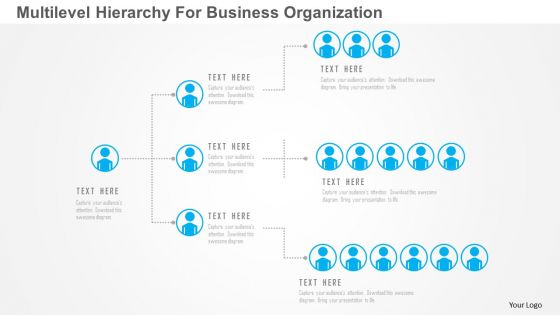
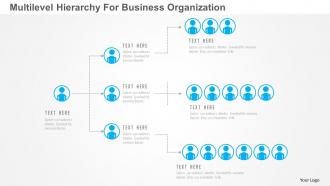
Multilevel hierarchy for business organization flat powerpoint design




Try Before you Buy Download Free Sample Product
 Impress Your
 Audience
 100%
100% Editable
 Save Hours
 of Time


Hunting down multilevel hierarchy for business organization layouts for your PowerPoint presentation to make them meriting your steady work and need to leave an impact on your gathering of spectators then the Slide Team is the ideal place for you. Our business organization multilevel hierarchy PPT layouts are delineated in such a way for your business require that you ought to just to insert the relevant information into the pined for practical or picture and you are set up to share your presentation. An association is a conclusive resort of any business development. Our business organization multilevel hierarchy PPT template layout class holds an immense number of PowerPoint templates with a combination of points and pictures to demonstrate the dynamic arrangement of the relationship in a suitable demand or game plan from beginning to end or base to beat by the need of your information to be passed on based upon the subject of your presentation. So, stop wasting your precious efforts and time, download these business organization multilevel hierarchy PowerPoint template slides.Our Multilevel Hierarchy For Business Organization Flat Powerpoint Design focus on deserving aspects. Keep clear of any gibberish.
People who downloaded this PowerPoint presentation also viewed the following :
Multilevel hierarchy for business organization flat powerpoint design with all 5 slides:
Use our Multilevel Hierarchy For Business Organization Flat Powerpoint Design like bricks and mortar. Build a strong structure for your thoughts.


FAQs for Multilevel hierarchy for business organization
So basically you get way clearer reporting lines - nobody's confused about who their boss is. Managers won't be drowning with like 15 direct reports either (been there, it's chaos). Strategic decisions stay with leadership while day-to-day stuff gets handled by people actually doing the work. Plus your team sees obvious promotion paths, which honestly keeps people around longer. Yeah, communication can get slower bouncing between levels, but that's fixable with decent processes. I'd start by just drawing out who reports to who right now - you'll probably spot the messy areas pretty quick.
So basically, multilevel hierarchies work because different people can make decisions at their own level instead of everything going to the CEO. Way more efficient that way. The managers closest to the actual work make the calls that affect their teams - which honestly just makes sense, right? You avoid those annoying bottlenecks where one person becomes the decision-making roadblock for everything. Just don't make it so rigid that creative ideas can't bubble up from the bottom. Oh, and communication needs to flow both directions or you'll end up with disconnected levels.
Honestly, the biggest pain will be everyone freaking out about who they report to now. Communication gets messy fast. Decisions take forever because they have to bounce through more people, and some folks just hate change - like, really hate it. Middle managers will definitely try protecting their turf too, which gets awkward. Oh, and you'll probably need to redo most of your processes from scratch. My advice? Over-communicate like crazy during the switch. Send constant updates, do town halls, make sure people know exactly where they stand. Sounds obvious but trust me, you can't do it enough.
Look, too many layers definitely kills morale - people feel cut off from whoever's actually making decisions. The approval process becomes this endless nightmare. But here's the thing: some structure actually helps engagement when done right. People need clear paths for advancement and mentorship. I've seen it work both ways honestly. The trick is preventing those layers from becoming walls. Communication has to flow up AND down, not just one direction. Give people real ownership over their stuff, even with hierarchy in place. Otherwise you're just creating fancy bureaucracy.
Yeah so basically all those management layers just gum up the works. Messages get stuck bouncing between levels, and by the time info reaches the top it's totally warped from the original version. People stick to talking with their own department too, which makes everything worse. I'd honestly keep your hierarchy super flat if you can swing it. Those skip-level meetings where people jump ranks? Game changer. Also try setting up direct lines between different levels - cuts through all that bureaucratic BS and actually gets stuff moving.
Honestly, you'll need good tech for this stuff - managing multilevel hierarchies manually is just brutal. Data analytics platforms help you track performance across different levels. Automation tools make communication between tiers way smoother. I'd also grab some visualization software to map out all those complex relationships (trust me, it gets messy fast). AI and machine learning are pretty solid for spotting bottlenecks and optimizing resources throughout everything. Just don't go overboard with tools - you don't want to be switching between a million different dashboards. Figure out your biggest headaches first, then find specific solutions for those problems.
Oh absolutely, those hierarchies are brutal for information flow. Stuff gets trapped at every level or twisted as it passes through. Cross-functional teams help a ton - they cut right through the layers. Skip-level meetings work too, though honestly they can feel awkward at first. Digital platforms where everyone sees the same info are clutch. The biggest thing? Get people talking sideways instead of just up and down the chain. You've gotta be proactive about it because those silos will cement themselves if you don't.
Start by mapping out who decides what at each level - honestly, you'll be shocked how much confusion that clears up. Your leaders need skip-level meetings so info actually flows up AND down, not just one way. Middle managers kill momentum when their roles aren't clear (I've watched this happen way too many times). Get everyone aligned on the big picture vision, but then back off and let each level figure out their own execution. Oh, and don't skip leadership development - different levels face totally different problems. Mentorship between levels helps too.
Okay so here's what you gotta do - match your metrics to what people can actually control at their level. Executives should track the big picture stuff like revenue growth, market share, you know? Middle managers need departmental KPIs that feed into those bigger goals - team productivity, staying on budget, project completion. Frontline people work best with daily or weekly numbers they can directly impact. Honestly, the hardest part is making sure all these metrics actually connect instead of just floating around randomly. I'd start by looking at who makes what decisions, then figure out where you're missing the right measurements.
Big companies with tons of moving parts really need those multilevel setups - manufacturing, hospitals, government stuff, tech giants. Military and aerospace are no-brainers since they'd be chaos without strict chains of command. Works great when you need people making specialized calls at different levels and clear accountability. Banking loves it too because regulations require serious oversight (honestly, they probably overdo it sometimes). The real test? If your whole company can still fit in one conference room for a meeting, you probably don't need all those layers yet. Once direct communication becomes impossible across everyone, that's when hierarchies start making sense.
Oh totally, culture makes a huge difference with hierarchies! Asian companies usually love clear management layers - people expect it and don't question up the chain. But try that in like Sweden? Good luck. They'll wonder why they can't just talk directly to whoever makes decisions. Communication styles are all over the place too - some cultures stick to proper channels religiously, others will skip three levels to get stuff done. Honestly the Scandinavian approach seems way more efficient to me. Anyway, I'd say figure out what cultural mix you're dealing with first, then adjust how strict your structure needs to be.
Look at Apple - they've got this crazy strict hierarchy but somehow teams still pump out innovative stuff constantly. Amazon's another good one, scaling across millions of people while keeping their core values consistent at every level. Toyota too, honestly. What makes these work isn't just having fancy org charts (though those help). It's more about getting communication flowing properly and making sure the right people can actually make decisions. The balance thing is huge - you need control but can't micromanage everything or you'll kill creativity. Clear reporting structures matter, but autonomy at each level is what separates the winners from bureaucratic nightmares.
Honestly, start by figuring out what each level actually needs to do their job well. Front-line people need the tactical stuff - the day-to-day skills that matter. Middle managers? Focus on leading teams and fixing processes. Senior folks should work on big-picture strategy and vision. Here's the thing though - make sure it all connects like a real ladder. Nobody wants random training that goes nowhere, you know? And definitely add some cross-level communication training. People need to get how their work affects everyone else. I'd audit what skills each role truly needs first, then build pathways that actually prep people for moving up.
So for multilevel stuff, Lucidchart and OrgChart are solid picks - they actually handle complex reporting without making you want to pull your hair out. Visio's decent if you're already in the Microsoft ecosystem, though it can be annoying to work with sometimes. Airtable's good for when your data changes a lot. Excel pivot tables work too if things aren't super complicated. I'd probably avoid the fancy database route unless you really need HR integration or live updates. Honestly just figure out what you actually need first, then hit up some free trials. Most people overthink this stuff anyway.
Honestly, I'd start by flattening some of those layers - too many levels just slow everything down. Cross-functional teams work great too, where people report to both their department head and project leads. Middle managers need way more decision-making power instead of constantly passing things upstairs (seriously, the bottlenecks this creates are insane). Rotating folks through different roles helps break down those annoying silos. Oh, and don't try to fix everything at once - figure out your worst pain points first and redesign around those specific problems. Fresh perspectives make a huge difference.
-
Nice and innovative design.
-
Very well designed and informative templates.