


Multiple Choice Questions For Session On Importance Of Customer Service Edu Ppt





Try Before you Buy Download Free Sample Product
 Impress Your
 Audience
 100%
100% Editable
 Save Hours
 of Time


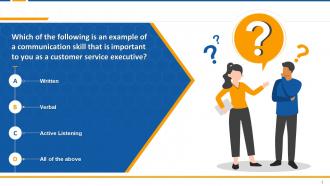
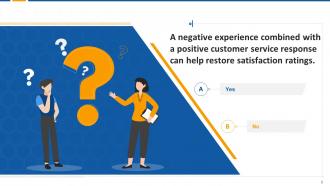
The PPT includes MCQs on the topic importance of customer service. The trainer can use these to test the knowledge of the training audience.
People who downloaded this PowerPoint presentation also viewed the following :
Multiple Choice Questions For Session On Importance Of Customer Service Edu Ppt with all 24 slides:
Use our Multiple Choice Questions For Session On Importance Of Customer Service Edu Ppt to effectively help you save your valuable time. They are readymade to fit into any presentation structure.


















FAQs for Multiple Choice Questions For Session On Importance Of Customer
Exceptional customer service includes active listening, empathy, prompt response times, product knowledge, and effective problem resolution. These components work together by building trust, reducing customer frustration, and creating positive experiences, with many organizations finding that consistently applying these practices enhances customer loyalty and drives competitive advantage.
Businesses can measure customer satisfaction through Net Promoter Score (NPS) surveys, Customer Satisfaction (CSAT) ratings, Customer Effort Score (CES), social media sentiment analysis, and feedback forms. These metrics enable organizations to track service quality, identify improvement areas, and enhance customer experiences, with many companies finding that combining multiple measurement approaches delivers more comprehensive insights and competitive advantage.
Technology revolutionizes customer service through AI-powered chatbots, CRM systems, omnichannel platforms, predictive analytics, and automated ticketing solutions. These innovations streamline response times, personalize interactions, and enable 24/7 support across multiple touchpoints, with many organizations finding that strategic technology integration ultimately delivers faster resolution rates and significantly enhanced customer satisfaction.
Personalization improves customer service quality by tailoring interactions to individual preferences, purchase history, and behavioral patterns, creating more relevant and meaningful experiences. Through AI-driven insights and data analytics, companies in retail, banking, and hospitality deliver faster problem resolution, proactive support, and customized recommendations, ultimately enhancing satisfaction while reducing service costs and building stronger customer loyalty.
Common customer service challenges include managing high call volumes, maintaining consistent quality across channels, resolving complex issues efficiently, handling demanding customers, and integrating fragmented communication systems. These obstacles significantly impact operational efficiency and customer satisfaction, with many organizations finding that strategic automation, comprehensive staff training, and omnichannel platforms streamline operations while ultimately delivering faster resolution times and enhanced customer experiences.
Effective communication skills significantly enhance customer service outcomes by building trust, reducing misunderstandings, and accelerating problem resolution through active listening, clear explanations, and empathetic responses. These skills enable representatives to handle complex inquiries more efficiently, create positive customer experiences, and ultimately drive customer retention, with many organizations finding that well-trained communication delivers measurable improvements in satisfaction scores.
Strategies for handling difficult customers include active listening, empathy acknowledgment, solution-focused dialogue, escalation protocols, and follow-up procedures. These approaches streamline conflict resolution by validating concerns, offering alternatives, and maintaining professional boundaries, with many retail and hospitality organizations finding that structured response frameworks ultimately enhance customer retention and employee confidence.
Training employees in customer service best practices is crucial for building customer loyalty, reducing complaint resolution times, and maintaining competitive differentiation in today's service-driven marketplace. Organizations that invest in comprehensive service training see measurable improvements in customer satisfaction scores, employee confidence, and revenue retention, with many companies finding that well-trained teams deliver faster resolutions and create lasting customer relationships.
Key trends shaping customer service's future include AI-powered chatbots, omnichannel integration, predictive analytics, self-service portals, and personalized experiences through data insights. These technologies streamline operations by reducing response times, enhancing consistency across touchpoints, and enabling proactive support, with many organizations finding that strategic automation ultimately delivers improved customer satisfaction while significantly reducing operational costs.
Customer feedback can be effectively utilized by systematically collecting data through surveys, reviews, and direct interactions, then analyzing patterns to identify service gaps and improvement opportunities. Many organizations streamline this process by implementing feedback management systems that track trends, prioritize issues based on impact, and measure resolution effectiveness, ultimately delivering enhanced customer experiences and stronger competitive positioning in increasingly service-focused markets.
Response time significantly impacts customer satisfaction, loyalty, and brand perception, as it directly influences how valued customers feel during interactions. Quick responses enhance customer experiences, reduce frustration, and build trust, with many businesses finding that faster response times lead to higher retention rates, improved reviews, and competitive advantage in increasingly demanding markets.
Companies create customer-centric cultures by aligning leadership commitment, employee training programs, performance metrics tied to customer satisfaction, and cross-departmental collaboration around customer needs. This strategic transformation involves empowering frontline staff with decision-making authority, implementing regular customer feedback systems, and recognizing employees who deliver exceptional experiences, ultimately driving loyalty, retention, and competitive advantage.
Companies should track response time, resolution rate, customer satisfaction scores, first-call resolution, net promoter score, and customer retention rates. These metrics enable organizations to identify service gaps, optimize resource allocation, and enhance customer experiences, with many businesses finding that comprehensive tracking ultimately delivers improved operational efficiency and stronger competitive advantage in increasingly demanding markets.
Social media can be leveraged for customer service success through real-time response capabilities, proactive engagement monitoring, personalized communication channels, community-driven support forums, and integrated feedback collection systems. These platforms enable businesses to streamline customer interactions, reduce response times, and enhance brand transparency, with many retail and hospitality companies finding that strategic social media integration ultimately delivers improved customer satisfaction and competitive advantage.
Businesses can balance automation and human touch by using AI for routine inquiries, initial responses, and data collection, while reserving complex issues, emotional situations, and relationship-building for human agents. This strategic combination enables faster response times, reduced operational costs, and improved customer satisfaction, with many organizations finding that seamless escalation processes ultimately deliver both efficiency and personalized experiences.
-
It’s really cool, and you can find pretty much everything you could need for your work or school.
-
Great designs, really helpful.