


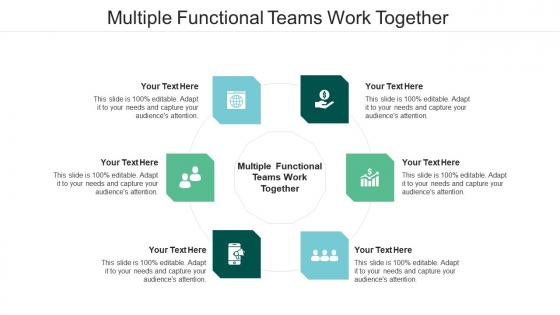
Multiple functional teams work together ppt powerpoint template cpb




Try Before you Buy Download Free Sample Product
 Impress Your
 Audience
 100%
100% Editable
 Save Hours
 of Time


Our Multiple Functional Teams Work Together Ppt Powerpoint Template Cpb are topically designed to provide an attractive backdrop to any subject. Use them to look like a presentation pro.
People who downloaded this PowerPoint presentation also viewed the following :
Multiple functional teams work together ppt powerpoint template cpb with all 6 slides:
Use our Multiple Functional Teams Work Together Ppt Powerpoint Template Cpb to effectively help you save your valuable time. They are readymade to fit into any presentation structure.





FAQs for Multiple functional teams work together ppt
Fostering collaboration between multiple functional teams delivers enhanced innovation, streamlined processes, improved decision-making, reduced silos, and accelerated project delivery. These collaborative approaches enable organizations to leverage diverse expertise, minimize redundancies, and enhance customer experiences, with many companies finding that cross-functional partnerships ultimately drive competitive advantage and operational efficiency.
Technology enhances cross-functional team communication through unified platforms like Slack, Microsoft Teams, and Asana, which centralize messaging, file sharing, and project tracking. These tools streamline collaboration by eliminating silos, enabling real-time updates, and providing transparent workflows, with organizations finding that integrated communication systems significantly reduce project delays and improve team alignment.
Common collaboration challenges include communication silos, conflicting priorities, resource competition, unclear accountability, and differing workflows across departments. These obstacles can be mitigated through establishing shared objectives, implementing cross-functional project management tools, creating regular inter-departmental meetings, and developing standardized processes, ultimately delivering improved coordination, faster decision-making, and enhanced organizational efficiency.
Organizational culture and leadership styles significantly impact multi-functional team collaboration by establishing communication norms, decision-making processes, and cross-departmental trust levels. Collaborative cultures with inclusive leadership enable seamless integration between engineering, marketing, and operations teams, while hierarchical structures can create silos, with many organizations finding that adaptive leadership styles ultimately deliver faster innovation and improved project outcomes.
Conflict resolution enables productive collaboration by addressing disagreements constructively, establishing clear communication channels, and creating frameworks for resolving competing priorities or resource constraints. Through structured mediation processes and collaborative problem-solving approaches, organizations streamline decision-making, enhance trust between departments, and ultimately deliver faster project outcomes, with many finding that proactive conflict management significantly improves cross-functional efficiency.
Teams can establish clear roles through detailed project charters, RACI matrices defining decision-making authority, regular kickoff meetings, and documented workflow processes that outline each member's specific contributions and boundaries. Many organizations find that combining role-mapping workshops with collaborative project management platforms enables seamless coordination, reduces duplicate efforts, and accelerates project delivery while maintaining accountability across departments.
Effective strategies include establishing clear role definitions, implementing rotating leadership opportunities, creating cross-functional mentorship programs, recognizing diverse skill contributions, and maintaining transparent communication channels. These approaches enhance engagement by ensuring equal participation, celebrating unique expertise, and fostering mutual respect, with many organizations finding that structured recognition systems and inclusive decision-making processes ultimately deliver stronger team cohesion and improved project outcomes.
Project management methodologies like Agile and Scrum adapt to multi-functional teams through cross-functional sprint planning, shared accountability frameworks, and integrated communication protocols. These approaches streamline collaboration by establishing common workflows, synchronized deliverables, and unified progress tracking, with organizations finding that structured iterations enhance team coordination and accelerate project outcomes.
Collaboration success metrics include project completion rates, cross-functional communication frequency, time-to-market improvements, quality scores, and stakeholder satisfaction ratings. These measurements enable organizations to track operational efficiency, identify bottlenecks, and optimize resource allocation, with many companies finding that regular metric review ultimately delivers faster innovation cycles and enhanced competitive advantage.
Cross-functional training improves collaboration by breaking down silos, fostering mutual understanding of roles and responsibilities, and creating shared vocabulary across departments. Through structured learning programs, teams develop empathy for other functions' challenges and constraints, while building relationships that facilitate smoother communication, faster problem-solving, and ultimately more cohesive project execution.
Effective collaborative project management tools include Slack for communication, Asana for task coordination, Microsoft Teams for integrated workflows, Trello for visual project tracking, and Jira for technical teams. These platforms streamline cross-functional coordination by centralizing communications, automating status updates, and providing real-time visibility, with many organizations finding that integrated dashboards significantly reduce project delays while enhancing team accountability.
Diversity within functional teams enhances creativity and problem-solving by bringing varied perspectives, experiences, and cognitive approaches that challenge conventional thinking and generate innovative solutions. Teams combining different backgrounds, expertise, and viewpoints consistently produce more comprehensive strategies and identify blind spots, with organizations like healthcare systems and financial services finding that diverse collaboration ultimately delivers stronger outcomes and competitive advantage.
Trust-building practices include regular cross-functional meetings, transparent communication channels, shared goal-setting sessions, collaborative problem-solving workshops, and celebrating joint achievements. These approaches streamline collaboration by breaking down silos, enhancing mutual understanding, and aligning diverse expertise toward common objectives, with many organizations finding that structured interaction ultimately delivers stronger project outcomes and competitive advantage.
Leadership can encourage collaboration by implementing cross-functional project teams, establishing shared performance metrics that reward collective outcomes, and creating regular inter-departmental communication channels through structured meetings and collaborative platforms. By modeling collaborative behavior themselves and recognizing teams that break down silos, leaders enable organizations to streamline decision-making, accelerate innovation, and ultimately deliver enhanced customer experiences while building sustainable competitive advantage.
Best practices for aligning diverse functional teams include establishing shared metrics and KPIs, implementing regular cross-functional meetings, creating transparent communication channels, developing unified project dashboards, and setting clear accountability structures. These approaches streamline collaboration by breaking down silos, enhancing visibility across departments, and ensuring consistent progress tracking, with many organizations finding that strategic alignment ultimately delivers faster project completion and improved operational efficiency.
-
Much better than the original! Thanks for the quick turnaround.
-
Excellent Designs.