


Multiple Projects Status Management Dashboard With Duration




Try Before you Buy Download Free Sample Product
 Impress Your
 Audience
 100%
100% Editable
 Save Hours
 of Time


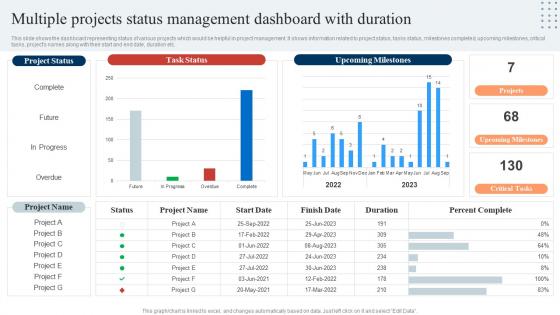
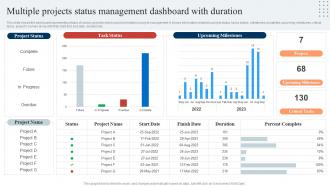
This slide shows the dashboard representing status of various projects which would be helpful in project management. It shows information related to project status, tasks status, milestones completed, upcoming milestones, critical tasks, projects names along with their start and end date, duration etc.
People who downloaded this PowerPoint presentation also viewed the following :
Multiple Projects Status Management Dashboard With Duration with all 7 slides:
Use our Multiple Projects Status Management Dashboard With Duration to effectively help you save your valuable time. They are readymade to fit into any presentation structure.





FAQs for Multiple Projects Status Management
The best tools for tracking multiple projects simultaneously include Microsoft Project, Asana, Monday.com, Smartsheet, and Trello, each offering centralized dashboards and real-time visibility. These platforms streamline project oversight by consolidating timelines, resource allocation, and progress indicators into unified interfaces, with many organizations finding that automated reporting and cross-project analytics ultimately deliver enhanced operational efficiency and faster decision-making capabilities.
Project managers can effectively prioritize tasks by implementing strategic frameworks like Eisenhower Matrix categorization, establishing clear project dependencies, conducting regular stakeholder impact assessments, and utilizing resource allocation scorecards. Through these systematic approaches, organizations streamline decision-making processes, minimize resource conflicts, and enhance cross-project visibility, with many companies finding that structured prioritization ultimately delivers improved project outcomes and competitive operational efficiency.
**INPUT**: What strategies can be employed to ensure consistent communication among team members working on different projects? **OUTPUT**: Effective cross-project communication strategies include standardized reporting templates, centralized project dashboards, regular inter-team sync meetings, shared communication platforms, and unified project management tools. These approaches streamline information flow by establishing consistent protocols, enabling real-time visibility across initiatives, and creating structured touchpoints, with many organizations finding that centralized systems ultimately enhance collaboration and minimize miscommunication across diverse project portfolios. **Word count: 60 words**
Stakeholders can be kept informed through executive dashboards, automated progress reports, milestone-based communications, and regular summary meetings that highlight key achievements and risks. These streamlined approaches enable project managers to deliver relevant updates by focusing on strategic metrics, visual progress indicators, and exception reporting, ultimately maintaining transparency while minimizing information overload across multiple initiatives.
Risk management serves as an early warning system in multiple project monitoring, enabling proactive identification of potential delays, resource conflicts, budget overruns, and scope changes across portfolios. Through systematic risk assessment and mitigation strategies, organizations can anticipate project interdependencies, allocate contingency resources more effectively, and maintain strategic alignment, with many project managers finding that integrated risk monitoring ultimately delivers improved success rates and stakeholder confidence.
Visual aids like Gantt charts and dashboards enhance multiple project management by providing real-time visibility into timelines, resource allocation, dependencies, and progress across all initiatives simultaneously. These tools enable project managers to quickly identify bottlenecks, reallocate resources strategically, and maintain stakeholder alignment, with many organizations finding that visual project oversight reduces delays and improves delivery predictability significantly.
Key metrics for assessing multiple project health include schedule variance, budget utilization, resource allocation efficiency, milestone completion rates, and risk exposure levels. These indicators enable project managers to identify bottlenecks, reallocate resources strategically, and maintain operational oversight across portfolios, with many organizations finding that consistent tracking delivers improved delivery timelines and enhanced stakeholder confidence.
Project managers can balance resource allocation by implementing priority matrices, conducting regular capacity assessments, establishing cross-functional resource pools, and maintaining transparent communication channels with stakeholders. Through strategic resource management platforms, organizations streamline workforce deployment, minimize bottlenecks, and optimize project timelines, with many enterprises finding that flexible allocation strategies ultimately deliver enhanced productivity and competitive advantage.
Common pitfalls include inconsistent status reporting formats, neglecting stakeholder communication schedules, overcomplicating tracking systems, failing to standardize priority classifications, and avoiding difficult conversations about delayed milestones. These challenges ultimately undermine project transparency and decision-making capabilities, with many organizations finding that streamlined processes and regular cross-project reviews deliver significantly better resource allocation and stakeholder confidence.
Technology streamlines multiple project status reporting through automated data collection, real-time dashboards, integrated communication platforms, and standardized reporting templates. These solutions eliminate manual updates by centralizing project information, providing instant visibility across portfolios, and enabling stakeholders to access current status through unified interfaces, ultimately reducing administrative overhead while improving decision-making speed and accuracy.
Team collaboration significantly impacts multiple project success by improving communication, resource coordination, knowledge sharing, and risk identification across concurrent initiatives. Through collaborative platforms and regular cross-project meetings, teams streamline workflows, prevent resource conflicts, and leverage collective expertise, with many organizations finding that strong collaboration reduces project delays by up to 30% while enhancing overall delivery quality.
Lessons learned can be applied by establishing standardized status reporting templates, implementing consistent milestone tracking methods, and creating centralized knowledge repositories that capture successful communication strategies. Organizations in manufacturing and healthcare increasingly adopt cross-project learning frameworks, enabling teams to replicate effective status management practices, streamline reporting processes, and ultimately deliver improved project visibility and stakeholder alignment.
Best practices for conducting status meetings include standardizing agenda formats, focusing on exceptions and roadblocks, using visual dashboards, time-boxing discussions, and rotating project priorities. These approaches streamline communication by minimizing redundant updates, accelerating decision-making, and maintaining stakeholder engagement across portfolios, with many organizations finding that structured formats and clear escalation paths ultimately deliver better project visibility and faster issue resolution.
**INPUT**: How should changes in project scope be managed across multiple projects? **OUTPUT**: Scope changes across multiple projects should be managed through centralized change control processes, standardized impact assessment frameworks, cross-project dependency mapping, and unified approval workflows that evaluate ripple effects. These systematic approaches streamline decision-making by maintaining project alignment, preventing resource conflicts, and ensuring strategic priorities, with many organizations finding that integrated scope management delivers better outcomes and competitive advantage. [Word count: 60]
Burnout prevention techniques include workload distribution analysis, rotating project assignments, implementing mandatory recovery periods, establishing clear priority frameworks, and creating cross-functional support systems. These approaches streamline resource allocation by preventing overcommitment, enhancing team resilience, and maintaining consistent project quality, with many organizations finding that strategic workload management ultimately delivers higher productivity and better employee retention.
-
Visually stunning presentation, love the content.
-
No second thoughts when I’m looking for excellent templates. SlideTeam is definitely my go-to website for well-designed slides.