


Nanorobotics In Healthcare And Medicine Chemotherapy Drug Delivery Using Nanorobots




Try Before you Buy Download Free Sample Product
 Impress Your
 Audience
 100%
100% Editable
 Save Hours
 of Time


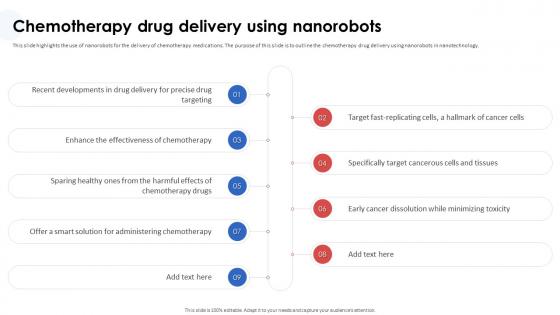
This slide highlights the use of nanorobots for the delivery of chemotherapy medications. The purpose of this slide is to outline the chemotherapy drug delivery using nanorobots in nanotechnology.
People who downloaded this PowerPoint presentation also viewed the following :
Nanorobotics In Healthcare And Medicine Chemotherapy Drug Delivery Using Nanorobots with all 9 slides:
Use our Nanorobotics In Healthcare And Medicine Chemotherapy Drug Delivery Using Nanorobots to effectively help you save your valuable time. They are readymade to fit into any presentation structure.








FAQs for Nanorobotics In Healthcare And Medicine Chemotherapy Drug
Nanorobotics in targeted drug delivery offers precision targeting, reduced side effects, enhanced bioavailability, controlled release mechanisms, and improved therapeutic outcomes. These microscopic systems streamline treatment by delivering medications directly to affected cells, minimizing healthy tissue exposure, and enabling real-time monitoring, with oncology and cardiovascular treatments finding significantly enhanced patient outcomes and reduced systemic toxicity.
Nanorobots improve cancer treatment precision by targeting specific tumor cells while avoiding healthy tissue, delivering chemotherapy drugs directly to cancer sites, and providing real-time monitoring of treatment progress. These microscopic devices enable oncologists to minimize side effects, reduce dosage requirements, and enhance therapeutic outcomes, with many cancer centers finding that targeted nanorobot therapy delivers faster recovery times and improved patient survival rates.
Nanobots serve as microscopic diagnostic tools that detect biomarkers, monitor cellular changes, identify pathogens, analyze tissue samples, and track disease progression at the molecular level. These nanoscale devices enhance diagnostic precision by delivering real-time cellular data, enabling earlier disease detection, and providing detailed insights into conditions like cancer, with many healthcare institutions finding that this technology streamlines diagnosis while improving patient outcomes.
Nanorobotics enhances minimally invasive surgery by providing unprecedented precision in targeted tissue manipulation, real-time diagnostic feedback, and reduced surgical trauma through microscopic intervention capabilities. These nanoscale systems enable surgeons to perform complex procedures with enhanced accuracy, minimize patient recovery times, and reduce complications, with cardiovascular and oncological applications increasingly demonstrating improved outcomes and operational efficiency.
Current limitations include manufacturing complexity, biocompatibility concerns, precise navigation challenges, power supply constraints, and regulatory approval hurdles. These challenges present both technical and commercial opportunities, with many healthcare institutions finding that addressing manufacturing scalability, ensuring safe biodegradation, and developing reliable targeting systems ultimately delivers more effective treatments and competitive advantages in personalized medicine.
Nanorobots navigate through the human body using magnetic guidance systems, biochemical targeting mechanisms, and programmed propulsion methods like flagella-inspired motors or bubble propulsion. These microscopic devices leverage blood circulation patterns, tissue-specific biomarkers, and external magnetic fields to reach precise locations, with applications in targeted cancer therapy and cardiovascular interventions delivering enhanced treatment accuracy.
Ethical considerations include patient consent for microscopic interventions, privacy concerns regarding internal monitoring data, potential long-term health effects, equitable access across socioeconomic groups, and regulatory oversight challenges. These concerns present both implementation hurdles and opportunities for establishing robust frameworks, with healthcare institutions increasingly finding that transparent protocols and comprehensive patient education enhance trust while delivering safer, more effective treatments.
Nanotechnology enables smart drug formulations through targeted delivery systems, controlled release mechanisms, and enhanced bioavailability optimization. These nanocarriers streamline therapeutic precision by encapsulating medications, bypassing biological barriers, and responding to specific cellular conditions, with pharmaceutical companies and hospitals finding that nanoscale formulations deliver improved patient outcomes while minimizing side effects.
Promising nanorobotic systems in clinical trials include targeted drug delivery nanocarriers, magnetic microrobots for minimally invasive procedures, DNA origami robots for cancer therapy, and biocompatible nanodevices for precise tissue repair. These systems enhance treatment precision by delivering medications directly to affected cells, reducing systemic side effects, and enabling real-time therapeutic interventions, with many medical institutions finding significantly improved patient outcomes.
Regulatory frameworks significantly impact nanorobot development through rigorous safety protocols, extensive clinical trial requirements, and comprehensive biocompatibility assessments that can extend development timelines by several years. While these regulations present challenges, they ultimately enhance patient safety and build public trust, with many pharmaceutical companies finding that early regulatory engagement streamlines approval processes and accelerates market entry for breakthrough therapeutic applications.
Nanorobots revolutionize patient monitoring by enabling real-time cellular-level diagnostics, continuous biomarker tracking, early disease detection, and precise medication delivery monitoring. These microscopic devices streamline health tracking by providing instant data transmission, reducing hospital visits, and enhancing preventive care, with many healthcare systems finding that continuous monitoring ultimately delivers faster interventions and significantly improved patient outcomes.
Artificial intelligence enhances nanorobotic systems through machine learning algorithms, predictive analytics, real-time data processing, and automated decision-making capabilities that optimize therapeutic interventions. Through AI-powered navigation and targeting, hospitals and research institutions achieve precise drug delivery, early disease detection, and personalized treatment protocols, ultimately delivering improved patient outcomes and reduced treatment costs.
Potential risks include immune system reactions, uncontrolled replication, toxicity from nanomaterial accumulation, difficulty in retrieval once deployed, and unpredictable interactions with cellular processes. While these challenges present legitimate concerns, ongoing research in biocompatibility and fail-safe mechanisms is addressing safety protocols, with many pharmaceutical companies finding that rigorous testing phases can minimize risks while maximizing therapeutic benefits.
Nanorobots could revolutionize regenerative medicine by delivering growth factors precisely to damaged tissues, removing cellular debris, and creating optimal microenvironments for healing. These microscopic devices enable targeted stem cell delivery, monitor tissue development in real-time, and facilitate scaffold integration, with cardiac and orthopedic applications showing promising outcomes for accelerated recovery.
Nanorobots combat antibiotic-resistant infections by delivering targeted antimicrobial agents directly to infection sites, bypassing traditional resistance mechanisms, and providing precise drug release at cellular levels. These microscopic devices enable hospitals and medical facilities to treat MRSA, tuberculosis, and other resistant pathogens more effectively, ultimately delivering enhanced treatment outcomes while minimizing systemic side effects.
-
These stunning templates can help you create a presentation like a pro.
-
Making a presentation has never been this easy for me. Thank you SlideTeam for offering a splendid template library.