


Narrative Analysis Process For Qualitative Research




Try Before you Buy Download Free Sample Product
 Impress Your
 Audience
 100%
100% Editable
 Save Hours
 of Time


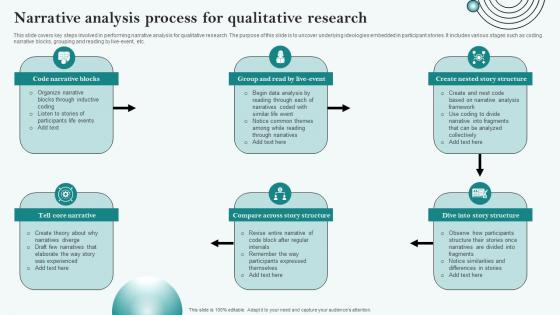
This slide covers key steps involved in performing narrative analysis for qualitative research. The purpose of this slide is to uncover underlying ideologies embedded in participant stories. It includes various stages such as coding narrative blocks, grouping and reading by live event, etc.
People who downloaded this PowerPoint presentation also viewed the following :
Narrative Analysis Process For Qualitative Research with all 9 slides:
Use our Narrative Analysis Process For Qualitative Research to effectively help you save your valuable time. They are readymade to fit into any presentation structure.








FAQs for Narrative Analysis Process
So you're looking at how people structure their stories - the characters they focus on, recurring themes, plot progression. Chronology's really important because people jump around when they're telling you stuff, and honestly that jumping around reveals what matters most to them. Don't forget who they're telling the story TO - that shapes everything. I'd start by transcribing word-for-word first. Then map out the actual story arc before you dive into coding themes. Oh, and watch for those turning points where the narrative shifts - those are gold.
So narrative analysis is pretty different - you're looking at how people actually tell their stories, not just what themes pop up. Instead of coding fragments, you examine the whole narrative structure. How do they sequence events? What meaning are they creating through storytelling? It's more like being a literary critic than a researcher sometimes. Thematic analysis asks "what patterns emerge?" but narrative analysis is like "how does this person make sense of their world?" Start with one complete story first. Don't jump straight into comparing cases - that comes later.
Think of narrative analysis like being a detective, but for stories. You're hunting for patterns in how people talk about their experiences. Collect stories from different community members - then look for what keeps showing up. Do they always mention individual success? That tells you something about their values. Who gets to be the hero in these stories usually reveals power dynamics too. Gender roles, what they're afraid of, generational stuff - it all comes through in how they structure their narratives. Honestly, people reveal way more than they realize when they're just telling stories naturally.
Cross-reference everything - check interviews against documents, look for patterns across sources. Honestly, I get sketchy vibes when timelines don't match up or details feel off. Think about why someone might stretch the truth or leave stuff out. Internal logic matters too - do all the pieces actually fit together? Go back to your participants afterwards and run your interpretations by them. That's super helpful. Don't obsess over getting every fact perfect though. You're after authentic meaning, not a court transcript. Oh, and define what "reliable" actually means for your specific project first - saves headaches later.
Oh totally, your background as a researcher definitely colors how you read people's stories. Can't really escape that. Two people might analyze the same interview and come away with totally different takeaways - depends what you're looking for, you know? I think the trick is just being upfront about where you're coming from and what lens you're using. Don't pretend you're some neutral robot. Your perspective might actually add something valuable to the analysis. Just be clear about your interpretive moves so people can follow your logic. Also maybe try to catch yourself when you're projecting too much of your own stuff onto the data.
Honestly, visuals are a game-changer for narrative analysis. Your audience will actually *get* what you're talking about when they can see the story patterns laid out. Charts work great for showing character development over time. Color coding is clutch for highlighting themes that pop up across different texts. Even basic formatting helps break down those messy narrative structures - nobody wants to stare at a wall of text, right? Oh, and timelines are perfect for tracking plot progression. You should totally try making a visual "story map" next time. Makes everything so much clearer.
Honestly, the subjectivity is what'll mess with your head the most - there's no "right" answer, which makes everything feel chaotic. People basically create their stories as they tell them, so you're not getting pure truth but how they want to look. Also, analyzing heavy stuff like trauma all day? Emotionally exhausting. I learned that the hard way. Power dynamics mess things up too since participants might adjust their stories based on who you are. My take: lean into the chaos instead of fighting it. Get multiple researchers or sources to back up your analysis - it'll save you from overthinking every interpretation.
So in schools and hospitals, narrative analysis basically means digging into people's actual stories instead of just looking at numbers. Teachers can analyze what students write or say in interviews - way better than test scores for understanding what's really blocking them. Doctors do this too, listening to how patients talk about being sick or following treatments. Honestly, the cultural stuff that comes up is fascinating. You'll spot patterns in the stories that data totally misses. My advice? Start small - grab like 5-6 detailed stories from whoever you're working with, then hunt for common themes and emotional moments.
First thing - get super clear informed consent and make sure people actually get how you'll use their stories. Anonymizing is tricky because personal narratives can be identifying even without names, so be careful there. Watch out for power dynamics too - like whose voices you're centering and whether you're accidentally misrepresenting someone. I've definitely seen researchers mess this up by forcing their own interpretations instead of listening to what people actually meant. Oh, and people are being vulnerable when they share personal stuff, so respect that. Circle back with participants if you can to check your analysis makes sense to them.
So narrative analysis is basically tracking the stories people tell when their world's changing. You catch all the emotional stuff surveys totally miss - like who they blame, what they're scared of, how they justify doing things differently. I find it fascinating honestly. Look for patterns in how different groups frame the same situation. You'll spot social movements brewing before they hit the news. Resistance makes more sense too when you see the competing stories people are telling themselves. Just start collecting stories during any big transition - interview different stakeholders and you'll be shocked what emerges.
Dude, AI is honestly a game-changer for narrative stuff. You can throw huge chunks of text at tools like NVivo or ChatGPT and they'll spot themes, patterns, character arcs way faster than doing it by hand. I tried this last month and was shocked how much it caught. But here's the thing - you can't just trust everything it spits out. The AI misses cultural context and deeper meanings that actually matter. Use it for the grunt work first, like basic theme coding. Then go back yourself for the real analysis where you need human intuition.
So you've got a few routes here. Interviews are probably your best bet - you can really dive deep and ask follow-ups as they talk. Focus groups work if you want to see how stories develop when people bounce off each other. Written stuff like journals or essays can be gold too, though honestly people get way more in their heads when they're writing vs just talking. Oh, and there's all that digital storytelling with photos and videos now - pretty cool way to let people tell their stories however feels right. Just make sure your questions are open enough that you actually get stories, not boring yes/no answers.
So basically you listen to the stories people tell about your company - both inside and outside. Pay attention to how employees actually describe working there, what words they use, themes that pop up in meetings. It's like being a detective but less boring lol. The cool part is you'll spot where leadership says one thing but employees experience something totally different. Like leadership preaches "teamwork" while everyone's complaining about departments not talking to each other. Once you catch these mismatches, you can fix your messaging to tackle what's really happening instead of just wishful thinking.
Oh man, context is everything when you're analyzing stuff. Think about it - a wartime story vs one written during peace? Totally different vibes even with similar plots. You've gotta know when it was written, who the author was writing for, what cultural stuff they assumed readers would get. I learned this the hard way after completely missing the point on a paper once lol. Do yourself a favor and research the background first. It'll prevent some really awkward misreadings that make you look like you have no clue what's going on.
Think of narratives as the stories people grab to explain themselves and their choices. Someone might use that "hustler who made it" workplace story, while another person leans into the whole devoted family caretaker thing - totally different vibes that let them do different stuff. Here's what's cool though: people don't just swallow these stories whole. They twist them around to fit what they actually need. When you're analyzing this stuff, watch for those little moments where someone bends the expected storyline. That's where it gets interesting - like when they take a classic narrative but make it work for their specific situation.
-
I’ve been your client for a few years now. Couldn’t be more than happy after using your templates. Thank you!
-
Their professional templates are very impressive, even my manager was curious about the source. I am very grateful.