


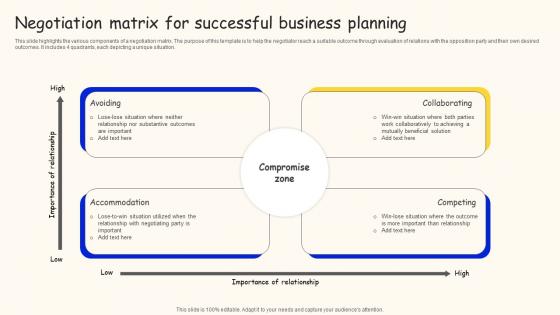
Negotiation Matrix For Successful Business Planning




Try Before you Buy Download Free Sample Product
 Impress Your
 Audience
 100%
100% Editable
 Save Hours
 of Time


This slide highlights the various components of a negotiation matrix. The purpose of this template is to help the negotiator reach a suitable outcome through evaluation of relations with the opposition party and their own desired outcomes. It includes 4 quadrants, each depicting a unique situation.
People who downloaded this PowerPoint presentation also viewed the following :
Negotiation Matrix For Successful Business Planning with all 9 slides:
Use our Negotiation Matrix For Successful Business Planning to effectively help you save your valuable time. They are readymade to fit into any presentation structure.








FAQs for Negotiation Matrix For
A negotiation matrix is a strategic framework that systematically evaluates negotiation variables, priorities, alternatives, and potential outcomes across different scenarios. Through structured analysis of stakeholder positions, trade-offs, and decision criteria, organizations streamline complex negotiations by identifying optimal strategies, anticipating counterparty responses, and maximizing value creation, ultimately delivering more favorable agreements and stronger strategic partnerships.
A negotiation matrix helps identify win-win outcomes by mapping each party's priorities, interests, and acceptable trade-offs in a structured format, revealing areas of mutual benefit and creative value creation. Through systematic analysis, negotiators can identify complementary needs where one party's lower-priority items align with another's high-priority goals, ultimately enabling strategic exchanges that maximize value for all stakeholders involved.
Key components of a negotiation matrix include stakeholder priorities, alternative solutions, value propositions, concession limits, and timeline constraints. These elements work together by mapping decision points, identifying trade-off opportunities, and establishing clear boundaries, with many negotiators finding that structured matrices streamline complex discussions while maximizing strategic outcomes.
Cultural differences significantly impact negotiation matrices through varying communication styles, decision-making processes, relationship priorities, and time orientations. While Western cultures often emphasize direct, data-driven approaches, many Asian and Latin cultures prioritize relationship-building and consensus, requiring matrix adaptations that account for hierarchical structures, face-saving considerations, and collaborative decision frameworks, ultimately delivering more culturally sensitive and successful negotiation outcomes.
Preparation enables negotiation teams to identify key variables, prioritize objectives, map potential concessions, and anticipate counterpart responses within a structured matrix framework. Through thorough research and strategic planning, negotiators can populate their matrix with realistic alternatives, define acceptable trade-offs, and establish clear boundaries, ultimately delivering more confident decision-making and successful outcomes during complex discussions.
A negotiation matrix can effectively be used in personal contexts like salary discussions, family decisions, real estate purchases, and divorce settlements by systematically evaluating priorities, trade-offs, and potential outcomes. This structured approach helps individuals clarify their goals, assess alternatives objectively, and identify win-win solutions, ultimately delivering better personal outcomes and reducing emotional decision-making in high-stakes personal negotiations.
Issues within a negotiation matrix are prioritized by assessing their strategic importance to your objectives, potential impact on deal value, and likelihood of achieving favorable outcomes. Successful negotiators typically rank high-impact, achievable items first, followed by relationship-building concessions, with many finding that this structured approach streamlines complex discussions while maximizing overall value and maintaining positive stakeholder relationships.
Common pitfalls include over-relying on the matrix without adapting to real-time dynamics, failing to update priorities as negotiations evolve, and neglecting emotional intelligence factors that matrices cannot capture. These tools enhance preparation and strategy tracking, but successful negotiators balance structured analysis with flexibility, active listening, and relationship-building, ultimately delivering stronger outcomes through both systematic planning and adaptive execution.
Technology enhances negotiation matrices through real-time data analytics, automated scenario modeling, predictive outcome analysis, and collaborative digital platforms. These tools streamline preparation by processing vast datasets, generating multiple strategic options, and enabling remote stakeholder collaboration, with many organizations finding that AI-powered insights deliver faster decision-making and more successful negotiation outcomes.
Different negotiation styles significantly influence matrix layout by determining priority weighting, information emphasis, and strategic positioning of key variables. Competitive negotiators typically structure matrices with win-lose scenarios prominently displayed, while collaborative styles emphasize mutual value creation sections, and accommodating negotiators focus on relationship-preservation metrics, with many organizations finding that style-adapted matrices ultimately deliver more targeted strategies and successful outcomes.
A negotiation matrix facilitates better communication by providing a structured framework that clearly outlines each party's interests, priorities, and potential trade-offs in a visual format. This transparency enables negotiators to identify common ground, articulate positions more effectively, and explore creative solutions systematically, with many organizations finding that structured approaches reduce misunderstandings while accelerating deal closure.
Visual elements enhance negotiation matrix clarity by incorporating color coding for priority levels, icons for different negotiation points, clear typography hierarchies, and strategic white space distribution. These design techniques streamline complex information processing, enable faster pattern recognition during high-stakes discussions, and ultimately deliver more effective decision-making outcomes, with many negotiation teams finding that well-designed matrices significantly reduce misunderstandings.
**INPUT**: What metrics or criteria should be used to evaluate the success of a negotiation matrix? **OUTPUT**: Success metrics for negotiation matrices include outcome achievement rates, stakeholder satisfaction scores, time-to-agreement measurements, relationship preservation indicators, and strategic objective fulfillment. These evaluation criteria enable organizations to assess negotiation effectiveness by tracking win-win outcomes, implementation compliance, and long-term partnership value, with many companies finding that systematic measurement ultimately enhances future negotiation strategies and competitive positioning. [Word count: 59]
A negotiation matrix adapts through customizable parameters including stakeholder priorities, outcome variables, timeline constraints, and cultural considerations specific to each scenario. Whether handling supplier contracts, salary discussions, or international partnerships, organizations can modify evaluation criteria, weight different factors, and adjust scoring mechanisms to reflect unique circumstances, ultimately enabling more strategic decision-making and improved negotiation outcomes.
Real-world negotiation matrices include salary negotiations weighing compensation against benefits and growth opportunities, supplier contract discussions balancing cost versus quality and delivery terms, and merger negotiations evaluating financial offers alongside strategic synergies. These structured frameworks enable negotiators to systematically assess trade-offs, prioritize key variables, and identify win-win solutions, with many organizations finding that matrix-based approaches deliver more strategic outcomes and stronger stakeholder relationships.
-
I looked at their huge selection of themes and designs. They appeared to be ideal for my profession. I'm sure I'll grab a few of them.
-
Love how there are no boring templates here! The design is fresh and creative, just the way I like it. Can't wait to edit and use them for my extended projects!