


Negotiation Phase Of SPANCO Sales Process Training Ppt




Try Before you Buy Download Free Sample Product
 Impress Your
 Audience
 100%
100% Editable
 Save Hours
 of Time


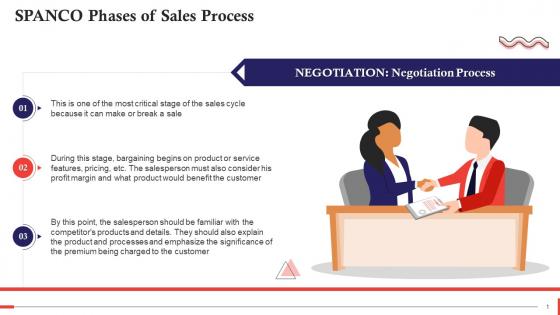
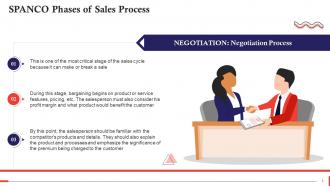
This slide explains the negotiation phase of the SPANCO sales process and emphasizes that negotiation is a critical stage of the sales cycle because it can make or break a sale. Bargaining on product or service features, pricing, and so on begins at this stage. The salesperson must also consider his profit margin and which product would be most beneficial to the customer. By this point, the salesperson should be familiar with the competitors products and details.
People who downloaded this PowerPoint presentation also viewed the following :
Negotiation Phase Of SPANCO Sales Process Training Ppt with all 16 slides:
Use our Negotiation Phase Of SPANCO Sales Process Training Ppt to effectively help you save your valuable time. They are readymade to fit into any presentation structure.









FAQs for Negotiation Phase Of SPANCO Sales
Key factors include preparation and research, clear objective setting, understanding counterpart interests, establishing negotiation boundaries, and developing flexible strategies. These elements streamline the process by enabling informed decision-making, strategic positioning, and adaptive responses, with many organizations finding that thorough preparation ultimately delivers better outcomes and stronger business relationships.
Building rapport during negotiations involves active listening, finding common ground, using mirroring techniques, asking open-ended questions, and showing genuine interest in the other party's perspective. Through these approaches, negotiators create collaborative atmospheres that facilitate trust and understanding, with many business leaders finding that strong rapport ultimately leads to more creative solutions and sustainable agreements.
Strategies include active listening to underlying concerns, asking open-ended questions about priorities, mapping shared goals like cost efficiency or timeline adherence, and reframing positions as mutual problems to solve. These approaches enable negotiators to uncover overlapping interests through collaborative dialogue, joint brainstorming sessions, and stakeholder mapping, ultimately delivering stronger agreements and long-term partnerships.
Handling objections effectively requires active listening, empathy, and strategic reframing techniques that address underlying concerns rather than surface-level pushback. Successful negotiators acknowledge objections respectfully, ask clarifying questions to understand root issues, and present alternative solutions or value propositions, with many finding that this approach builds trust and ultimately delivers more collaborative outcomes.
Emotional intelligence enables negotiators to read counterparts' emotions, manage their own reactions, and build rapport through empathy and active listening. Through emotional awareness, negotiators can identify underlying concerns, de-escalate tensions, and find mutually beneficial solutions, with many business professionals finding that emotionally intelligent approaches ultimately deliver stronger relationships and more sustainable agreements.
Active listening enhances negotiations by building rapport, uncovering underlying interests, identifying shared goals, and creating collaborative problem-solving opportunities. Through careful attention to verbal cues and emotional context, negotiators can address unspoken concerns, adapt their strategies in real-time, and ultimately achieve mutually beneficial outcomes that strengthen long-term business relationships.
Countering aggressive negotiation tactics involves staying calm, asking clarifying questions, setting clear boundaries, using strategic pauses, and reframing discussions around mutual benefits rather than confrontation. These approaches enable negotiators to maintain professional control while redirecting aggressive counterparts toward collaborative solutions, with many organizations finding that structured de-escalation techniques ultimately deliver better outcomes and preserve valuable business relationships.
Preparation is critically important in negotiations, determining success through thorough research, clear objective-setting, stakeholder analysis, and strategy development. Effective preparation entails understanding counterpart interests, establishing BATNA alternatives, defining negotiable terms, and anticipating potential objections, with many organizations finding that comprehensive preparation delivers stronger outcomes and competitive positioning.
Common negotiation pitfalls include poor preparation, emotional decision-making, inflexible positioning, inadequate listening, and rushing toward quick agreements. These mistakes often derail discussions by creating adversarial dynamics, missed opportunities, and suboptimal outcomes, with many organizations finding that structured preparation and collaborative approaches ultimately deliver stronger partnerships and sustainable competitive advantages.
Cultural differences significantly impact negotiation strategies through varying communication styles, decision-making processes, relationship priorities, time orientations, and hierarchy expectations. These variations affect everything from contract discussions in international business deals to partnership agreements across different markets, with many multinational organizations finding that culturally-informed approaches ultimately deliver stronger relationships and more sustainable outcomes.
Collaborative negotiation techniques include active listening, shared problem-solving, interest-based discussions, transparent information sharing, and joint brainstorming sessions. These approaches streamline outcomes by building trust, identifying mutual benefits, and creating win-win solutions, while competitive tactics often limit long-term partnerships, with many organizations finding that collaborative methods ultimately deliver stronger relationships and sustainable agreements.
Effectively communicating your value proposition requires clearly articulating specific benefits, quantifiable outcomes, and competitive differentiators that address the client's core business challenges. Frame your solution through their perspective, using concrete examples from similar organizations, detailed ROI projections, and testimonials that demonstrate measurable results, ultimately positioning your offering as a strategic investment rather than a cost.
Successful negotiation closing practices include summarizing agreed points, addressing remaining concerns, creating urgency through deadlines, offering strategic concessions, and confirming mutual benefits. These approaches streamline final decisions by building momentum, eliminating last-minute objections, and reinforcing value propositions, with many organizations finding that structured closing processes ultimately deliver faster agreements and stronger long-term partnerships.
Timing and deadlines significantly influence negotiation dynamics by creating urgency, shifting power balances, and affecting decision-making quality throughout the process. Strategic negotiators leverage favorable timing while managing deadline pressure, with many organizations finding that well-timed proposals and realistic deadlines enhance outcomes, streamline agreements, and ultimately deliver competitive advantages in complex business negotiations.
Negotiation success metrics include deal value achieved, timeline efficiency, relationship preservation scores, cost reduction percentages, and implementation compliance rates. These measurements enable organizations to assess both immediate outcomes and long-term strategic value, with many companies finding that balanced scorecards tracking financial gains alongside stakeholder satisfaction ultimately deliver sustainable competitive advantage.
-
Fantastic and innovative graphics with useful content. The templates are the best and latest in the industry.
-
Love how there are no boring templates here! The design is fresh and creative, just the way I like it. Can't wait to edit and use them for my extended projects!