

Netflix investor funding elevator pitch deck ppt template





Try Before you Buy Download Free Sample Product
 Impress Your
Audience
 100%
Editable
 Save Hours
of Time


OTT or over-the-top platforms are currently one of the most significant growing trends and segments of the entertainment world. Here is a professionally designed pitch deck for one of the largest OTT platforms, Netflix. The slides are usually preceded by the problem slide, which helps users display the critical problems they are willing to solve with their product and services. The following slide provides an overview of the organizations history to the user as it can be utilized to display the organizations journey from the date of inception. We provide you with an overview of how the organization will be earning revenues. this complete framework is called the revenue model. the following OTT platform utilizes a subscription-based or a recurring revenue model, which depends on multiple subscription models. While making a pitch deck, detailed competition analysis plays a key role. Thus we provide you with our understanding of the competition slide, which highlights the significant competitors of Netflix in the market and compares them on various parameters and usage. Get access to this 100 percent editable deck now.
People who downloaded this PowerPoint presentation also viewed the following :
Content of this Powerpoint Presentation
Slide 1: This slide introduces Netflix Investor Funding Elevator Pitch Deck. State Your Company Name and begin.
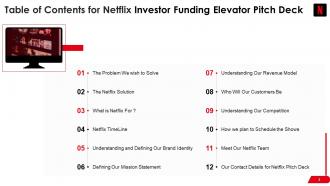
Slide 2: This slide shows Table of Contents for Pitch Deck.
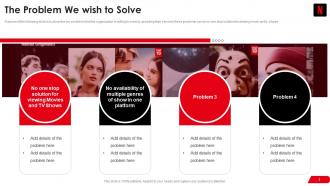
Slide 3: This slide presents key problems that the organization is willing to solve by providing their services.
Slide 4: This slide shows key solution that the organization is willing to solve by providing their services.
Slide 5: This slide displays key idea behind Netflix as it highlights 2 major scenarios, which are key usage of Netflix and what are the expectations for Netflix.
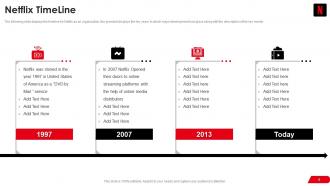
Slide 6: This slide represents timeline for Netflix as an organization, the provided displays the key years in which major development took place.
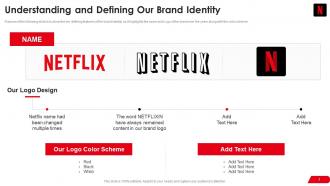
Slide 7: This slide shows key defining features of the brand identity as it highlights the name and Logo of the brand over the years.
Slide 8: This slide presents key points of brand identity of the organization as it highlights the most popular OTT platform.
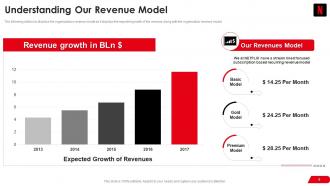
Slide 9: This slide shows organizations revenue model as it displays the expected growth of the revenue along with the organization revenue model.
Slide 10: This slide displays details of the key customer base of Netflix as it displays the gender, racial ethnicity, age, sexuality, lifestyle etc.
Slide 11: This slide represents key competitors of Netflix in the market as it highlights the name and logo of major competitors.
Slide 12: This slide shows result of general population survey of preference over OTT platforms.
Slide 13: This slide presents details of scheduled shows to appear on the streaming channel.
Slide 14: This slide shows key team members of the organization who are responsible for handling, the organizations operations.
Slide 15: This slide displays Our Contact Details for Netflix Pitch Deck.
Slide 16: This slide represents Icons for Netflix Investor Funding Elevator Pitch Deck.
Slide 17: This slide is titled as Additional Slides for moving forward.
Slide 18: This slide presents key core value of the organization as it highlights the main tagline of the value.
Slide 19: This slide shows Identifying the Key Issues in the Process.
Slide 20: This slide displays 2 major rules on which the organization focuses on.
Slide 21: The following slide is to show and understand the corporate model of the organization.
Slide 22: This slide shows 30 60 90 Days Plan with text boxes.
Slide 23: This slide presents Roadmap with additional textboxes.
Slide 24: This is a Financial slide. Show your finance related stuff here.
Slide 25: This is a Timeline slide. Show data related to time intervals here.
Slide 26: This slide represents Venn diagram with text boxes.
Slide 27: This slide shows Post It Notes. Post your important notes here.
Slide 28: This is a Comparison slide to state comparison between commodities, entities etc.
Slide 29: This slide shows Bar Chart with two products comparison.
Slide 30: This slide displays Dashboard with additional text boxes to show information.
Slide 31: This is a Thank You slide with address, contact numbers and email address.
Netflix investor funding elevator pitch deck ppt template with all 36 slides:
Use our Netflix Investor Funding Elevator Pitch Deck Ppt Template to effectively help you save your valuable time. They are readymade to fit into any presentation structure.











FAQs for Netflix investor funding elevator pitch
Netflix got early funding because their DVD-by-mail thing actually fixed what people hated about Blockbuster - no more late fees and way better selection. Plus investors loved that subscription model since it meant steady monthly money coming in. Way more predictable than random rental income. The founders being tech guys helped a lot too, especially when they started mentioning streaming (which seemed crazy back then but whatever). For your pitch, focus on recurring revenue and actually making customers' lives easier. Those two things are still gold with investors today.
So Netflix went from mailing DVDs to streaming, then started making their own shows - each move got them huge investor money. The subscription thing was nice steady income, but House of Cards changed everything. Suddenly VCs saw they weren't just tech, they were building a media empire to take on HBO and Disney. Plus they had all this viewer data that made their content bets way smarter than traditional studios shooting in the dark. Honestly, that's the pattern to watch - companies that stop just moving content around and start owning it.
Dude, Netflix would've been toast without VC money. They burned through cash like crazy in those early DVD-by-mail days - I'm talking late 90s, early 2000s when nobody knew if this thing would work. Multiple funding rounds kept the lights on while they figured out their subscription model. Without that patient investor cash, they couldn't have built their distribution network or expanded their catalog. It's actually insane how different streaming would look today if those VCs hadn't stuck with them through the bleeding money phase. Perfect case study for your startup research honestly.
Dude, Netflix is totally different from the old-school studios. They dump SO much data on investors every quarter - subscriber counts, regional breakdowns, content performance, all of it. Meanwhile Disney and Warner Bros? They keep that streaming info locked down tight. Netflix treats their earnings calls like everyone's a data nerd, which honestly makes sense since they're basically a tech company that happens to make shows. Traditional studios still act more... traditional, I guess? Way less detailed reporting. Check out their quarterly letters if you want to see how it's done - they're crazy thorough.
So Netflix basically had to go into massive debt when all the other streaming services popped up. They raised like $15+ billion in bonds between 2011-2019 because they knew Disney, HBO, everyone would pull their shows eventually. Remember when Netflix was just other people's content? Now it's all Netflix Originals because they had to spend crazy money upfront before making anything back. Honestly, it was probably their only move but man, that debt's gonna stick around for years. They're prioritizing grabbing market share over actually making profit right now.
So Netflix basically went all-in on debt to fund their takeover of the world. Since 2011 they've issued billions in bonds instead of diluting shareholders - pretty clever tbh. All that borrowed money went into original shows like House of Cards and international expansion. Their debt peaked around 2018-2020 when they were in full aggressive mode. The crazy part? It actually worked because subscriber growth was insane back then. If you're thinking about similar strategies, just make sure you've got the growth numbers to justify all that borrowing first.
So Netflix basically did a complete 180 since their IPO in 2002. Back then it was all about DVD numbers, now everyone's obsessed with streaming subscribers and global expansion stuff. Around 2013 they went crazy with original content - honestly that pivot was genius but risky. Now investors expect them to blow $15+ billion on shows every year while still growing subscribers worldwide. Earnings calls are just subscriber additions and churn rates on repeat. It's pretty wild for a company that used to mail DVDs. If you're thinking about their stock, focus on subscriber metrics and how well their content investments pay off, not the old retail stuff.
So Netflix is all about subscriber numbers - that's the main thing. Are they adding more people than they're losing? Regional stuff matters too, like how they're doing internationally. Revenue per user is huge, and honestly their content spending is insane sometimes (but you gotta track if it's actually working). Free cash flow is worth watching since they burn money on original shows constantly. The real question is whether new subscribers are worth what it costs to get them. Oh, and churn rates - basically how many people are canceling. That tells you if their content strategy is actually keeping people hooked.
So Netflix dumps most of their cash into content - we're talking billions every year. Original shows, movies, licensing deals, all that stuff. They grab investor money to fund huge productions like Stranger Things or snag exclusive rights before other companies can. It's honestly wild how much they spend. Data analytics help them figure out what people actually want to watch, plus they're buying tons of international content now. If you're following their stock, definitely check their content spending - it's usually their biggest expense and totally drives whether they gain or lose subscribers.
Netflix basically had to sell investors on three totally different companies - first the DVD thing, then streaming, now they're making their own shows. Wild pivot strategy but it worked. They also raised cash while things were going well instead of waiting until they were desperate (smart but brutal when you're eating ramen every day). Here's the thing though - they didn't just pitch profitability. They sold VCs on owning ALL of entertainment distribution. That's huge. For your startup, paint the picture of dominating a massive market. Then raise money while you're crushing it, not scrambling.
Strategic partnerships were actually Netflix's secret weapon for funding. They cut down on traditional equity raises by creating revenue streams and splitting costs with other companies. Content deals with studios, international partnerships, tech infrastructure arrangements - all worked like funding without the dilution. Disney was perfect example until they backstabbed Netflix and went solo (classic move). These deals let them grab content and expand markets without burning cash. Smart structuring meant less upfront capital too. Honestly, it kept investors from freaking out about cash burn while Netflix built their empire.
Honestly, Netflix's main problem is proving they can keep adding subscribers when everyone's broke right now. The streaming wars are brutal - Disney+, HBO Max, all these services fighting for the same eyeballs. They're dropping insane money on original shows while trying to not lose customers to competitors. Wall Street gets super jumpy whenever subscriber numbers miss targets, especially with those price increases pissing people off. Their stock is all over the place after earnings because analysts are obsessed with those growth metrics. I'd watch their international numbers though - that's where the real growth potential is.
Yeah, Netflix's funding is basically tied to whatever's happening in the market. When competition gets crazy, they scramble for more cash to beef up content and tech. Consumer habits shift and they have to shift their money too - remember when everyone went nuts for international shows? They dumped tons into global productions overnight. Honestly, if you want to predict their next moves, just watch viewing patterns and when competitors launch stuff. That's when they'll hit up debt markets or completely change how much they're spending on content. Their whole strategy is just chasing what people want while trying to stay ahead of rivals.
Netflix is basically hunting for subscribers everywhere except the US now. The American market? Pretty much tapped out. So when they go to investors, it's all about those international numbers - that's where the real growth is hiding. They're burning through cash to make local shows for different countries, plus all the tech infrastructure stuff. Honestly, it makes sense - you can't just dump American content everywhere and expect it to work. If you're following their stock or whatever, just watch those international subscriber counts. That's literally what determines how much money they'll ask for next.
So Netflix is basically drowning themselves in debt to keep up with Disney+ and HBO Max. They're issuing bonds left and right - billions every year - because you can't survive without killer originals anymore. The cash burn is pretty wild tbh. Smart move though is how they're focusing on international shows that work everywhere, not just the US market. Gets more bang for their buck that way. Oh and definitely keep an eye on their international subscriber numbers - that's where all this borrowed money is actually paying off for them.
-
I discovered this website through a google search, the services matched my needs perfectly and the pricing was very reasonable. I was thrilled with the product and the customer service. I will definitely use their slides again for my presentations and recommend them to other colleagues.
-
Amazing product with appealing content and design.