


Grab Investor Funding Elevator Pitch Deck Ppt Template




Try Before you Buy Download Free Sample Product
 Impress Your
 Audience
 100%
100% Editable
 Save Hours
 of Time


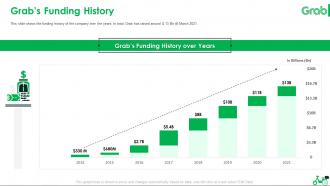
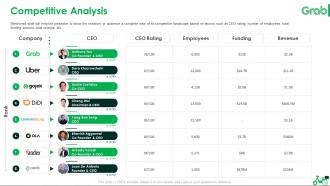
Grab Holdings Inc., or simply Grab, is a Southeast Asian technology company based in Singapore and Indonesia. Aside from transportation, the company provides food delivery and digital payment services through a mobile app. Since its inception in 2012, Grab has grown exponentially to become Southeast Asias most valuable startup, with a doller16 billion valuation. Grab our competently designed pitch deck on Grab that presents a summary of Grab, showing challenges and solutions, Grab service offerings, user journey for GrabCar services, and Grabs team structure. Also, this PowerPoint presentation provides details about Grabs geographical presence, Grabs technology stack, Grab business strategies, Grab value proposition, Grab business model, and grabs funding history. Additionally, this pitch deck provides information on Grabs competitive analysis, Grab business acquisitions, Grab business investments, Grabs all-star program, and Grab reviews. Book a free demo with our research team now.
People who downloaded this PowerPoint presentation also viewed the following :
Content of this Powerpoint Presentation
What is your big product or service idea? What does it do? Why is it worth investing? An elevator pitch deck provides the answers to these questions.
An elevator pitch deck must be brief but effectively convey the problem you are solving. It is your opportunity to show investors the uniqueness of your brand. It should be persuasive enough to get the investor to talk to you again.
If you want to build an elevator pitch deck for your business, explore our Grab Investor Funding Elevator Pitch template for inspiration.
Grab is one of the leading businesses in Southeast Asia. It offers transportation, food delivery, and digital payment services. Our presentation template uses Grab's brand colors—green and white.
We cover topics like company overview, service offerings, and value proposition - all of which can help you grab investor attention.
Are you seeking funds to expand your beauty business? Use our customizable Glossier investor funding elevator pitch deck template to design a PPT for your business. The template covers topics like problems, solutions, strategies, and financial highlights.
Grab Investor Funding Elevator Pitch Template
Our elevator pitch template is designed to help you garner investor interest. The deck can be used to present your services, business model, and acquisitions. We have used different layouts, charts, and tables to showcase necessary information. The slides are also content-ready according to Grab's offerings.
Is your business mission to help customers eat healthy? Are you looking for investors for your food business? Here is a HelloFresh investor funding elevator pitch deck that you can tailor to your business model.
Here are some of the important slides that make up our Grab investor funding template.
Template 1: Company Overview
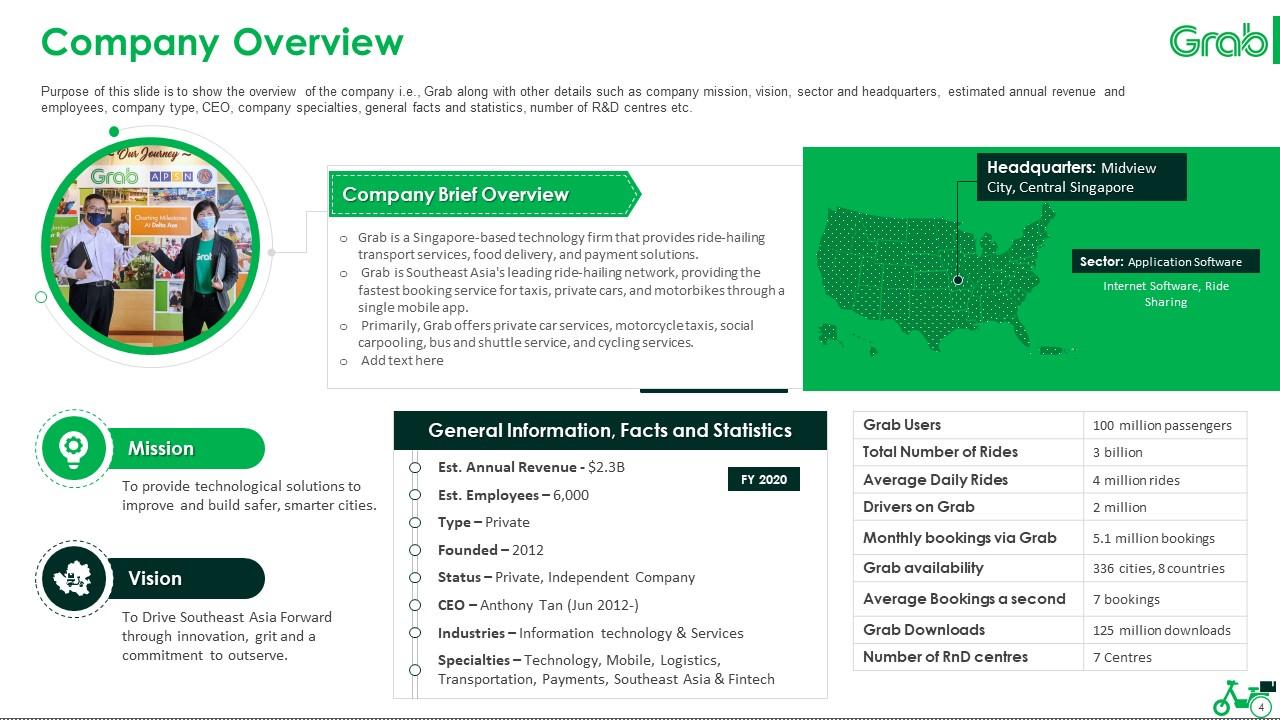
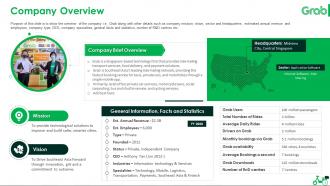
Everything that an investor needs to know about your company is included in this slide. The slide starts with a brand logo or offering on the top. The text near it allows you to describe your USP, and locate your headquarters on the map. The bottom-left of the slide is where you mention your mission and vision. Next is a text box and table wherein you can highlight statistics and financial data.
Template 2: Challenges and Solution
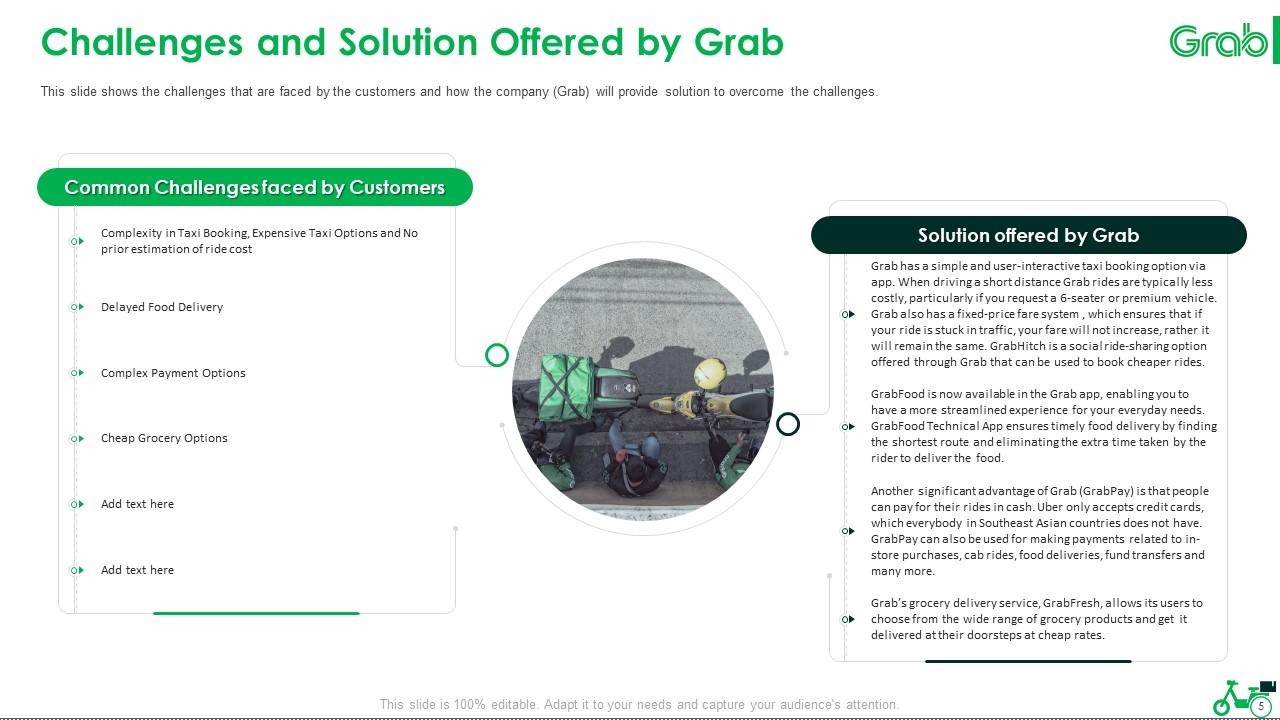
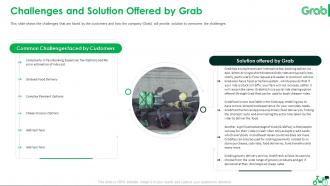
The slide's two segments of challenges and solutions are beautifully and separately presented, but lined through visuals. You can mention challenges in a bulleted list format. You can mention the solutions in the same format. You can use the picture section for your product or service. If you have a transportation or delivery service business, there is researched content available that you can adapt to your offerings.
Template 3: Underlying Magic
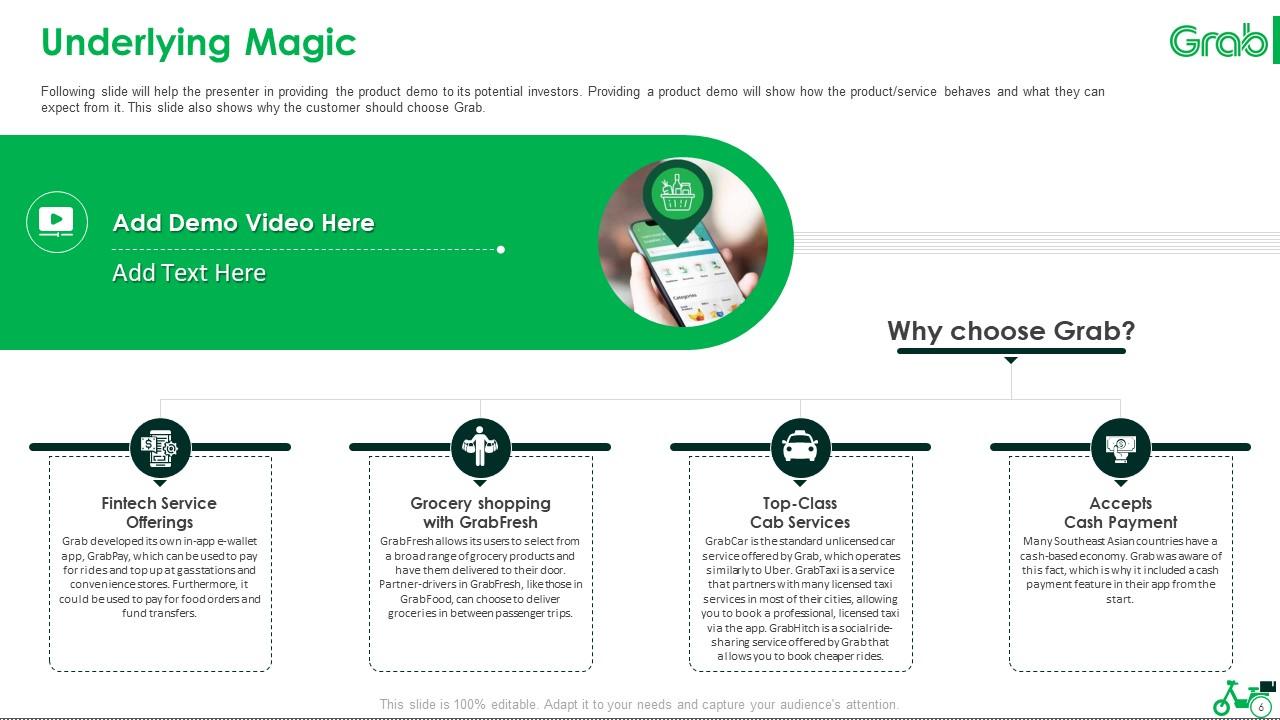
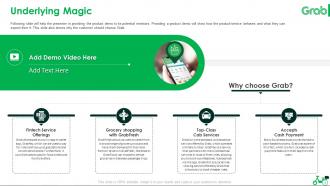
Why should an investor fund your idea? You can use the bottom part of the slide to explain how choosing your brand will benefit customers. There are text boxes available with icons and headings with ample space to elaborate on your brand's strong points.
Template 4: Service Offerings
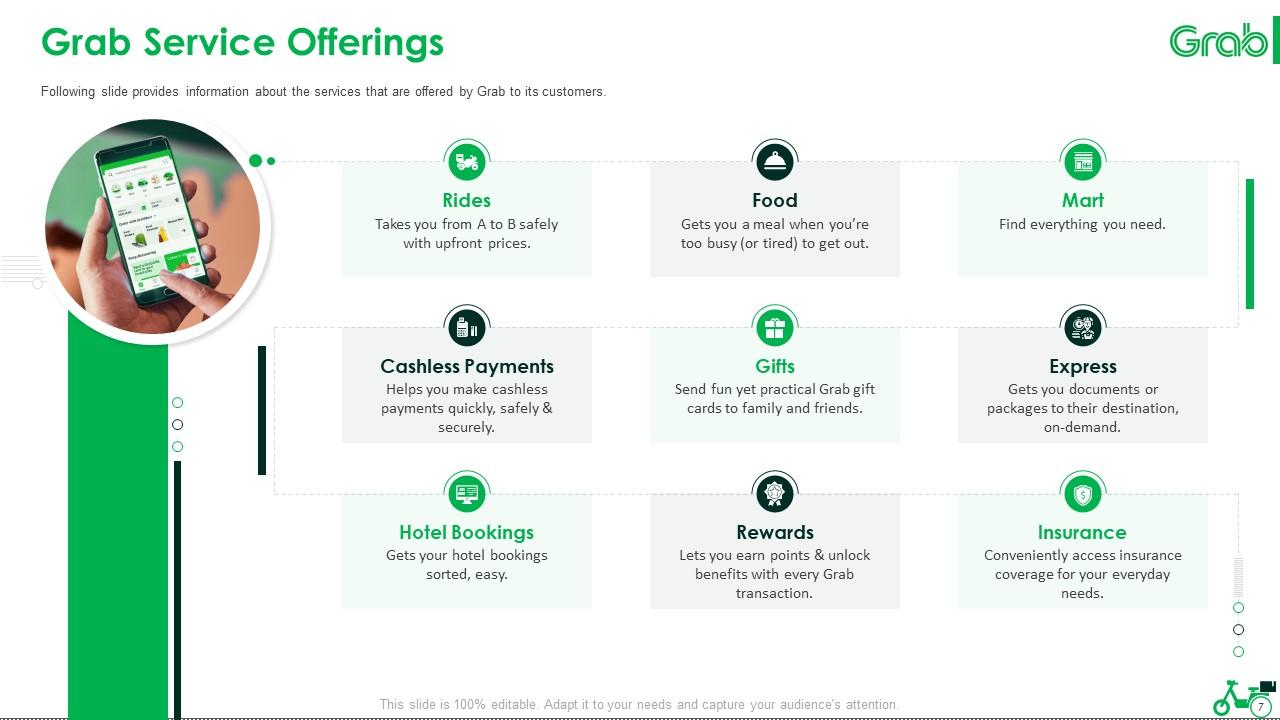
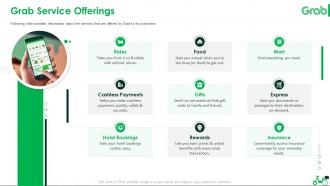
What services does your business offer? We have mentioned nine services on the slide, taking Grab as an example. The services take up the majority of space on the slide while being neatly divided into sections. Each service is described with an icon, a heading, and a one-liner. We have designed the slide to help you showcase the extent of your product or service line. Thus, the layout focuses on bringing the viewer's attention to the icon and the heading boosting recall.
Template 5: User Journey
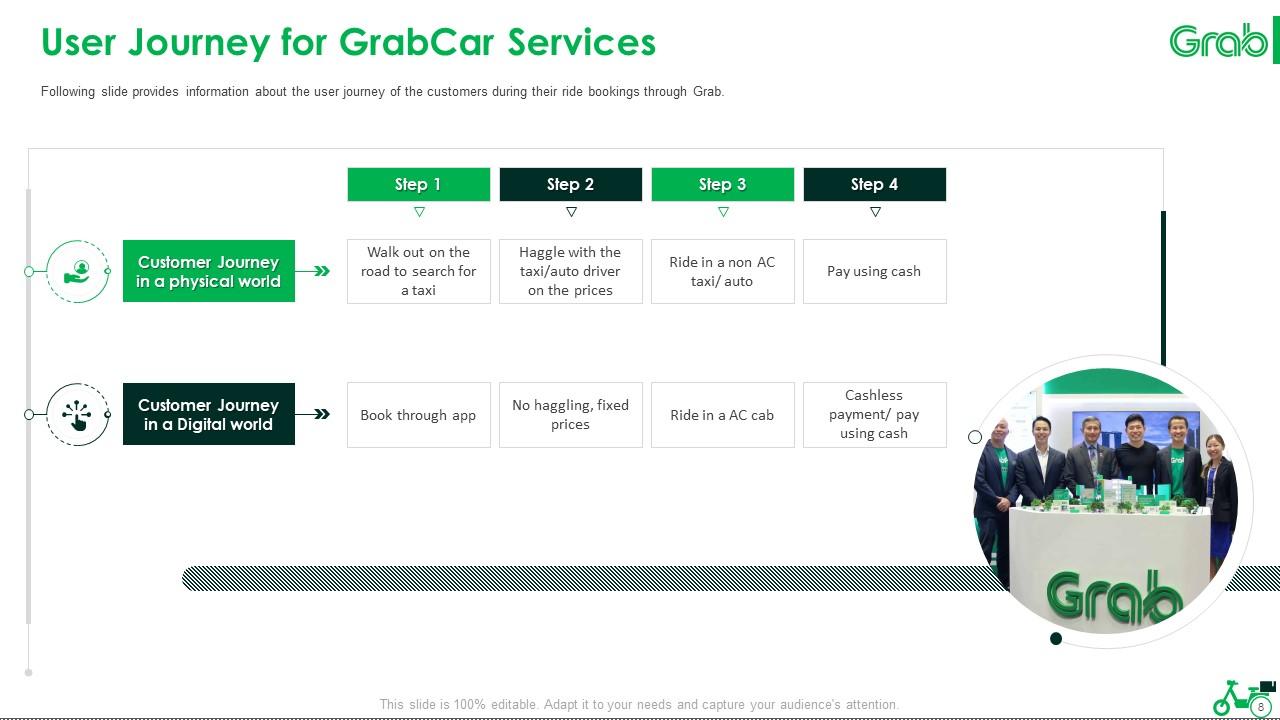
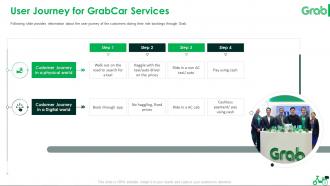
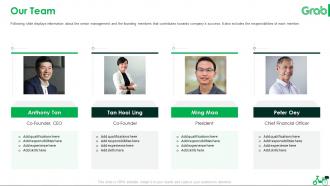
How will a customer interact with your product? You can use the 'User Journey' template to explain the process with steps. The process is divided into four steps. The comparison of the real and digital world scenarios helps reiterate how Grab is the more convenient option. Another design element that you will see through the deck is the placement of pictures. The picture element can be used to improve brand recall, showcase popular products, or introduce key members.
Template 6: Geographical Presence
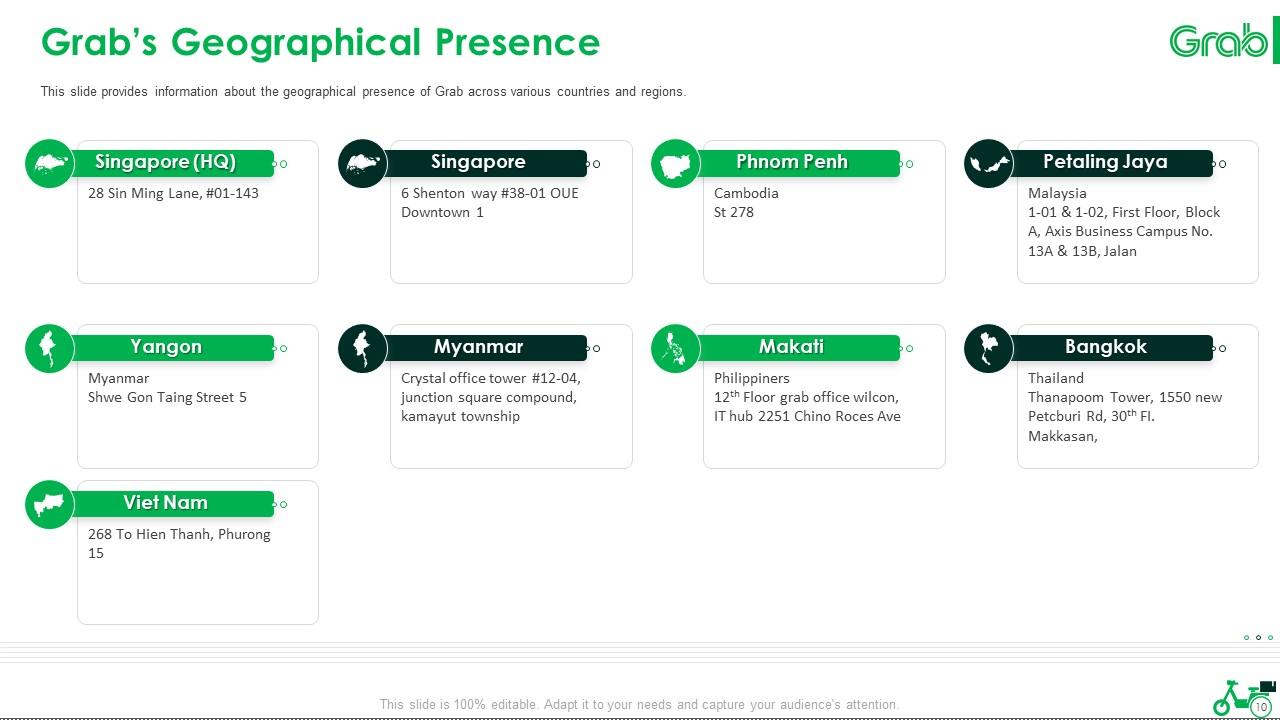
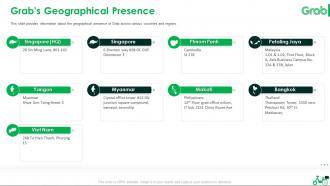
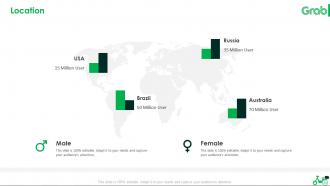
Do you offer services on the global stage? In which countries are your services available? You can use the 'Geographical Presence' slide, as the name suggests, to highlight the countries in which you operate your business. Our template mentions nine countries, but as it is 100% editable, you can add or remove countries according to your company's offices. Each country is represented by an icon, label, and text box containing the office address. An interesting design element is that the icons include the map of the country mentioned. Such small elements can help show how detail-oriented you are.
Template 7: Business Strategies
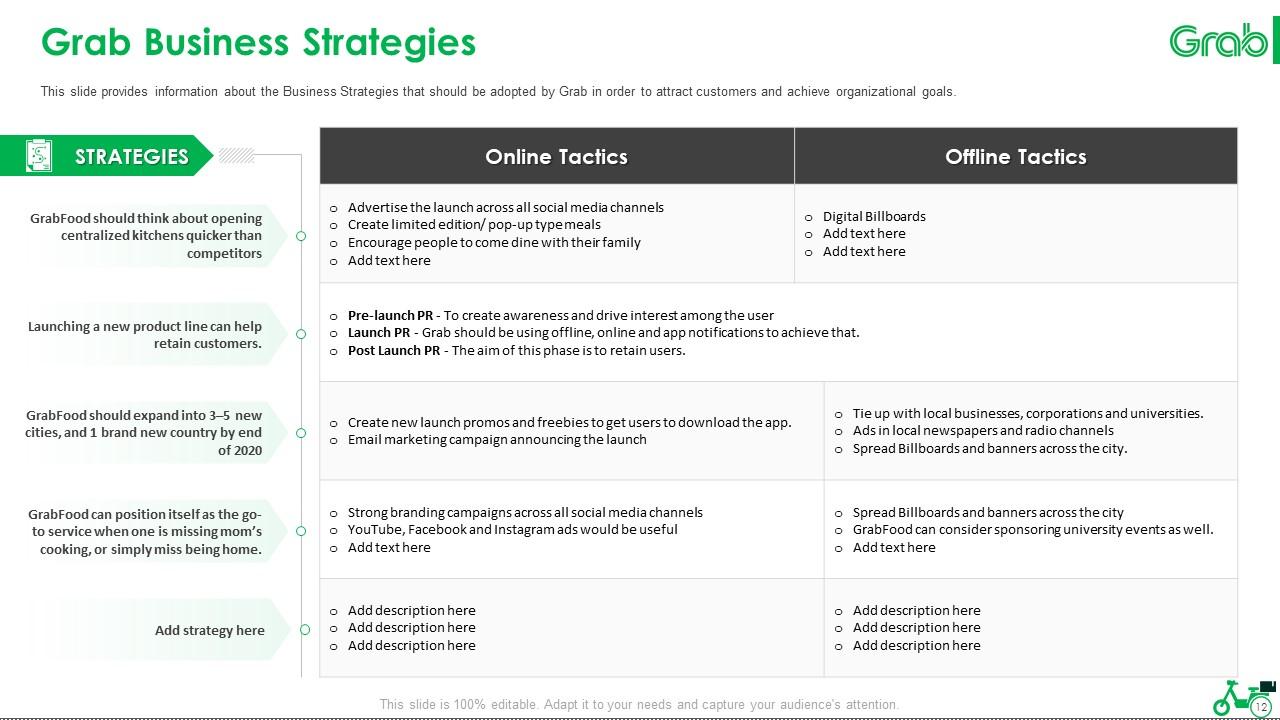
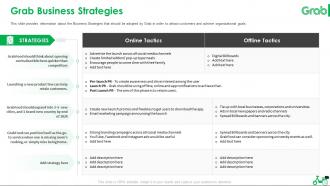
How do you plan to grow your business? What specific business strategies are you employing to meet your goals? The Business Strategy slide includes a lot of content. Thus, the design is kept simple with the use of a table. On the left side of the slide, we have listed the goals for the year. Next to it is a table with online and offline tactics. It includes tasks and steps whose completion will help achieve the mentioned goals. This slide is your chance to show investors that you have a vision for the future and a concrete plan in place for achieving that vision.
Template 8: Value Proposition
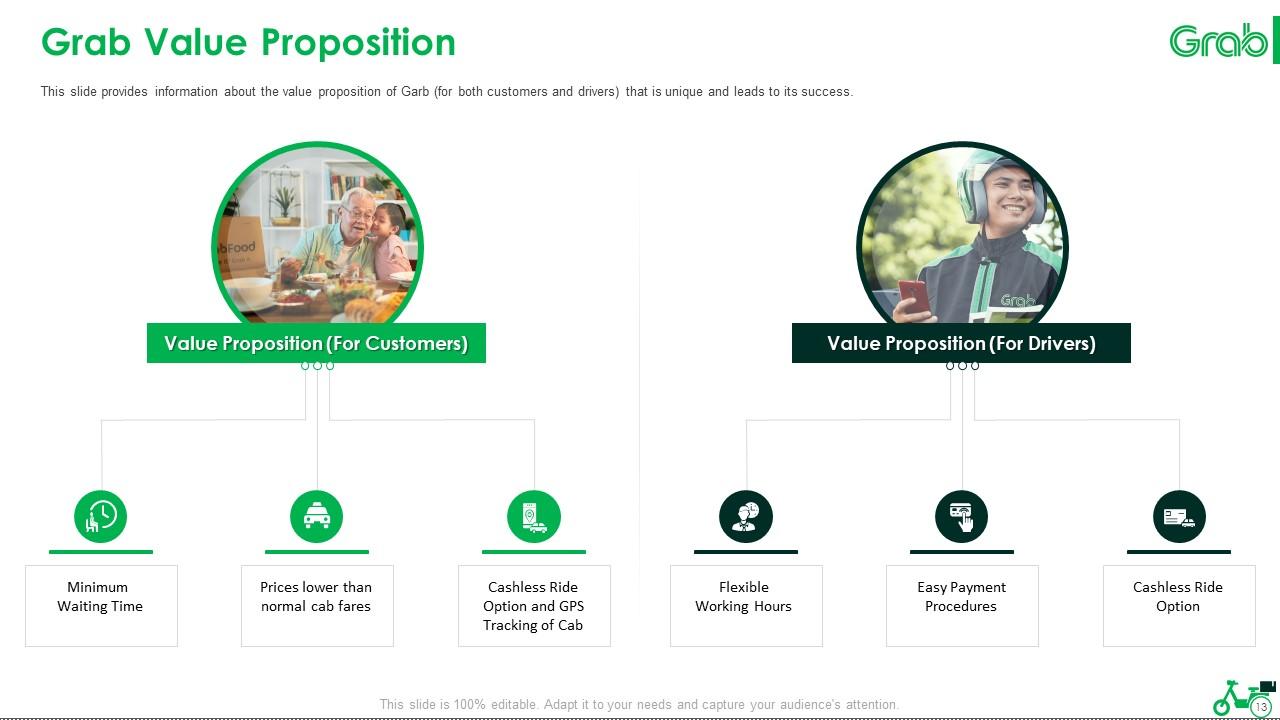
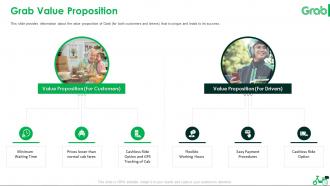
After a content-heavy slide, we switch to a more graphical and visually appealing slide. Value proposition conveys why stakeholders should engage with your product. What value does your product provide them? In the case of Grab, the stakeholders are customers and drivers. A hierarchy flow defines the stakeholders at the top with a picture, followed by benefits below. The benefits are represented on the slide.
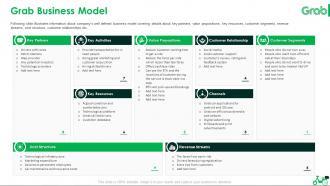
Template 9: Business Model
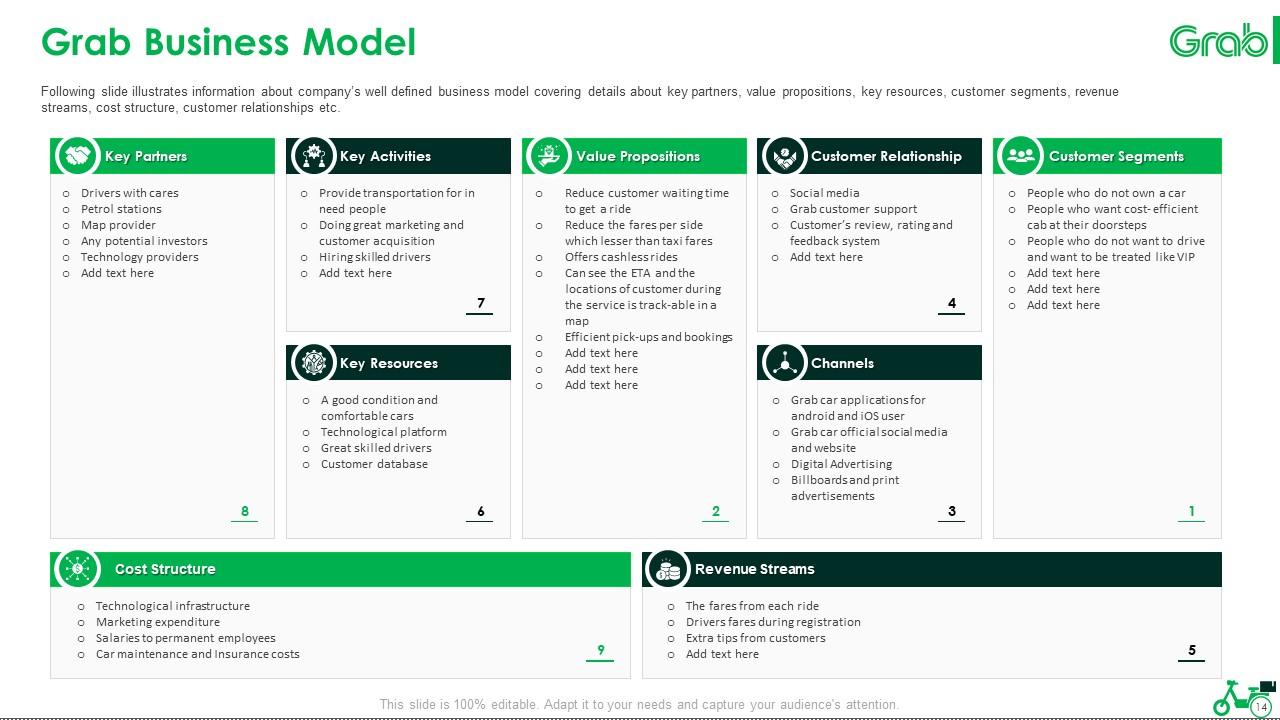
What value does your business deliver? What are your revenue streams? How do you manage customer relationships? A business model encapsulates all this information and more. It helps the investor understand how their investment will be used and how they will get their returns. As the content takes priority, we have stuck to tables for a clean presentation and viewing experience. Again, you can add/remove tables and data and adapt the slide to your business model.
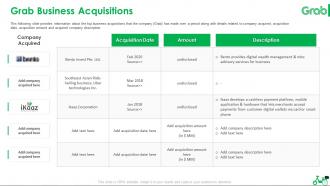
Template 10: Business Acquisitions
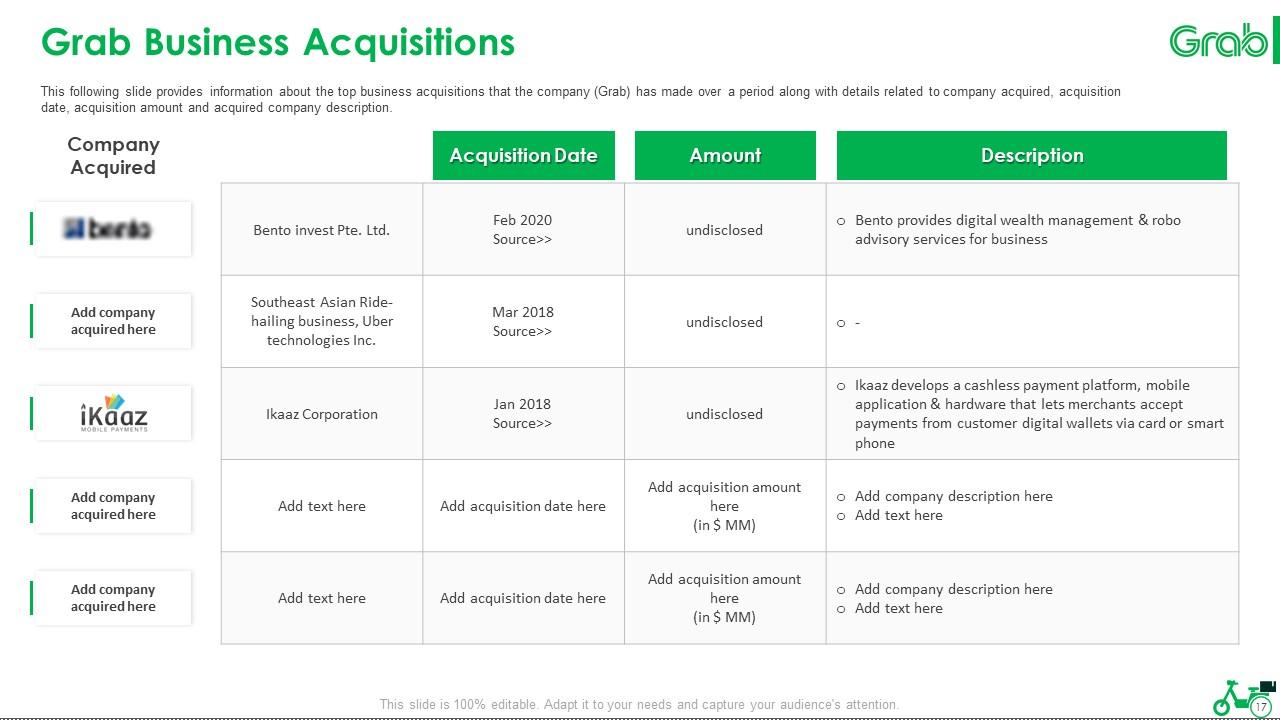
Business purchases help companies get on the road to high growth in a short time. The parent company gains from the bought company's assets, such as data and technology. For example, Grab acquired Bento Invest in 2020. The slide depicts businesses bought on the left, with a table with columns for company name, acquisition date, amount, and description.
******
Secure Funding with our Elevator Pitch Deck
An elevator pitch deck is your opportunity to get investors interested in your business and help you secure funding. Our pitch deck is designed to convey the most information in an unburdened manner. Thus, throughout the deck, you will see multiple tables, lists, and neatly sectioned slides. As the presentation is designed for Grab business, most slides include highly researched content. As the deck is editable, you can add/remove slides, content, and particular design elements.
Do you help people grow nutritious plants in their backyards? For inspiration, explore our Hamama investor funding elevator pitch deck. It covers topics like value proposition, business model, and exit strategy.
Grab Investor Funding Elevator Pitch Deck Ppt Template with all 40 slides:
Use our Grab Investor Funding Elevator Pitch Deck Ppt Template to effectively help you save your valuable time. They are readymade to fit into any presentation structure.





FAQs for Grab Investor Funding Elevator Pitch
So investors basically care about three main things - your team, how big the market is, and whether you're actually getting anywhere. A solid team with domain expertise can take a meh idea pretty far, but the reverse? Not so much. The market has to be massive enough for VC-level returns too. You need proof people want your product - some kind of traction or early customers. Oh and they'll definitely poke around your business model, who you're competing against, the financials. Show them you've got momentum building. Having a clear path to making money doesn't hurt either. Most importantly though, nail down why your timing is perfect right now.
So basically seed investors just want to see you've got a decent team and some early signs people actually want your product - they're betting on potential more than anything. Series A is where things get real though. You need actual revenue growth, solid unit economics, the whole deal. By Series B? They want proven business models and competitive advantages. Honestly the term sheets get pretty brutal at that point. Everything becomes way more data-driven as you go up the ladder. My take: don't rush to the next round until you've really nailed where you're at, because the bar just keeps getting higher.
Look, business valuation is how you and investors figure out what your company's actually worth - that's what determines equity splits. So if an investor wants to drop $500K for 20% of your business, the valuation tells you if that math makes sense. You'll be giving up chunks of your company for cash, and honestly? This negotiation can get pretty brutal. I'd say nail down your valuation method first - maybe comparable companies or revenue multiples, whatever works. You don't want to be scrambling for numbers when they start grilling you. Trust me, they will.
Dude, focus on three core things: problem, solution, traction. Tell a story about the actual pain point - people remember stories way better than boring feature lists. Show real demand through user numbers, revenue, whatever proves people want this. Most founders I know totally bomb because they're super vague about who their customer actually is. Be specific about market size and your target audience. Oh, and practice like crazy until it feels natural, not rehearsed. You'll need to handle curveball questions without sweating. Always end with exactly what you want from them. Test it on other founders first - they'll catch stuff you missed.
Dude, biggest thing is don't overprice yourself from day one. Have your financials actually ready - like properly done, not scribbled on napkins. Also pitch decks that drag on forever are brutal... keep it under 15 slides max. You'd be shocked how many founders can't explain where the money's going or how investors make their cash back. Oh and research who you're pitching to first! If they only do fintech and you're selling dog treats, you're wasting everyone's time. Sounds obvious but half the pitches I've seen miss this completely.
Honestly, it comes down to whether you want to stay in control or not. Equity means giving up ownership - investors get a say in your decisions, but you also get their connections and know-how. Plus no monthly payments crushing your cash flow. Debt's the opposite. You keep full control but man, those fixed payments can be rough when business slows down. For fast growth, equity's usually better since you're not bleeding money every month. But if your revenue's steady and predictable? Debt works fine. Really depends how much control you're cool with trading away.
Honestly, crowdfunding can be great for testing if people actually want your thing - if they're willing to pay upfront, you know there's demand. You get to keep all your equity too, which is huge. But fair warning, it's gonna consume your life for like 3-4 months straight. Most campaigns totally bomb, and you're basically handing your competitors a roadmap to copy you. Oh, and there's always that fun anxiety of maybe not hitting your goal at all. The campaign video is make-or-break though - I've seen amazing products fail because their video sucked. Marketing prep beforehand separates the winners from the "what were we thinking" disasters.
Here's what they'll want to see: revenue growth, gross margins, CAC, LTV, and your burn rate. SaaS companies need solid MRR numbers. Unit economics are critical - they need proof your model works when you scale up. Some VCs have weird obsessions with specific metrics (I swear one guy I know only cares about cohort retention), but most stick to the basics. Oh, and get your dashboard organized now, not later. Trust me on this one - scrambling to find clean data while investors are breathing down your neck is the worst. You'll thank yourself for doing the boring prep work upfront.
Look, the economy is basically investors' mood ring. Good times? They throw money around like confetti. Bad times? Suddenly everyone's a skeptic demanding bulletproof business plans and crazy returns. I've noticed VCs get super picky during recessions - they want to see you're basically printing money before they'll even look at you. But here's the thing: low interest rates make them way more adventurous with risky bets. Don't fight the current economic vibe, just roll with it. Time your funding rounds smart and tweak your pitch to match whatever financial chaos is happening right now.
Honestly, the right investor's rolodex is worth way more than their cash. You'll get direct access to customers, partners, talent, even future funding rounds. I've watched companies score their first big client literally from one investor intro call. Plus when you're doing cold outreach, having a solid investor vouch for you actually gets people to respond to your emails - wild difference. Oh and ask any potential investor about their recent intros before you sign. Don't just look at their portfolio companies on paper.
Dude, investor feedback is literally free consulting from people who've watched countless startups crash and burn. When they tear apart your business model, don't get defensive - they're showing you stuff you can't see because you're too close to it. Their whole job is making money when you win, so they're actually rooting for you. I'd keep notes from every pitch, especially the brutal rejections (those are goldmines honestly). Track the patterns in what they're saying. Maybe throw it all in a spreadsheet or something. Then actually fix the issues they keep bringing up. It's wild how many founders just ignore this stuff.
Dude, the funding landscape is rough right now. AI/ML and climate tech are still hot, plus fintech stuff, but VCs are being super picky. Series A rounds? Absolutely brutal compared to that 2021 madness when money was practically free. Everyone wants to see actual revenue now, not just growth numbers that look good on paper. Your unit economics better be bulletproof because investors want clear profitability within like 18-24 months max. That whole "burn cash for growth" thing is dead. Show them sustainable numbers instead of those crazy hockey stick projections - honestly, those just make you look naive at this point.
Be strategic about how much equity you give away and who sits on your board. Raise smaller rounds if you can swing it. Fight for voting rights that protect big decisions - CEO removal, major pivots, that stuff. Convertible notes buy you time on valuation talks (you'll deal with it later though). When investors want board seats, maybe start with observer rights first. Stack the board with founder-friendly people where possible. Honestly, most founders don't think about cumulative dilution across multiple rounds and it bites them later. Document what control you want early, before you're desperate for cash and have zero leverage.
So your lead investor is basically the domino that makes everything else fall into place. They commit first and set all the terms. Usually they're putting in the biggest check too. What's nice is they handle most of the due diligence stuff, so you're not dealing with like 15 different investors asking for the same documents over and over. Other investors see them as proof your startup isn't trash - honestly it's pretty much social validation but with money. They'll grab a board seat and become your main sounding board. Land a solid lead first, then ride their reputation to fill out the rest.
Hey! So basically you want to raise enough cash to hit your next big milestone - like nailing product-market fit or actually scaling revenue. Don't just ask for money to "keep things running" because that's boring as hell to investors. Show them exactly how their money speeds up your timeline. The timing thing is super tricky though - you don't want to be desperately hunting for cash when you should be executing. I always tell people to map out which funding rounds align with major roadmap phases. And honestly? Build in extra time because random stuff always breaks your timeline anyway.
-
The designs are very attractive and easy to edit. Looking forward to downloading more of your PowerPoint Presentations.
-
No second thoughts when I’m looking for excellent templates. SlideTeam is definitely my go-to website for well-designed slides.