


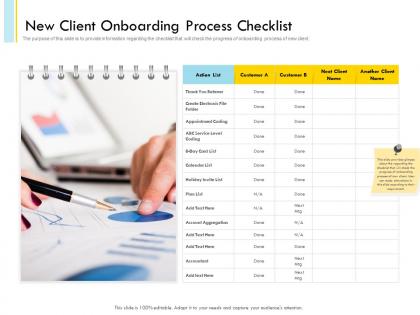
New client onboarding process checklist calendar list ppt slides




Try Before you Buy Download Free Sample Product
 Impress Your
 Audience
 100%
100% Editable
 Save Hours
 of Time


The purpose of this slide is to provide information regarding the checklist that will check the progress of onboarding process of new client.
People who downloaded this PowerPoint presentation also viewed the following :
New client onboarding process checklist calendar list ppt slides with all 2 slides:
Use our New Client Onboarding Process Checklist Calendar List Ppt Slides to effectively help you save your valuable time. They are readymade to fit into any presentation structure.
FAQs for New client onboarding process checklist calendar
Effective client onboarding includes initial discovery calls, setting clear expectations and timelines, gathering necessary documentation, establishing communication protocols, and conducting kickoff meetings. This strategic process streamlines project delivery by building trust early, minimizing scope creep, and ensuring alignment, with many service organizations finding that structured onboarding reduces project delays and enhances client satisfaction.
Understanding client goals enables tailored onboarding experiences by customizing workflows, prioritizing relevant features, and aligning service delivery with specific business objectives. This strategic approach streamlines implementation timelines, reduces confusion, and enhances client satisfaction, with many organizations finding that goal-aligned onboarding increases retention rates and accelerates time-to-value significantly.
Effective communication ensures client expectations align with service delivery, reduces misunderstandings, and builds trust through transparent timelines, clear role definitions, and regular progress updates. Through structured communication channels, organizations streamline feedback loops, accelerate decision-making, and enhance client satisfaction, with many financial services and consulting firms finding that proactive communication ultimately delivers stronger client relationships and reduces onboarding timelines.
Businesses can streamline client onboarding through digital document management, automated workflow systems, AI-powered verification tools, customer portals, and integrated communication platforms. These technologies enhance efficiency by reducing paperwork, accelerating approval processes, and improving transparency, with many financial services and consulting firms finding that automated onboarding delivers faster service delivery and significantly better client experiences.
Essential client onboarding documentation includes contact information, business registration details, financial statements, compliance certificates, project requirements, and legal agreements. These documents streamline account setup, ensure regulatory compliance, and establish clear project parameters, with many organizations finding that comprehensive documentation upfront reduces delays, minimizes miscommunication, and accelerates service delivery timelines.
Businesses can tailor onboarding by segmenting clients based on industry, company size, technical expertise, and specific needs, then creating customized workflows, communication styles, and resource allocation for each persona. Through personalized welcome sequences, role-specific training materials, and dedicated support channels, companies streamline client integration while enhancing satisfaction, ultimately delivering faster value realization and stronger long-term partnerships.
Compliance best practices include thorough identity verification, comprehensive risk assessments, regulatory documentation collection, automated screening against watchlists, and detailed audit trail maintenance. Financial institutions and healthcare organizations increasingly leverage automated compliance workflows to streamline KYC requirements, AML checks, and data protection protocols, ultimately reducing regulatory risks while accelerating client activation and enhancing operational efficiency.
Client feedback can be integrated through post-onboarding surveys, real-time check-ins during key milestones, exit interviews for unsuccessful conversions, and feedback loops with account managers. These mechanisms streamline process refinement by identifying bottlenecks, enhancing communication touchpoints, and personalizing experiences, with many organizations finding that systematic feedback collection ultimately delivers higher retention rates and faster time-to-value.
Cultural differences significantly impact client onboarding by influencing communication preferences, decision-making processes, documentation requirements, and relationship-building expectations across different regions. Global organizations adapt their approaches through localized communication styles, culturally appropriate timeline expectations, and region-specific compliance protocols, with many multinational companies finding that tailored onboarding strategies enhance client satisfaction and accelerate market penetration.
Key onboarding metrics include time-to-first-value, completion rates, client satisfaction scores, retention rates, and support ticket volume during the initial period. These measurements enable organizations to identify bottlenecks, streamline workflows, and enhance client experiences, with many financial services and SaaS companies finding that tracking these metrics ultimately delivers faster adoption and stronger long-term relationships.
A well-designed onboarding presentation enhances client understanding by clearly outlining services, expectations, timelines, and key contact points while using visual elements to simplify complex processes. Through strategic presentation design, organizations streamline communication, reduce client confusion, and accelerate relationship building, with many financial services and consulting firms finding that structured onboarding presentations significantly improve client satisfaction and long-term engagement rates.
Common pitfalls include unclear communication, overwhelming clients with information, lengthy approval processes, inadequate technology integration, and lack of progress tracking. These issues create frustrating experiences that damage client relationships, with many financial services and consulting firms finding that streamlining documentation, setting realistic timelines, and maintaining regular touchpoints significantly improves retention and satisfaction.
Onboarding establishes clear communication channels, defines project scope and timelines, introduces key team members, and outlines service delivery processes from the start. Through structured welcome sessions and transparent documentation, service providers demonstrate professionalism and reliability, while clients gain confidence in their partnership choice, ultimately reducing misunderstandings and fostering long-term collaborative relationships.
Recommended onboarding tools include customer relationship management (CRM) systems, automated workflow platforms, document management software, communication portals, and progress tracking dashboards. These technologies streamline client integration by centralizing information, automating routine tasks, and providing transparent milestone visibility, with many organizations finding that strategic tool combinations reduce onboarding time while enhancing client satisfaction and retention rates.
Maintaining ongoing support involves regular check-ins, personalized training sessions, dedicated account management, proactive issue resolution, and continuous feedback collection. Through strategic touchpoints and relationship management, organizations enhance client retention, identify expansion opportunities, and build long-term partnerships, with many companies finding that sustained engagement significantly increases customer lifetime value and referrals.
-
Enough space for editing and adding your own content.
-
Wonderful templates design to use in business meetings.
-
Awesome use of colors and designs in product templates.
-
Informative design.