


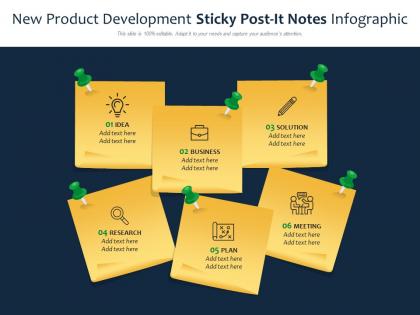
New product development sticky post it notes infographic




Try Before you Buy Download Free Sample Product
 Impress Your
 Audience
 100%
100% Editable
 Save Hours
 of Time


Our New Product Development Sticky Post It Notes Infographic are topically designed to provide an attractive backdrop to any subject. Use them to look like a presentation pro.
People who downloaded this PowerPoint presentation also viewed the following :
New product development sticky post it notes infographic with all 2 slides:
Use our New Product Development Sticky Post It Notes Infographic to effectively help you save your valuable time. They are readymade to fit into any presentation structure.
FAQs for New product development sticky post
The key stages of new product development include idea generation, concept development, market research, product design, prototyping, testing, and commercialization. These stages streamline innovation by validating market demand, minimizing development risks, and ensuring product-market fit, with many organizations finding that structured processes accelerate time-to-market while reducing costly late-stage modifications.
Market research informs product conceptualization by identifying customer pain points, unmet needs, preference patterns, competitive gaps, and emerging market trends. Through surveys, focus groups, and behavioral analytics, companies like consumer electronics manufacturers and automotive brands streamline design decisions, minimize development risks, and enhance product-market fit, ultimately delivering solutions that resonate with target audiences.
Cross-functional teamwork enables successful new product development by integrating diverse expertise, accelerating decision-making, reducing silos, and ensuring market alignment from conception to launch. This collaborative approach streamlines development cycles, minimizes costly revisions, and enhances product-market fit, with many organizations finding that cross-functional teams deliver faster time-to-market and stronger competitive positioning.
Companies effectively gather customer feedback through surveys, focus groups, beta testing programs, user interviews, and social media monitoring during development phases. These methods enable organizations to identify user preferences, validate product features, and refine designs before launch, with many businesses finding that early customer input significantly reduces development costs while enhancing market acceptance and competitive positioning.
Common pitfalls include insufficient market research, poor project management, inadequate resource allocation, lack of customer feedback integration, and unrealistic timeline expectations. These challenges significantly impact product success by creating misaligned features, budget overruns, and delayed launches, with many organizations finding that early stakeholder engagement and iterative testing ultimately deliver better market outcomes.
Agile methodologies enhance new product development by enabling iterative testing, faster feedback loops, and continuous improvement throughout the development cycle. Through sprint-based development and cross-functional collaboration, companies streamline time-to-market, reduce development costs, and better align products with customer needs, ultimately delivering more competitive offerings and enhanced market responsiveness.
New product launch success metrics include revenue growth, market share capture, customer acquisition rates, retention percentages, and user engagement levels. These indicators help organizations assess commercial viability, competitive positioning, and long-term sustainability, with many companies finding that combining financial performance with customer satisfaction data ultimately delivers the most comprehensive view of launch effectiveness.
Competitive analysis influences product development by identifying market gaps, revealing consumer preferences, and highlighting successful features or pricing strategies. Through systematic competitor research, companies can differentiate their offerings, avoid saturated market segments, and capitalize on unmet customer needs, ultimately delivering products with stronger market positioning and competitive advantage.
Technology adoption accelerates new product innovations by enabling rapid prototyping, advanced data analytics, and streamlined collaboration across development teams. Through AI-driven market research and automated testing processes, companies in sectors like automotive and pharmaceuticals can reduce development cycles significantly, ultimately delivering more targeted products and gaining competitive advantage in increasingly dynamic markets.
Companies ensure regulatory compliance through comprehensive research of applicable standards, early integration of compliance requirements into design processes, and continuous testing throughout development cycles. By establishing cross-functional teams including legal and regulatory experts, conducting regular audits, and maintaining detailed documentation, organizations streamline approval processes while minimizing costly redesigns, ultimately delivering market-ready products faster.
Strategies to reduce time-to-market include agile development methodologies, cross-functional team integration, rapid prototyping, concurrent engineering processes, and strategic supplier partnerships. These approaches streamline product cycles by eliminating bottlenecks, accelerating testing phases, and enhancing collaboration across departments, with many organizations finding that parallel development workflows ultimately deliver faster launches and competitive advantage.
Branding is crucial in new product development as it shapes consumer perception, differentiates offerings from competitors, and establishes emotional connections that drive purchase decisions. Through strategic branding, companies in sectors like consumer electronics, pharmaceuticals, and retail create compelling narratives that communicate value propositions, ultimately enabling faster market adoption and premium pricing capabilities.
Current trends shaping new product development include AI-driven market analysis, sustainable design principles, agile development methodologies, customer co-creation platforms, and rapid prototyping technologies. These approaches streamline innovation cycles by reducing time-to-market, enhancing customer alignment, and minimizing resource waste, with many organizations finding that integrating sustainability and AI delivers significant competitive advantages.
Storytelling leverages emotional connection and contextual understanding by creating customer journey narratives, demonstrating problem-solution scenarios, and illustrating real-world impact through relatable characters and situations. Through compelling narratives, product teams enhance stakeholder buy-in, simplify complex features, and communicate value propositions more effectively, ultimately delivering stronger market positioning and clearer competitive differentiation.
Prototyping enables organizations to test, validate, and refine product concepts through iterative design cycles, identifying functionality gaps, usability issues, and manufacturing constraints early in development. Through rapid prototyping technologies, companies in automotive, electronics, and medical device sectors streamline design validation, reduce costly late-stage modifications, and accelerate time-to-market while enhancing user experience.
-
Excellent work done on template design and graphics.
-
Great quality product.
-
Easily Editable.