

Nike Campaign Advertising Strategy Timeline




Try Before you Buy Download Free Sample Product
 Impress Your
Audience
 100%
Editable
 Save Hours
of Time


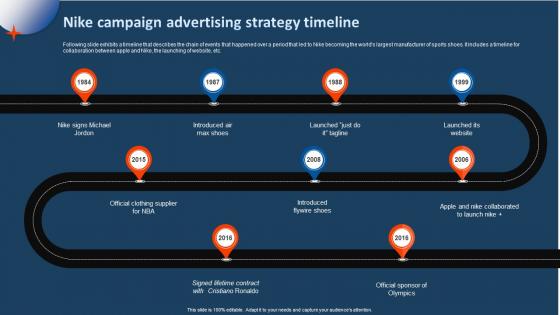
Following slide exhibits a timeline that describes the chain of events that happened over a period that led to Nike becoming the worlds largest manufacturer of sports shoes. It includes a timeline for collaboration between apple and Nike, the launching of website, etc.
People who downloaded this PowerPoint presentation also viewed the following :
Nike Campaign Advertising Strategy Timeline with all 6 slides:
Use our Nike Campaign Advertising Strategy Timeline to effectively help you save your valuable time. They are readymade to fit into any presentation structure.






FAQs for Nike Campaign
Nike's advertising milestones include the 1988 "Just Do It" campaign launch, celebrity athlete partnerships with Michael Jordan and Air Jordan, the controversial Colin Kaepernick campaign, and digital transformation initiatives. These strategic campaigns revolutionized sports marketing by combining emotional storytelling, athlete endorsements, and social activism, ultimately delivering brand loyalty and market dominance while establishing Nike as a cultural icon.
Social media platforms have revolutionized Nike's advertising by enabling direct athlete partnerships, real-time storytelling, and user-generated content campaigns that bypass traditional media channels. Through Instagram, Twitter, and TikTok, Nike creates viral moments with strategic hashtags, influencer collaborations, and interactive experiences, ultimately delivering more personalized customer engagement and significantly broader global reach than conventional advertising methods.
Nike has built its advertising strategy around high-profile athlete endorsements, featuring sports icons like Michael Jordan, Serena Williams, LeBron James, and Cristiano Ronaldo in campaigns that connect athletic excellence with brand identity. These partnerships deliver authentic storytelling, emotional resonance, and global market reach, with many finding that athlete-driven campaigns significantly enhance brand credibility and consumer engagement across diverse demographics.
Nike's "Just Do It" campaign evolved from simple motivational messaging in 1988 to encompass social justice, athlete empowerment, and inclusivity themes across diverse demographics. The campaign expanded beyond traditional sports advertising to address cultural movements, controversial endorsements, and global causes, while maintaining its core inspirational message, ultimately delivering sustained brand loyalty and market leadership in an increasingly competitive athletic apparel landscape.
Emotional branding forms Nike's core marketing foundation by connecting products to personal aspirations, athletic achievement, and self-empowerment through storytelling that transcends traditional product features. This approach enables Nike to command premium pricing, build lasting customer loyalty, and maintain competitive differentiation, with campaigns like "Just Do It" ultimately delivering deeper consumer relationships than purely performance-focused messaging.
Nike has addressed social issues through campaigns featuring Colin Kaepernick, supporting racial equality, promoting gender inclusion in sports, and championing athlete mental health advocacy. These strategic initiatives demonstrate how brands can leverage their platform for social impact while strengthening customer loyalty, with Nike finding that purpose-driven messaging ultimately delivers enhanced brand authenticity and competitive differentiation in increasingly socially-conscious markets.
The "Dream Crazy" campaign initially sparked controversy and boycotts, causing a temporary 3% stock dip, but ultimately strengthened Nike's brand loyalty among key demographics, particularly younger consumers and athletes. Within weeks, Nike's stock reached record highs, online sales surged 31%, and the campaign reinforced Nike's positioning as a bold, socially conscious brand, with many companies finding that authentic advocacy delivers long-term competitive advantage.
Nike has adapted its advertising strategies for global markets by localizing campaigns for cultural relevance, partnering with regional athletes and sports figures, and tailoring messaging to specific market preferences while maintaining consistent brand identity. Through strategic combinations of global brand consistency and local market customization, Nike enhances cultural connection, builds regional brand loyalty, and ultimately delivers stronger market penetration across diverse international markets.
Nike measures advertising campaign success through brand awareness scores, engagement rates across digital platforms, sales conversion metrics, and social media sentiment analysis. Through comprehensive tracking of website traffic, retail footfall, and purchase intent surveys, Nike evaluates campaign ROI while monitoring athlete endorsement impact, ultimately delivering data-driven insights that enhance future marketing strategies and strengthen competitive positioning.
Nike's advertising themes adapt strategically across different sports and product lines, with basketball emphasizing individual excellence and cultural influence, running focusing on personal achievement and endurance, while soccer highlights global unity and passion. This targeted approach enables Nike to authentically connect with diverse athletic communities, delivering sport-specific messaging that resonates with each audience's values, ultimately strengthening brand loyalty and market position across multiple sporting categories.
Nike has employed augmented reality for virtual try-ons, artificial intelligence for personalized marketing, interactive digital billboards, motion-capture technology for athlete analysis, and blockchain for product authentication campaigns. These technologies enhance customer engagement by creating immersive experiences, delivering targeted content, and building brand authenticity, with many retail companies finding that such strategic innovation ultimately drives stronger consumer connections and competitive differentiation.
Nike's advertising strategy has evolved by embracing digital-first campaigns, personalized messaging, and social activism to match shifting consumer values and media consumption habits. The brand has transitioned from traditional celebrity endorsements to influencer partnerships, direct-to-consumer engagement, and purpose-driven campaigns like "Just Do It" activism, ultimately delivering stronger emotional connections and competitive advantage in an increasingly values-conscious marketplace.
Nike leverages storytelling by creating emotional narratives around athlete journeys, personal triumph, and overcoming adversity, positioning products within inspiring human experiences rather than focusing solely on features. These campaigns, from "Just Do It" to athlete-specific stories, build deep brand connection and loyalty, with many consumers finding that Nike's narrative-driven approach transforms products into symbols of aspiration and achievement.
Nike's visual aesthetics create powerful emotional connections through bold imagery, dynamic movement, and iconic branding that transcends traditional product advertising. These carefully crafted visuals enhance brand recognition, inspire athletic aspiration, and communicate performance excellence across global markets, with campaigns like "Just Do It" demonstrating how strategic visual storytelling ultimately drives consumer loyalty and competitive differentiation.
Nike's digital marketing strategy seamlessly integrates with traditional advertising through synchronized campaigns, unified brand messaging across all channels, and strategic timing that amplifies reach. The company leverages social media to extend TV commercial narratives, uses digital platforms to drive engagement with print campaigns, and creates cohesive experiences where traditional ads direct audiences to interactive digital content, ultimately delivering maximum brand impact.
-
I am a big fan of their newsletters because that is how I found my perfect requirement at the time of urgency. Thank God, I kept opening those.
-
“Excellent service from the customer support team when I wanted a slide that was a bit different from those on their standard menu. Super helpful.”