


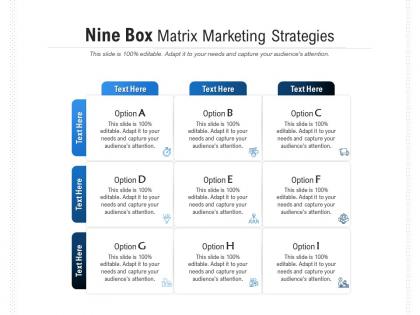
Nine box matrix marketing strategies infographic template




Try Before you Buy Download Free Sample Product
 Impress Your
 Audience
 100%
100% Editable
 Save Hours
 of Time


Our Nine Box Matrix Marketing Strategies Infographic Template are topically designed to provide an attractive backdrop to any subject. Use them to look like a presentation pro.
People who downloaded this PowerPoint presentation also viewed the following :
Nine box matrix marketing strategies infographic template with all 2 slides:
Use our Nine Box Matrix Marketing Strategies Infographic Template to effectively help you save your valuable time. They are readymade to fit into any presentation structure.

FAQs for Nine box matrix marketing
The Nine Box Matrix is a strategic assessment tool that evaluates business units or products based on market attractiveness and competitive position, creating nine distinct categories for resource allocation decisions. In marketing strategies, companies utilize this matrix to prioritize investments, identify growth opportunities, and develop targeted campaigns, with many organizations finding that it streamlines portfolio management while enhancing strategic focus across diverse market segments.
Businesses effectively categorize products using the Nine Box Matrix by plotting them across market attractiveness and competitive position dimensions, evaluating factors like growth rate, profitability, market share, and competitive strength. This strategic framework enables companies to identify investment priorities, resource allocation opportunities, and portfolio optimization strategies, with many organizations finding that systematic categorization streamlines decision-making and enhances overall competitive positioning.
Key criteria include market growth rate, competitive position, market share, profitability potential, and strategic fit with company objectives. These factors determine placement by evaluating business unit strength, market attractiveness, and resource allocation priorities, with many organizations finding that systematic assessment across these dimensions enables more strategic portfolio decisions and competitive advantage.
The Nine Box Matrix helps prioritize marketing efforts by categorizing opportunities based on market attractiveness and competitive strength, enabling strategic resource allocation toward high-potential segments. This framework allows marketing teams to identify priority markets, allocate budgets more effectively, and focus campaigns on segments with the greatest growth potential, ultimately delivering improved ROI and competitive advantage.
Market growth and competitive position form the two primary axes of the Nine Box Matrix, with market growth measuring industry expansion potential and competitive position assessing relative market strength through factors like market share, brand recognition, and operational efficiency. These dimensions enable organizations to strategically categorize business units or products, with high-growth, strong-position combinations receiving priority investment, while low-growth, weak-position areas face divestiture considerations, ultimately delivering optimized resource allocation.
Yes, the Nine Box Matrix effectively evaluates digital marketing strategies by plotting them across performance metrics like ROI, engagement rates, and conversion potential against strategic factors such as market reach, implementation complexity, and competitive differentiation. Through this framework, marketers can prioritize high-performing channels like targeted social media campaigns or SEO initiatives while identifying underperforming areas, ultimately optimizing resource allocation and maximizing digital marketing effectiveness.
**INPUT**: How do you assess the performance of products within the Nine Box Matrix framework? **OUTPUT**: Products are assessed using two key dimensions: market attractiveness and business unit strength, evaluated through metrics like market growth rate, competitive intensity, profitability, market share, and operational capabilities. This strategic combination enables organizations to systematically categorize their portfolio into nine distinct positions, with many companies finding that this framework streamlines resource allocation decisions and enhances competitive positioning across diverse product lines. [Word count: 58]
**INPUT**: What insights can businesses gain from the placement of their products in the matrix? **OUTPUT**: Product placement in the nine box matrix reveals market position, competitive standing, resource allocation priorities, and strategic growth opportunities across different market segments. These insights enable businesses to identify underperforming products requiring repositioning, high-potential areas for investment, and portfolio gaps, with many organizations finding that systematic matrix analysis streamlines decision-making and enhances overall market strategy effectiveness. [Word count: 58 words]
The Nine Box Matrix guides campaign development by categorizing market opportunities based on market attractiveness and competitive position, enabling marketers to allocate resources strategically across high-potential segments. Through this framework, organizations can prioritize premium campaigns for star segments, develop nurturing strategies for question marks, and optimize resource allocation, ultimately delivering targeted messaging that maximizes ROI and competitive advantage.
Potential pitfalls include oversimplifying complex market dynamics, relying on subjective assessments that may lack data precision, creating rigid categorizations that miss nuanced opportunities, and fostering short-term thinking over strategic innovation. While the matrix provides valuable strategic framework, marketing teams in sectors like technology and retail increasingly find that combining it with real-time analytics and customer feedback delivers more adaptive, competitive strategies.
Companies should reevaluate their Nine Box Matrix positions quarterly or semi-annually, with comprehensive annual reviews during strategic planning cycles. Market dynamics, competitive pressures, and internal capabilities shift rapidly, requiring regular assessment to maintain accurate positioning, optimize resource allocation, and identify emerging opportunities or declining segments before they significantly impact business performance.
The Nine Box Matrix aligns seamlessly with strategic marketing models by providing resource allocation insights that complement portfolio analysis, competitive positioning frameworks, and growth strategies. Through its systematic evaluation approach, organizations integrate BCG matrices, SWOT analyses, and market segmentation models, while enhancing strategic planning processes, ultimately delivering comprehensive marketing strategies that maximize competitive advantage across diverse business units.
**INPUT**: What types of businesses or industries can benefit the most from implementing the Nine Box Matrix? **OUTPUT**: Industries with diverse product portfolios, such as consumer goods, technology, pharmaceuticals, and automotive, benefit significantly from the Nine Box Matrix. These sectors leverage this strategic tool to optimize resource allocation across multiple product lines, identify growth opportunities, and streamline portfolio management, ultimately delivering enhanced market positioning and competitive advantage.
Data analytics enhances Nine Box Matrix effectiveness by providing precise customer segmentation data, predictive behavioral modeling, real-time performance tracking, and automated portfolio optimization algorithms. Through advanced analytics platforms, marketing teams can identify high-value customer migration patterns, optimize resource allocation across matrix segments, and deliver personalized campaigns, ultimately improving customer lifetime value and strategic positioning accuracy.
After placing products in the Nine Box Matrix, organizations should develop targeted strategies for each quadrant, allocate resources based on product positioning, and create action plans for portfolio optimization. These steps enable companies to streamline investment decisions, enhance underperforming products, and maximize returns from high-potential offerings, with many businesses finding that systematic portfolio management ultimately delivers improved market positioning and competitive advantage.
-
Top Quality presentations that are easily editable.
-
Excellent products for quick understanding.
-
Unique research projects to present in meeting.
-
Thanks for all your great templates they have saved me lots of time and accelerate my presentations. Great product, keep them up!