


Nursing orientation ppt powerpoint presentation infographics example




Try Before you Buy Download Free Sample Product
 Impress Your
 Audience
 100%
100% Editable
 Save Hours
 of Time


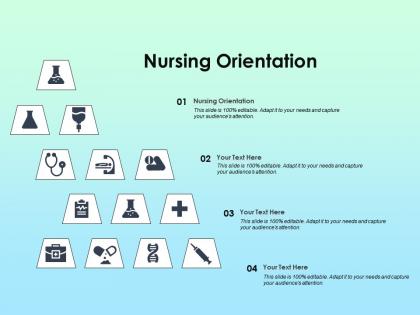
The following is a completely editable Medical Powerpoint Template Slide that discusses the topic Nursing Orientation. It is designed for medical professionals to discuss Nursing Orientation and can be completely customized to suit their needs. Add more items to this list and include this in your deck to impress your audience.
People who downloaded this PowerPoint presentation also viewed the following :
Nursing orientation ppt powerpoint presentation infographics example with all 2 slides:
Use our Nursing Orientation Ppt Powerpoint Presentation Infographics Example to effectively help you save your valuable time. They are readymade to fit into any presentation structure.
FAQs for Nursing orientation ppt powerpoint
So basically they're trying to get you comfortable with everything - the unit vibe, policies, all that stuff. You'll pick up department-specific skills and figure out their computer systems (which are always weirdly complicated for some reason). They'll show you who to bug when you're confused, and honestly you'll be confused a lot at first. Safety protocols and emergency procedures are huge too. Most programs run 6-12 weeks depending on your background. Seriously though, ask everything during orientation because that's literally what it's for - way better than being lost later when you're flying solo.
Honestly, ditch those boring manual orientations and go digital. Simulation software lets newbies practice without killing anyone (kidding... mostly). Mobile apps work great for quick references they can pull up anytime. Interactive modules are clutch since people learn at different speeds. VR sounds amazing but it's stupid expensive right now. Digital checklists changed everything at my last job - no more paperwork nightmares and you can actually track who's struggling with what. My advice? Start small with basic apps first. Don't blow your budget on fancy stuff until you know what actually works for your unit.
Start with the obvious stuff - hospital policies, emergency procedures, and how to document everything properly. Computer training is honestly the worst part but you can't skip it. Make sure they know the unit's patient population and what equipment they'll actually touch every day. Pair them with good mentors from day one. Communication protocols and infection control are huge too. Oh, and definitely do competency checks throughout instead of dumping everything at once. A progress checklist helps new nurses see they're actually getting somewhere instead of feeling totally lost.
Pair every new nurse with someone experienced right from orientation - it's a game changer when you're drowning those first few weeks. Have them shadow each other and do regular check-ins, then gradually let the newbie fly solo over like 8-12 weeks. Train your mentors properly though, because not everyone's naturally good at teaching (learned that the hard way). Don't just squeeze mentoring into crazy busy shifts - actually block out time for it. Otherwise it becomes one more thing getting ignored when everything hits the fan.
Oh sim lab is honestly amazing for orientation! You get to mess up on the fancy mannequins instead of real people lol. They'll run you through codes, med passes, all that intense stuff without the terror of actually hurting someone. The mannequins are weirdly realistic too - they breathe, have pulses, the whole deal. I'm kinda jealous because we barely had any sim time when I started. You can totally bomb a scenario, talk through what went sideways, then jump right back in. Ask your preceptor what you'll be doing so you're not going in blind.
Definitely get feedback from your new hires - they're the ones who actually lived through your orientation! Survey them after week one, then again at the one-month and three-month marks. Trust me, they'll tell you if those ancient training videos are garbage or if certain preceptors just can't teach. Nothing drives me crazier than "we've always done it this way" thinking. Their input helps you spot timing issues and knowledge gaps you didn't know existed. Set up quarterly reviews with your education team and actually use what you learn to make changes.
Honestly, orientation is rough for everyone - you're basically drowning in info while trying not to look clueless. The whole theory vs reality thing hits hard too. Time management with multiple patients? Nightmare at first. Plus those computer systems are like... why is everything so complicated? Building confidence with procedures takes forever, and don't even get me started on figuring out office politics. Ask questions though - seriously, ask the same thing five times if you need to. Oh, and find someone who actually wants to help you succeed, not just someone assigned to train you. Makes all the difference.
Hospital orientation is usually 8-12 weeks with a preceptor, but outpatient clinics? More like 2-4 weeks since it's way less chaotic. Long-term care places are obsessed with documentation - seriously, the paperwork never ends. ICUs will put you through months of critical thinking drills and emergency stuff. OR and dialysis take forever because of all the technical skills you need to learn. I'd definitely ask about their timeline and what competencies they expect during your interview. That way you won't be blindsided by how long it actually takes.
Honestly, you'll want to mix hard numbers with the softer stuff. Retention rates and time-to-competency are obvious ones to track. New hire satisfaction scores too. But don't sleep on the informal feedback - it's often more telling than surveys. Exit interviews with early leavers are gold. Also check in with your preceptors about how they think it's going. Following up at 90 days and 6 months will show you if people actually retained what they learned (or if they're just winging it). Oh, and track confidence levels - that's huge for new nurses. Start small though, maybe just two metrics you can actually keep up with consistently.
Mix diverse patient scenarios into your simulations - that's where people really get it. Get some community health workers to come talk about their experiences. The unconscious bias discussions are awkward but honestly? They're the most important part. Cover different communication styles, religious stuff that matters for care, plus the health disparities your patients actually deal with. Don't do the typical one-hour training everyone forgets about afterward. Build this into your regular clinical skills and case studies instead. Makes it way more natural than some separate "diversity module" or whatever.
Oh man, interprofessional stuff during orientation is SO important - wish someone had told me this sooner! You're basically learning how to talk to everyone on the team, not just other nurses. Doctors, pharmacists, PT... the whole crew. Those communication habits you pick up? They stick with you forever. Plus you'll actually understand who does what, so you won't be that person calling the wrong department at 3am (been there). Definitely try to shadow different people during orientation if you can. I know it feels like information overload, but trust me on this one.
Oh, definitely mix online stuff with your regular orientation! New nurses can access training materials whenever they want - super helpful during those crazy first weeks. Interactive modules and video demos work great for reinforcing floor learning. Some of the simulation software is actually pretty cool now (way better than the clunky stuff from a few years ago). You'll still want that face-to-face mentoring though - can't replace human connection. Try setting up a digital library with unit protocols they can quickly reference during shifts. It's like having a safety net in their pocket.
Honestly, weekly check-ins with preceptors are huge - somewhere new nurses can vent without feeling judged. Don't bury EAP info in some manual nobody reads, tell them about it day one. Peer groups work really well too since everyone's drowning together lol. Your preceptors need training to spot burnout early. Oh and definitely tell new hires that orientation sucks for literally everyone - I cried in my car multiple times those first few weeks! Celebrate the small stuff. Set realistic expectations about how long it takes to feel competent.
So definitely focus on communication stuff - not just medical terms but how we actually talk to patients here. That makes a huge difference in their confidence, trust me. Cultural expectations go both ways too, so cover local healthcare customs and what patients expect. Documentation systems are totally different between countries, so build in extra time for that and legal requirements. Oh and if you can pair them with a buddy nurse from a similar background, that's gold. Create safe spaces for questions about things that might seem obvious to us but aren't to them.
Okay so first thing - pair new nurses with actual dedicated preceptors for like 8-12 weeks, not just random people. Competency checklists are your friend here, trust me. Regular check-ins help track where they're at. Focus on unit-specific stuff, not just boring hospital-wide policies everyone forgets anyway. The psychological safety thing is huge - new nurses need to ask questions without feeling stupid. Oh, and gradually increase their responsibilities instead of throwing them in the deep end. I'd start by figuring out where your current new hires usually hit roadblocks first.
No Reviews