


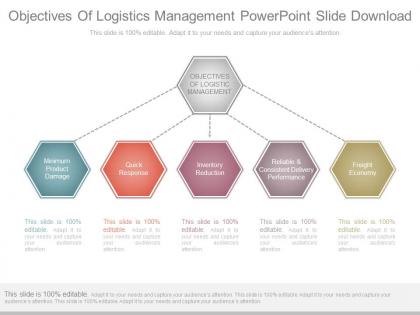
Objectives of logistics management powerpoint slide download




Try Before you Buy Download Free Sample Product
 Impress Your
 Audience
 100%
100% Editable
 Save Hours
 of Time


Keep them glued with our Objectives Of Logistics Management Powerpoint Slide Download. They may even forget to blink.
People who downloaded this PowerPoint presentation also viewed the following :
Objectives of logistics management powerpoint slide download with all 7 slides:
Our Objectives Of Logistics Management Powerpoint Slide Download ensure you don't jump the gun. The chain of events will flow correctly.






FAQs for Objectives of logistics management
Primary logistics management objectives include cost optimization, delivery speed enhancement, inventory accuracy, customer satisfaction improvement, and supply chain visibility. These objectives work synergistically through advanced technologies like real-time tracking and automated warehousing, with companies in retail, manufacturing, and e-commerce finding that strategic logistics management delivers competitive advantage and operational efficiency.
Effective logistics management enhances customer satisfaction by ensuring timely deliveries, accurate order fulfillment, transparent tracking systems, and seamless returns processing. Through optimized supply chain coordination, companies streamline operations while minimizing costs and delivery times, with many retail and e-commerce businesses finding that reliable logistics directly drives customer loyalty and competitive advantage.
Technology serves as the backbone for achieving logistics management objectives by enabling real-time tracking, automated inventory management, predictive analytics, and seamless integration across supply chain networks. Through AI-powered demand forecasting and IoT sensors, companies streamline operations, reduce costs, and enhance delivery accuracy, with many retailers and manufacturers finding that these digital solutions deliver faster fulfillment and improved customer experiences.
Logistics management enhances operational efficiency by streamlining supply chain processes, optimizing inventory levels, and reducing transportation costs through strategic route planning and warehouse automation. These improvements enable companies across manufacturing, retail, and e-commerce sectors to minimize delivery times, reduce operational expenses, and improve customer satisfaction, ultimately delivering competitive advantage in increasingly demanding markets.
Key logistics performance metrics include on-time delivery rates, order accuracy, inventory turnover, transportation costs per unit, and customer satisfaction scores. These metrics enable organizations to streamline operations, reduce expenses, and enhance service quality, with many retail and manufacturing companies finding that balanced scorecards incorporating these measurements ultimately deliver competitive advantage and improved profitability.
Inventory management directly supports logistics management objectives by optimizing stock levels, reducing carrying costs, and ensuring product availability across distribution networks. Through strategic inventory positioning and demand forecasting, organizations streamline warehouse operations, minimize transportation expenses, and enhance customer service levels, while maintaining optimal cash flow and operational efficiency throughout their supply chains.
Sustainability can be integrated into logistics management through optimizing transportation routes, adopting eco-friendly packaging materials, implementing energy-efficient warehousing systems, reducing carbon emissions, and establishing circular supply chain practices. These approaches enable organizations to minimize environmental impact while reducing operational costs, with many retail and manufacturing companies finding that sustainable logistics strategies ultimately deliver competitive advantage and enhanced brand reputation.
Organizations face challenges including siloed departmental thinking, conflicting priorities between cost reduction and service quality, inadequate data integration across supply chain systems, and difficulty measuring logistics performance against strategic metrics. These alignment gaps often result from poor communication between logistics teams and senior leadership, legacy technology limitations, and rapidly changing market demands, with many companies finding that cross-functional collaboration and integrated planning platforms help bridge these strategic disconnects.
Risk management in logistics contributes to strategic objectives by identifying potential disruptions, implementing contingency plans, and ensuring supply chain continuity through diversified supplier networks and real-time monitoring systems. These proactive approaches enable organizations to minimize operational costs, maintain customer satisfaction, and preserve competitive advantage, with many companies finding that robust risk frameworks ultimately deliver enhanced resilience and sustained market positioning.
Global supply chain dynamics significantly reshape logistics management objectives by requiring enhanced flexibility, real-time visibility, and risk mitigation strategies across multiple markets and regulatory environments. These complexities drive organizations to prioritize supply chain resilience, cost optimization through strategic sourcing, and agile distribution networks, with many multinational companies finding that adaptive logistics frameworks ultimately deliver competitive advantage in volatile markets.
Collaboration among stakeholders improves logistics performance by enhancing communication, sharing real-time data, coordinating resources, and aligning strategic objectives across the supply chain. Through integrated platforms and partnerships, manufacturers, suppliers, distributors, and retailers streamline operations, reduce delays, and minimize costs, ultimately delivering faster services and enhanced customer experiences while maintaining competitive advantage.
Traditional logistics management objectives focused on cost minimization, basic inventory control, transportation efficiency, and reactive problem-solving within individual departments. Modern logistics management emphasizes customer satisfaction, supply chain integration, sustainability, real-time visibility, and proactive optimization, with companies like Amazon and Walmart leveraging these approaches to deliver faster services, reduce environmental impact, and maintain competitive advantage in increasingly complex global markets.
Data analytics transforms logistics decision-making by providing real-time visibility into supply chain performance, identifying bottlenecks through predictive modeling, and optimizing route planning through historical trend analysis. Through advanced analytics platforms, logistics managers can reduce transportation costs by up to 15%, minimize delivery delays, and enhance customer satisfaction, ultimately delivering competitive advantage in an increasingly data-driven marketplace.
Strategies to optimize last-mile logistics include route optimization software, micro-fulfillment centers, crowd-sourced delivery networks, automated delivery vehicles, and dynamic delivery scheduling systems. These approaches streamline operations by reducing delivery times, minimizing fuel costs, and enhancing customer satisfaction, with many retailers and e-commerce companies finding that strategic combinations ultimately deliver competitive advantage in increasingly demanding markets.
Employee training is crucial for achieving logistics management objectives, as it enhances operational efficiency, reduces errors, and improves customer service delivery across supply chain operations. Well-trained teams in warehouses, transportation companies, and distribution centers streamline inventory management, optimize route planning, and ensure compliance with safety regulations, ultimately delivering cost reductions and competitive advantage in an increasingly complex logistics landscape.
-
Great designs, really helpful.
-
Easy to edit slides with easy to understand instructions.