


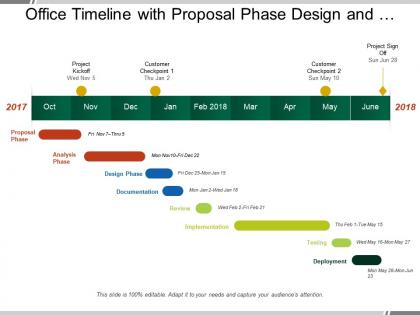
Office timeline with proposal phase design and review implementation




Try Before you Buy Download Free Sample Product
 Impress Your
 Audience
 100%
100% Editable
 Save Hours
 of Time


Proposal to the client as well as investors is the initial step for setting up of new business. An organization must insert the office timeline with proposal PowerPoint template in a business proposal presentation. Add on the data or ideas which you have prepared and shared the proposal with your client. It really helps in convincing the investors to finance your business along with that encourage people to join your organization. Office timeline with proposal review implementation slide helps a user to describe how to implement different proposal plans. You can customize the business plan PPT slide as per your requirement. Moreover the business timeline proposal presentation template designed for multipurpose use such as business, technology, medical and many others. Office timeline with proposal phase design presentation slide is the best and advanced technique to share innovative ideas, in order to encourage the investors, employee, and others to join the organization. You can discuss the company or business’s vision with others with the use of a business proposal timeline PPT slide. A user can insert office timeline proposal PowerPoint slide in his presentation as the well-defined icons and appropriate content can easily attract others attention. Gains are assured with our Office Timeline With Proposal Phase Design And Review Implementation. You can bet blindly on it.
People who downloaded this PowerPoint presentation also viewed the following :
Office timeline with proposal phase design and review implementation with all 5 slides:
Discover an expanse of avenues before you with our Office Timeline With Proposal Phase Design And Review Implementation. Break out into freedom.
FAQs for Office timeline with proposal phase design
Office timeline proposals should include project milestones, deliverable deadlines, resource allocation schedules, budget phases, and stakeholder review points. These elements streamline project management by establishing clear expectations, enabling proactive resource planning, and facilitating transparent communication, with many organizations finding that comprehensive timelines reduce project delays and enhance client confidence.
Visual design enhances timeline proposals by improving comprehension through clear milestones, color-coded phases, and intuitive progress indicators that make complex project sequences immediately understandable. Well-designed timelines enable stakeholders to quickly identify dependencies, resource requirements, and critical deadlines, while professional visual presentation builds credibility and confidence in project planning capabilities.
Tools for creating engaging office timeline proposals include project management software like Microsoft Project and Asana, presentation platforms such as PowerPoint and Prezi, and specialized timeline creators like Lucidchart and Visio. These platforms streamline proposal development by enabling interactive elements, visual milestones, and collaborative editing, with many organizations finding that combining multiple tools delivers more compelling presentations and faster client approval rates.
Color psychology significantly influences timeline effectiveness by enhancing comprehension, guiding attention, and reinforcing brand messaging through strategic hue selection, contrast management, and emotional associations. These design principles streamline information processing, improve stakeholder engagement, and strengthen proposal credibility, with many organizations finding that thoughtful color schemes accelerate decision-making and enhance professional perception.
Common timeline proposal design mistakes include unrealistic deadlines, insufficient buffer time, unclear milestone definitions, poor visual hierarchy, and lack of stakeholder input integration. These oversights often result in project delays, budget overruns, and stakeholder confusion, with many organizations finding that investing in thorough timeline validation and clear communication frameworks ultimately delivers stronger client relationships and more successful project outcomes.
Data visualization improves timeline proposal clarity by transforming complex schedules into intuitive visual formats, incorporating color coding, milestone markers, and progress indicators that make project phases immediately comprehensible. Through interactive charts and visual hierarchies, stakeholders can quickly identify dependencies, bottlenecks, and critical deadlines, while enhanced graphics streamline decision-making processes and ultimately deliver faster approvals.
Best practices for presenting timelines to stakeholders include clear milestone marking, realistic deadline setting, visual clarity through charts and graphics, regular progress updates, and contingency planning for potential delays. These approaches streamline project communication by establishing transparent expectations, facilitating informed decision-making, and maintaining stakeholder confidence, with many organizations finding that well-structured timeline presentations ultimately deliver enhanced project approval rates and stronger executive buy-in.
Audience analysis influences timeline proposal design by determining visual complexity, technical detail levels, and presentation formats that resonate with specific stakeholders. Executive audiences require high-level milestones with strategic outcomes, while technical teams need granular task breakdowns, with many organizations finding that tailored timeline presentations significantly improve proposal approval rates and stakeholder engagement.
Typography significantly enhances timeline proposal readability through strategic font choices, consistent hierarchy, appropriate sizing, and optimal spacing that guides readers through complex project phases. Clear, professional fonts like Arial or Calibri, combined with bold headers for milestones and consistent formatting, enable stakeholders to quickly navigate project timelines, ultimately improving comprehension and facilitating faster approval processes.
Animations and transitions enhance timeline storytelling by guiding viewer attention through chronological sequences, emphasizing key milestones, and creating visual connections between related events or phases. These dynamic elements help organizations present complex project histories more engagingly, with many consulting firms and project managers finding that subtle motion graphics improve stakeholder comprehension and retention during proposal presentations.
Gantt charts, milestone timelines, phase-based roadmaps, interactive digital timelines, and visual project maps are most effective for proposal presentations. These formats streamline complex project sequences by highlighting key deliverables, dependencies, and critical milestones, with many organizations finding that well-designed timeline visuals enhance stakeholder understanding and ultimately deliver stronger proposal approval rates.
Collaborative feedback enhances timeline proposal design by incorporating diverse perspectives, identifying potential bottlenecks, and ensuring realistic scheduling across departments. Through structured review processes, teams can refine project milestones, optimize resource allocation, and address implementation challenges early, with many organizations finding that collaborative input ultimately delivers more accurate timelines and stronger stakeholder buy-in.
**INPUT**: What strategies can be employed for creating a visually balanced timeline? **OUTPUT**: Visual balance strategies include consistent spacing between milestones, alternating content placement, strategic color distribution, proportional element sizing, and hierarchical typography that guides the eye naturally. These design approaches streamline information flow by reducing cognitive load, enhancing readability, and maintaining professional aesthetics, with many organizations finding that balanced timelines significantly improve stakeholder comprehension and proposal approval rates. [Word count: 58 words]
Cultural differences significantly influence timeline perception through varying approaches to time orientation, visual hierarchy preferences, reading patterns, and color symbolism across different societies. While Western cultures often favor linear, left-to-right chronological flows, many Asian and Middle Eastern audiences prefer circular or right-to-left presentations, with organizations increasingly finding that culturally adaptive timeline designs enhance stakeholder engagement and project approval rates.
Success metrics for timeline proposal design include clarity scores, stakeholder comprehension rates, approval timeframes, revision requests, and visual engagement levels. These measurements help organizations assess whether their proposals effectively communicate project scope, deliverables, and milestones, with many finding that well-designed timelines reduce approval cycles by 30-40% while enhancing stakeholder confidence and project buy-in.
-
Awesome presentation, really professional and easy to edit.
-
Innovative and attractive designs.